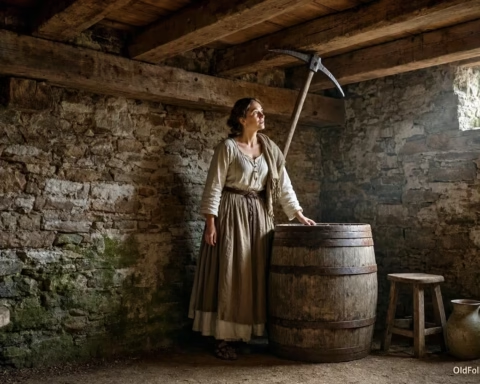
In Casoria, there lived a poor woman named Ceccarella and her son, Peruonto. He was so awkward, foolish, and peculiar in appearance that his mother had almost lost patience with him. No matter how often she scolded him or begged him to help with their daily needs, he seemed unable to do anything properly.
One day, with little food left in the house, Ceccarella sent him into the woods to gather firewood. She reminded him that they needed sticks to prepare a simple meal and urged him to return quickly.
Peruonto set off at his usual slow pace, wandering along the road as though he had nowhere particular to go. When he reached a plain crossed by a river, he came upon three young men sleeping on the grass beneath the blazing sun. They had no shade to protect them from the heat, and the stones beneath their heads made uncomfortable pillows.
Explore more stories from our Basile’s Pentamerone collection.
Peruonto felt sorry for them. Rather than passing by, he gathered branches from an oak tree and carefully arranged them into a leafy shelter over the sleeping youths.
The three young men awoke to find that a stranger had protected them from the scorching sunlight. They were the sons of a fairy, and they were grateful for the kindness he had shown them. To reward him, they granted him a magical power: from that moment onward, whatever he asked for would be done.
Peruonto, however, did not fully understand the extraordinary gift he had received. He simply continued towards the woods, unaware that his life was about to change.
The Magical Bundle of Firewood
When Peruonto reached the woods, he gathered an enormous bundle of branches. It was far too heavy for him to carry home on his back, and he struggled to think of a way to transport it.
At last, he climbed onto the bundle and made a wish.
“How fortunate I would be if this firewood could carry me home like a horse!”
His wish had barely left his mouth when the bundle sprang to life. It began to trot and gallop beneath him as though it were a spirited horse, carrying him along the road.
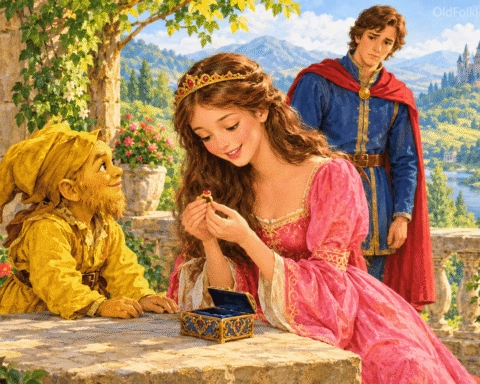
As Peruonto approached the king’s palace, his wooden steed pranced and danced in such a ridiculous fashion that the ladies watching from a window burst into laughter. They called for the king’s daughter, Princess Vastolla, who was known for her melancholy and rarely laughed at anything.
When Vastolla looked out and saw Peruonto riding his dancing bundle of firewood, she laughed as she had not laughed in a very long time.
Peruonto noticed her amusement. Instead of understanding that she was laughing at the extraordinary sight, he called up to her in anger and wished that she might become pregnant.
Then he rode away, continuing home on his magical mount.
The princess’s laughter soon gave way to alarm. Before long, she discovered that she was indeed pregnant, although she could not explain how it had happened.
The King’s Anger and the Search for a Father
When the king learned of his daughter’s condition, he was overcome with shame and fury. He considered her pregnancy a disgrace to his family and wanted her put to death.
His councillors persuaded him to wait. If the princess were killed before the child was born, they argued, the man responsible might escape punishment. The king reluctantly agreed.
In time, Vastolla gave birth to two beautiful boys. Yet the king remained determined to discover their father. His councillors advised him to wait until the children were old enough for their natural attachment to reveal the truth.
Seven years passed.
The king then arranged a great banquet and invited the noblemen and distinguished men of his city. He ordered the children to walk past the assembled guests, hoping they would recognise their father among them.
But the boys showed no particular affection for any of the men.
The king was furious. His councillors proposed another gathering, this time inviting people from the humbler ranks of society. Perhaps, they suggested, the man they sought would be found among those whom the king would never have suspected.
When Ceccarella heard about the second banquet, she urged Peruonto to attend. He eventually went, and as soon as the two boys saw him, they rushed towards him, embraced him, and showered him with affection.
The king watched in disbelief. The father of his beloved grandsons was none other than Peruonto, the awkward and foolish-looking young man whom he considered utterly unworthy of his daughter.
The Punishment at Sea
The king could scarcely bear the discovery. He could not understand why Vastolla would have chosen such a man, and his anger returned with renewed force.
His councillors proposed a cruel solution. Vastolla, Peruonto, and the two children would be locked inside a large cask and thrown into the sea. In this way, they reasoned, the king could rid himself of the family without personally carrying out their execution.
The judgement was put into effect. Before the cask was sealed, however, some of Vastolla’s ladies slipped a small basket of raisins and dried figs inside, hoping to give the prisoners something to eat.
The cask was carried to the shore and cast into the open sea. It floated wherever the wind and waves took it, leaving the four prisoners uncertain of their fate.
Inside, Vastolla wept bitterly. She could not understand how she had fallen into such misery or why Peruonto seemed to possess powers that had brought about her pregnancy and their imprisonment.
She demanded an explanation.
Peruonto, who had listened quietly to her distress, agreed to tell her what had happened, but only if she gave him some figs and raisins. Once she had fed him, he recounted his encounter with the three youths, the magical gift they had given him, his ride on the bundle of firewood, and the wish he had made when he saw her laughing at the palace window.
Vastolla finally understood the mystery. Their terrible circumstances had begun with a magical power Peruonto had never known how to control.
Rather than surrender to despair, she decided to use that power to save them.
A Ship, a Palace, and a New Life
Vastolla asked Peruonto to change their miserable cask into a ship that could carry them safely to shore.
As usual, he demanded his payment in figs and raisins. She gave him what he wanted, and he spoke his wish. At once, the cask became a splendid sailing vessel, complete with sails, ropes, sailors, and everything needed to navigate the sea.
The four were no longer trapped in a wooden prison. They were aboard a fine ship, surrounded by the promise of escape.
But Vastolla wanted more than a ship. She asked Peruonto to turn it into a beautiful palace where they could live in safety. Again, she fed him figs and raisins, and again his words brought about the impossible. The vessel reached land and became a magnificent palace, furnished with rich curtains, elegant rooms, and every comfort they could desire.
Vastolla had escaped the king’s sentence, but she still had one wish in her heart. She wanted Peruonto to become handsome and graceful, so that they could live together without the embarrassment his appearance had once caused her.
She asked him to grant this final favour.
Peruonto repeated his familiar demand for figs and raisins. Once she had fed him, he spoke the wish, and the transformation began. The awkward, unattractive young man became handsome, charming, and refined in his manners.
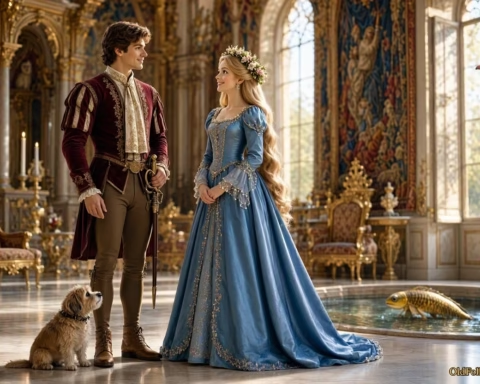
Vastolla embraced him joyfully. The man she had once found impossible to understand had become the husband with whom she could look forward to a happy future.
The King Discovers the Palace
Far away, the king continued to mourn his daughter’s disgrace and the loss of his grandchildren. One day, while out hunting with his courtiers, night overtook him. He noticed a light shining from a magnificent palace and decided to seek shelter there.
The inhabitants welcomed him, and he entered the building. Inside, he found no adults, only two beautiful boys who ran towards him, calling him their grandfather.
The king was astonished. He sat down to rest, and before long, a splendid feast appeared before him. Delicious food filled the table, and beautiful music played as the children attended to him. When the meal was over, a magnificent bed appeared, and the king and his courtiers settled down for the night.
The palace offered comforts beyond anything the king had expected. Yet the greatest surprise awaited him in the morning.
As he prepared to leave, he wanted to take the two boys back to his palace. At that moment, Vastolla appeared with her husband.
She knelt before her father and begged his forgiveness. Then she explained everything: the strange encounter at the palace window, the wish that had caused her pregnancy, Peruonto’s magical gift, and the events that had led to their banishment.
The king listened and gradually understood what had happened. His lost daughter stood before him, her two sons were alive and well, and the man he had condemned as unworthy had become a handsome and capable husband.
His anger gave way to joy. He embraced Vastolla and Peruonto, welcomed his grandsons into his arms, and took them back to the city.
To celebrate their reunion, the king arranged a magnificent feast that lasted for many days. The family that had once been cast into the sea was restored, and the king openly acknowledged that events had unfolded in a way he could never have planned.
The story closes with a familiar truth: people may make their plans, but the final outcome does not always follow their intentions.
Explore our complete Historic Folklore & Fairy-Tale Collections archive.
Moral
Kindness can bring unexpected blessings, and people should not be judged solely by their appearance or social standing. The story also reminds readers to think carefully before speaking or acting, because careless wishes and decisions can have consequences far beyond their intentions.
Knowledge Check
1. Why did Peruonto receive magical powers?
He sheltered the three sons of a fairy from the blazing sun, and they rewarded his kindness.
2. What caused Vastolla to become pregnant?
Peruonto unknowingly used his newly acquired magic when he wished that Vastolla would become pregnant after seeing her laugh at him from the palace window.
3. How did the king discover the identity of the children’s father?
After the noblemen failed to attract the boys’ affection, a second banquet brought Peruonto into their presence. The children immediately recognised him and rushed to embrace him.
4. How did Vastolla and her family escape the cask?
Vastolla persuaded Peruonto to use his magic to transform the cask into a ship and then into a magnificent palace.
5. What is the central lesson of the story?
A simple act of kindness may bring unexpected rewards, while pride, careless words, and judgments based on appearances can lead to suffering.
Source
Giambattista Basile, The Pentamerone, or The Story of Stories: Fun for the Little Ones, translated from the Neapolitan by John Edward Taylor, illustrated by George Cruikshank, second edition (London: David Bogue, 1850), “Peruonto,” listed on page 27.
Explore More of Basile’s Pentamerone