Long ago, in a village where the fields stretched beyond the houses and a great water tank served the people, there lived seven brothers and their only sister. All seven brothers were married, but their wives left the household cooking and much of the daily preparation of meals to the young woman.
She remained at home while the others went out to work, preparing food and looking after the household. Although she did her best, her sisters-in-law were never satisfied. They complained that she did not work in the fields and yet sometimes failed to have the meals ready when they wanted them.
Their complaints gradually turned into jealousy. Each wanted to take over the household responsibilities and enjoy the position their sister-in-law held. Eventually, they decided that the young woman must be removed.
Explore more stories from our Joseph Jacobs’ Indian Fairy Tales collection.
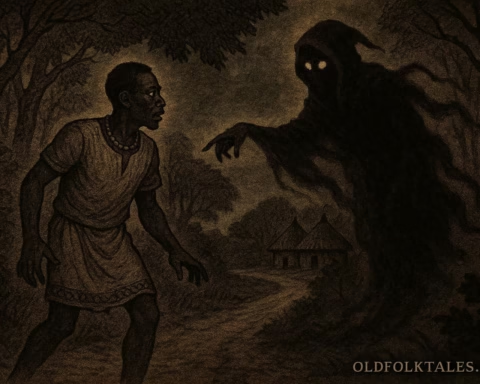
To accomplish this, they sought the help of a Bonga, a spirit associated with the supernatural world in the tradition represented in the tale. They made promises and offered their devotion in exchange for his assistance.
They asked him to wait until their sister-in-law went to fetch water at midday. At that moment, he was to make the water disappear and then return little by little, preventing her from filling her pitcher. If she remained trapped by the rising water, they told him, he could take her away.
Their plan was set in motion.
At noon, the young woman went to the water tank with her pitcher. But when she arrived, the water had vanished. Confused and frightened, she waited. After a while, it began to return, rising slowly from the bottom.
When it reached her ankles, she tried to lower her pitcher into it, but the vessel would not dip beneath the surface. She called out desperately to her brother:
“My brother, the water has reached my ankles, but still my pitcher will not fill!”
The water continued rising. When it reached her knees, she cried out again. Then it rose to her waist, and she repeated her desperate appeal. Still, the pitcher would not fill.
Soon the water reached her neck. She called for her brother once more, but no one came to rescue her.
At last, the water rose above her height. Only then did her pitcher begin to fill. But it was too late. The young woman sank beneath the water and drowned.
The Bonga took her away and transformed her into a spirit like himself.
Yet her story did not end in the water tank.
After some time, a bamboo shoot appeared along the embankment where she had drowned. It grew and grew until it became a magnificent, towering bamboo.
One day, a Jogi, a wandering religious mendicant, passed by. He admired the bamboo and immediately imagined what a fine musical instrument it would make. He decided to cut it down and fashion a fiddle from its stem.
But as he raised his axe, the bamboo spoke.
“Do not cut me at the root. Cut me higher up.”
The Jogi lifted his axe towards the upper part of the stem. Immediately, the bamboo changed its instruction.
“Do not cut me near the top. Cut me at the root.”
He lowered his axe, only to hear the same contradictory directions again. Each time he prepared to make a cut, the bamboo instructed him to do the opposite.
After several attempts, the Jogi became convinced that a Bonga was trying to frighten him. Annoyed by the interference, he struck the bamboo at its root, brought it down and carried it away.
He fashioned it into a fiddle.
The instrument turned out to be extraordinary. Its sound was sweeter than anything he had heard before, and everyone who listened to it was delighted. The Jogi began carrying it with him on his begging rounds. Wherever he played, people were so pleased with the music that they rewarded him generously. He soon found himself returning home each evening with a well-filled wallet.
Sometimes, during his travels, he visited the home of the seven brothers. Whenever he played there, the music affected the household deeply. The brothers were strangely moved, and some even wept. The fiddle seemed to produce the sorrowful cries of someone suffering terribly.
The eldest brother was particularly impressed. He offered to support the Jogi for an entire year if he would give him the instrument.
But the Jogi understood how valuable his fiddle was. It was his livelihood, and he refused to part with it.
Some time later, the Jogi visited the home of a village chief. After entertaining the household with several tunes, he asked for something to eat. The people were so delighted with his performance that they offered to buy the fiddle for a generous price.
Once again, he refused.
Realising that money would not persuade him, the household offered him food and plenty of liquor. The Jogi accepted their hospitality and drank far more than he should have. Before long, he became thoroughly intoxicated.
While he was unable to look after his belongings, the people secretly took his wonderful fiddle and replaced it with an old instrument of their own.
When the Jogi recovered, he immediately noticed that something was wrong. His fiddle was missing. He suspected that the household had stolen it and demanded that they return it.
But they denied everything.
Unable to prove what had happened, he had no choice but to leave with the inferior instrument they had given him in exchange.
The chief’s son was a musician and soon began playing the stolen fiddle. Its beautiful music delighted everyone who heard it.
But the young man was unaware that the instrument contained a secret.
Whenever the household members went out to work in the fields, the spirit of the young woman emerged from the bamboo fiddle. She would dress her hair, prepare the family’s rice meal and eat her own portion. Then she would carefully place a serving of food beneath the chief’s son’s bed, covering it to protect it from dust.
Afterwards, she would disappear back inside the fiddle.
This happened day after day.
The other members of the household noticed that the young man always seemed to have a meal prepared especially for him. They assumed that one of his female friends was secretly showing him affection, so they paid little attention to the mystery.
The chief’s son, however, became curious. He wanted to discover who was preparing the food and hiding it beneath his bed.
One day, he decided to catch the mysterious visitor. He hid himself among a pile of firewood in a corner of the house, waiting for the household to leave.
Before long, the girl emerged from the fiddle.
She began arranging her hair and making herself presentable. When she had finished, she prepared the rice as usual, ate some of it and placed the young man’s portion beneath his bed.
Just as she was about to return to the fiddle, the chief’s son rushed out of his hiding place and caught her.
Startled, the young woman protested. She feared that he might belong to a caste with whom she could not marry. She exclaimed that he might be a Dom or a Hadi, communities that the old account describes through its caste-based social distinctions.
But the young man reassured her that he was not. He declared that from that day onwards they would belong together.
The two began speaking affectionately, and their relationship developed. When the rest of the household returned that evening, they discovered that the mysterious visitor was now living among them in human form, although she still possessed her supernatural nature as a Bonga.
They were delighted by the discovery and welcomed her.
For a time, the young woman remained with the chief’s household.
Meanwhile, misfortune had fallen upon her own family. Her brothers had become very poor, and eventually they travelled to the chief’s house as visitors.
The young woman recognised them immediately.
Her brothers, however, did not recognise their sister. They had no idea that the woman welcoming them into the household was the very person who had disappeared years before.
She brought them water and served them cooked rice. After they had eaten, she sat beside them.
Then her voice changed.
In sorrowful, reproachful tones, she began telling them what had happened at the water tank. She described the cruelty of their wives, the supernatural trick that had caused her death, and everything she had endured since that terrible day.
She reminded them that they had been her brothers and that they should have protected her.
Most painfully, she accused them of knowing how their wives treated her without ever intervening to save her.
Her words left them confronted with the suffering they had failed to prevent.
But she did not punish them. She did not seek their deaths or demand that they suffer as she had suffered.
She simply told them the truth about what had happened.
And that was all the revenge she took.
Explore our complete Historic Folklore & Fairy-Tale Collections archive.
Moral
Jealousy and cruelty can destroy innocent lives, but silence in the face of injustice also carries responsibility. The seven brothers failed to protect their sister when she needed them most. Her final response teaches that confronting those who have wronged us and making them acknowledge their actions can be more meaningful than seeking revenge.
Knowledge Check
1. How many brothers did the young woman have?
Seven brothers.
2. Why did her sisters-in-law plot against her?
They resented her position as the household cook and wanted one of themselves to take over her responsibilities.
3. How did the young woman become a fiddle?
After drowning and being transformed into a Bonga, she later reappeared as a bamboo plant. A Jogi cut down the bamboo and fashioned it into a fiddle.
4. Why did the fiddle produce such sorrowful music?
It contained the spirit of the young woman, whose suffering seemed to find expression through its music.
5. How did the young woman encounter her brothers again?
They visited the chief’s household after becoming poor. She recognised them, served them food and eventually revealed her identity and the injustice they had allowed.
6. What was her final act of revenge?
She told her brothers everything that had happened and confronted them with their failure to protect her. She did nothing more to punish them.
Source
The retelling is based on “The Magic Fiddle,” Chapter VI, pages 40–45, in Indian Fairy Tales, selected and edited by Joseph Jacobs, illustrated by John Dickson Batten, published in London by David Nutt in 1892.
Explore More Joseph Jacobs’ Fairy Tales
- The Lambikin: A Classic Indian Folktale About Cunning, and Survival
- Soria Moria Castle: Halvor’s Quest to Win Back His Princess
- The Yellow Dwarf: The Princess, the Cursed Ring, and a Love That Ended in Tragedy
- The Three Sillies: An English Fairy Tale
- The Frog-King and Iron Henry: The Princess Who Broke Her Promise
- The Death of Koschei the Deathless: The Red Fairy Book