Rapunzel is one of the best-known fairy tales collected by Jacob and Wilhelm Grimm. It tells of a young girl taken from her parents by an enchantress and raised in a secluded tower deep within a forest. With no door or staircase, the tower keeps Rapunzel apart from the world. Her long golden hair becomes the means by which her guardian reaches her, but it also provides an unexpected visitor with a way to discover her hidden home.
The story follows Rapunzel’s childhood in captivity, her meeting with a prince, and the painful consequences of the enchantress’s discovery. Although separation and hardship mark much of her life, the tale ends with a reunion that brings hope after years of suffering.
The Story of Rapunzel
There once lived a man and his wife who wished more than anything to have a child. For a long time, their hopes remained unfulfilled. At last, the wife discovered that she was expecting a baby, and the couple looked forward to welcoming the child into their home.
Behind their house stood a beautiful garden filled with flowers and useful herbs. A high wall surrounded it, keeping everyone away. The garden belonged to an enchantress whose power was feared throughout the land. No one dared to enter without her permission.
From a small window at the back of their house, the wife could see the garden. One day, her attention settled on a bed of fresh, green rampion. The plant looked so inviting that she developed an overwhelming desire to eat some. As the days passed, her longing became stronger. She grew pale and weak, and her husband became increasingly worried about her condition.
When he asked what troubled her, she explained that she wanted some of the rampion growing in the enchantress’s garden. She believed that she would die if she could not taste it.
The man loved his wife and could not bear to watch her suffer. He decided to enter the garden, even though he knew the danger of trespassing. As evening approached, he climbed over the high wall, gathered a handful of rampion and hurried home.
His wife prepared the plant and ate it with great satisfaction. However, the taste pleased her so much that her desire returned even more strongly the following day. Her husband realised that he would have to enter the garden again if he wanted to ease her suffering.
Once more, he waited until the light began to fade before climbing over the wall. This time, however, he was not alone. As soon as he reached the garden, the enchantress appeared before him. Her angry expression made it clear that she knew exactly what he had come to do.
She demanded to know why he had dared to steal from her garden and warned that he would pay for his actions. Frightened, the man explained that his wife had become desperately ill with longing for the rampion. He begged the enchantress to show mercy, saying that he had acted out of love and concern rather than greed.
The enchantress listened to his explanation. Her anger softened, and she agreed to let him take as much rampion as he wanted. But she placed one condition upon her permission: when his wife gave birth, they must surrender the child to her.
The man was terrified by the demand. Yet he feared the enchantress’s power and, in his distress, agreed. He returned home with the rampion, carrying a promise that would change his family’s future.
When the child was born, the enchantress appeared as she had said she would. She took the baby girl away and gave her the name Rapunzel, after the plant that had led to the bargain.
Rapunzel grew into an exceptionally beautiful child. As the years passed, her beauty became even more striking. When she reached the age of twelve, the enchantress took her far into a forest and shut her inside a tall tower.
Explore more stories from our Brothers Grimm Tales collection.
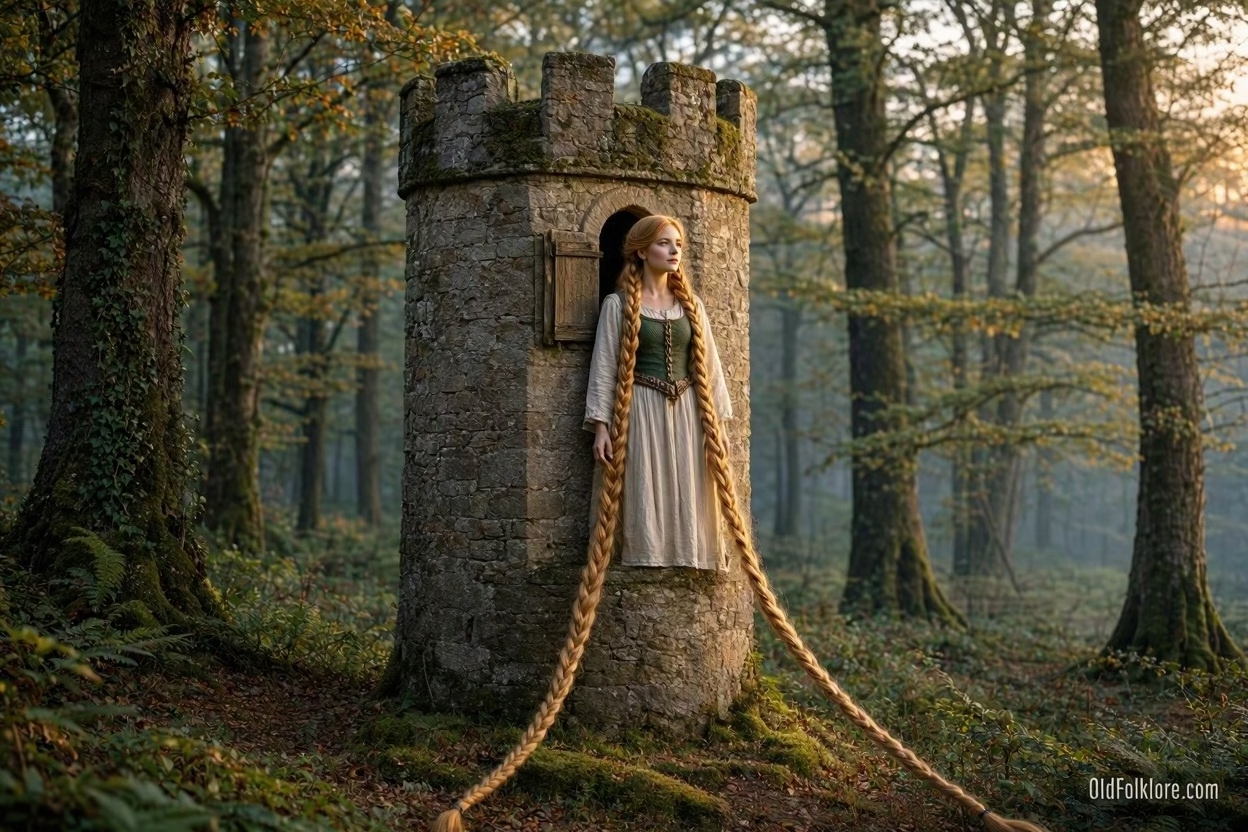
The tower had no staircase and no ordinary entrance. Its walls rose high above the ground, and the only opening was a small window near the top. Anyone standing outside could look up at it, but there was no way to climb inside.
Rapunzel’s guardian had a particular way of reaching her. Whenever the enchantress wished to enter, she stood beneath the window and called:
“Rapunzel, Rapunzel,
Let down thy hair to me.”
Rapunzel had long, beautiful hair with a golden colour and a fine texture. When she heard the familiar call, she loosened her braids and fastened them around a hook near the window. Her hair then fell down the side of the tower, reaching far enough for the enchantress to climb up.
In this way, Rapunzel remained hidden from the world. She had no ordinary company and could not leave the tower whenever she wished. Her days passed in solitude, and she found ways to occupy herself within the narrow space of her home. One of her greatest comforts was singing. Her voice carried through the forest, reaching places beyond the tower walls.
After a year or two, a king’s son happened to ride through the forest. As he approached the tower, he heard a beautiful voice. He stopped his horse and listened. The singing came from above, but he could not see the person responsible for it.
The prince was deeply moved by what he heard. He looked around the tower for a door or staircase, hoping to discover how he might reach the singer. However, he found no entrance. After searching without success, he returned home.
Even so, he could not forget the voice. From that day onwards, he often rode through the forest and stopped near the tower to listen. He wanted to meet the young woman whose singing had touched him so deeply.
One day, while waiting near the tower, he saw the enchantress arrive. He remained hidden behind a tree and watched carefully. The enchantress stood beneath the window and called out the familiar words:
“Rapunzel, Rapunzel,
Let down thy hair.”
At once, a long golden braid descended from the window. The enchantress grasped it and climbed up until she disappeared inside the tower.
The prince understood how the enchantress entered. He decided that he would try the same method. The following evening, when the forest began to grow dark, he approached the tower and called out the words he had heard.
Rapunzel let down her hair, believing that her guardian had returned. The prince climbed up and entered the tower.
When Rapunzel saw a man standing before her, she was frightened. She had never encountered anyone like him inside her secluded home. The prince spoke gently and explained that her singing had drawn him to the tower. He told her that he had listened to her voice repeatedly and could find no peace without seeing her.
His friendly manner gradually eased her fear. As they spoke, Rapunzel became comfortable in his presence. The prince was young and handsome, and she began to hope that he would treat her with more affection than the enchantress who controlled her life.
The prince asked Rapunzel to become his wife. She agreed and placed her hand in his. Although she wanted to leave the tower with him, she did not know how she could reach the ground safely.
She suggested a plan. Each time he visited, he should bring a skein of silk. She would use the silk to weave a ladder long enough to reach the ground. When the ladder was ready, she would climb down, and the prince would take her away on his horse.
They agreed that he would visit her in the evenings. The enchantress usually came during the day, so Rapunzel believed they could keep their meetings secret.
For a time, their arrangement remained undiscovered. The prince continued bringing silk, and Rapunzel worked towards making the ladder. She looked forward to his visits, which gave her companionship and hope beyond the lonely walls of the tower.
But one day, Rapunzel made a careless remark. While speaking with the enchantress, she wondered aloud why it was so much harder to pull her guardian up into the tower than it was to draw the young prince up. The prince, she explained, seemed to reach the window much more quickly.
The enchantress immediately understood that someone else had been visiting Rapunzel. Her anger was terrible. She accused the young girl of deceiving her and breaking the isolation she had carefully arranged.
In her fury, the enchantress seized Rapunzel’s beautiful hair. She wrapped the braids around one hand and took a pair of scissors in the other. With a few sharp cuts, she removed the long golden tresses that had served as the ladder into the tower.
Rapunzel could do nothing to prevent her. Her hair fell to the ground, and the means by which she had welcomed visitors was gone.
The enchantress then took Rapunzel away from the tower and carried her into a desert place. There, the young woman was left to live in sorrow and hardship, far from the prince and everything familiar to her.
The enchantress had not finished her revenge. That same evening, she returned to the tower and fastened Rapunzel’s severed braids to the hook beside the window. She knew that the prince would probably come, and she intended to make him believe that Rapunzel was still there.
When the prince arrived, he called the familiar words. The golden hair descended, and he climbed up as he had done on previous evenings. But instead of finding Rapunzel, he came face to face with the enchantress.
She looked at him with cruel satisfaction and told him that the young woman he sought was gone. Rapunzel would never again be found in the tower.
The prince was overwhelmed with grief. In his despair, he leapt from the tower. He survived the fall, but landed among thorn bushes. Their sharp branches pierced his eyes, leaving him blind.
Unable to see, he wandered through the forest in misery. He had lost Rapunzel, and the injury made it impossible for him to return easily to his former life. He survived on roots and berries, moving from place to place while mourning the woman he loved.
Years passed in this unhappy condition. Eventually, his wandering brought him to the desert region where Rapunzel had been sent. She was no longer alone: she had given birth to twins, a boy and a girl. Yet she continued to live in hardship, separated from the prince and the life they had once hoped to share.
One day, the prince heard a voice that seemed strangely familiar. He followed the sound, moving carefully towards it. As he came closer, Rapunzel recognised him.
She rushed towards him and threw her arms around his neck. Overcome with emotion, she wept. Two of her tears fell upon his eyes, and his sight returned. The prince could see again, just as he had before the terrible fall.
Their long separation had finally ended. Rapunzel and the prince were reunited, and he took her and their children to his kingdom. There, they were welcomed with joy. After so many years of captivity, loss and suffering, Rapunzel found a home where she could live freely with her family.
The prince and Rapunzel remained together, happy and contented for the rest of their lives.
Explore our complete Historic Folklore & Fairy-Tale Collections archive.
Moral Lesson
The story of Rapunzel reminds readers that love, hope and companionship can endure even through long periods of hardship. It also shows the harm caused by possessiveness and the desire to control another person’s life. Rapunzel’s freedom comes after years of separation, teaching that cruelty cannot always prevent people from finding their way back to one another.
Knowledge Check
1. Why did Rapunzel’s mother become ill?
She developed an overwhelming longing to eat the rampion growing in the enchantress’s garden.
2. What condition did the enchantress place on the man’s permission to take the rampion?
She demanded that he surrender the child his wife was expecting.
3. How did the enchantress enter Rapunzel’s tower?
She called for Rapunzel to let down her long hair, then climbed up it to the window.
4. How did the prince discover Rapunzel’s hiding place?
He heard her singing in the forest and later watched the enchantress climb into the tower using Rapunzel’s hair.
5. What happened when the enchantress discovered the prince’s visits?
She cut off Rapunzel’s long hair and sent her away to live in a desert place.
6. How did the prince regain his sight?
Rapunzel wept when they were reunited, and two of her tears fell upon his eyes, restoring his sight.
Source
Jacob and Wilhelm Grimm, “Rapunzel” (KHM 12), in Grimm’s Household Tales, translated from the German and edited by Margaret Hunt, Volume I (London: George Bell and Sons, 1884).
Explore More Brothers Grimm Tales
- The Louse and the Flea: A Grimm Fairy Tale
- The Three Languages: Grimm Fairy Tales
- Clever Elsie: A Brothers Grimm Fairy Tale
- The Wishing Table, the Gold Ass and the Cudgel
- Thumbling: A Grimm Fairy Tale
- The Wedding of Mrs Fox: Grimm Fairy Tale
- The Elves: A Grimm Fairy Tale
- The Robber Bridegroom’s Terrifying