Long ago, when King Brahmadatta ruled the kingdom of Benares, a wealthy Brahmin lived in the north-western country. Although he possessed great riches and enjoyed the comforts that came with his position, he gradually began to recognise the troubles that accompanied worldly pleasures. Wealth could bring comfort, but it could not guarantee peace. Possessions created attachments, and the pursuit of pleasure often brought more restlessness than satisfaction.
After reflecting on the disadvantages of worldly life and the benefits of spiritual discipline, he made a remarkable decision. He abandoned his wealth and comfortable home, left his former life behind, and travelled to the Himalayan mountains. There, he became a hermit and devoted himself to meditation. Through years of disciplined practice, he attained the Eight Attainments, advanced states of meditative concentration.
His wisdom and reputation attracted many followers. Before long, five hundred ascetics had gathered around him, eager to learn from his example.
When the rainy season arrived, the hermit left the mountains with his disciples and travelled through towns and villages until they reached Benares. King Brahmadatta welcomed the company and offered them accommodation in his royal park, where they could remain during the four months of the rainy season.
The king greatly respected the hermit and enjoyed his presence. When the four months had passed and the time came for the ascetics to return to the mountains, the king was reluctant to let their teacher leave.
Explore more stories from our Jataka Tales collection.
“You are growing old, venerable sir,” he said. “Why should you endure the difficult journey back to the Himalayas? Let your disciples return to the mountains, but remain here with me. You will be comfortable, and I shall continue to provide for you.”
The hermit considered the king’s request. Rather than dismissing it, he decided that his followers could return to the mountains under the guidance of his senior disciple.
This senior pupil was no ordinary ascetic. In a former life, he had been a powerful king who had abandoned an entire kingdom to pursue the religious life. Through meditation and spiritual discipline, he had also attained the Eight Attainments.
The teacher gathered the five hundred ascetics and placed them under his senior pupil’s care.
“Take them back to the Himalayas,” he instructed. “Live there together and continue your spiritual practice. I shall remain here for the time being.”
The senior disciple accepted the responsibility and led the company back to the mountains. There, they settled into their familiar life of meditation and simplicity.
Some time later, however, the senior pupil began to long for his teacher. He wished to see him again, pay his respects, and spend a little time in his company.
He called the other ascetics together.
“Remain here and continue your practice,” he told them. “I am going to visit our teacher. I shall return before long.”
After making the necessary arrangements, he travelled to Benares.
When he arrived at the royal park, he found his teacher and respectfully greeted him. He then spread a mat beside him and lay down, resting comfortably in his presence.
At that very moment, King Brahmadatta arrived at the park to visit the hermit.
The king approached, paid his respects, and sat down nearby. He noticed the senior disciple lying beside the teacher. Although the ascetic had seen him arrive, he made no attempt to rise or greet him. Instead, he remained where he was and began to repeat a joyful exclamation.
“Oh, happiness! Oh, happiness!”
The king was displeased.
He was accustomed to receiving respect wherever he went. Even holy men and religious teachers generally acknowledged his arrival. Yet this ascetic had seen him and remained lying on his mat, apparently too comfortable to show him any courtesy.
Turning to the hermit, the king expressed his irritation.
“Venerable sir, this ascetic must have enjoyed himself so thoroughly that he has forgotten his manners. Look at him. He lies there without concern, singing happily as though nothing else matters.”
The hermit understood the king’s misunderstanding and decided to explain.
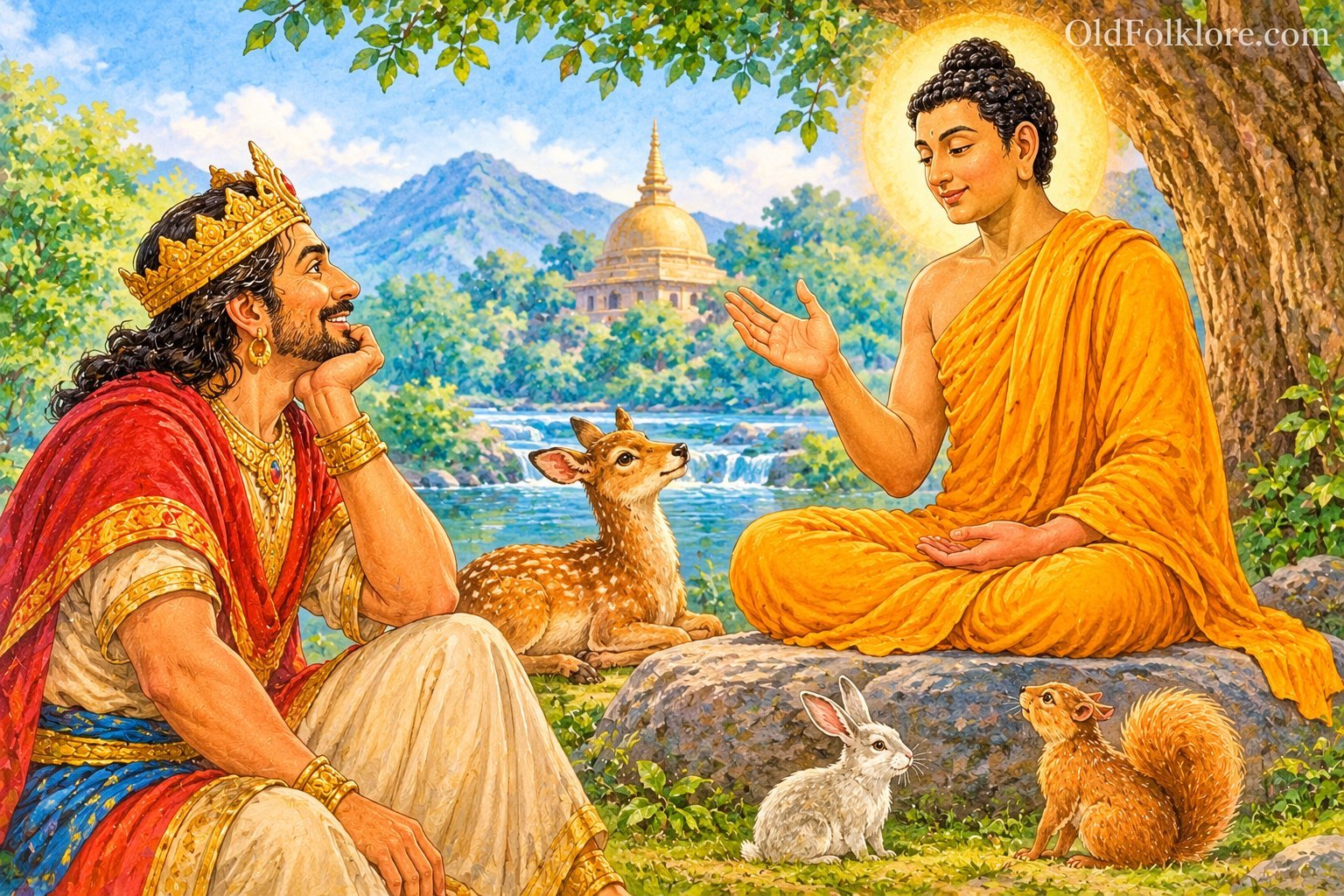
“Great king, this man was once a king, just as you are today. He possessed royal wealth and enjoyed the pleasures of his position. He was surrounded by guards and protected by men carrying weapons. Yet, even with all that security and splendour, he never experienced the happiness he now enjoys.”
The king listened more carefully.
The hermit continued.
“Consider what he has left behind. In his former life, he depended on armed men to protect him. His palace was filled with comforts, yet his mind was never entirely free from fear. Now he lives without a kingdom, without servants, and without the protection of soldiers. He wanders through forests and remote places, yet he is happier than he was when he possessed everything a king might desire.
“His joy comes from meditation and the peaceful life of renunciation. He has found a happiness that does not depend on possessions, power, or the presence of others.”
The king began to understand why the ascetic had greeted his arrival with such indifference. The man was not displaying disrespect or laziness. He was simply enjoying a peace that royal authority could not command.
To make the lesson clearer, the hermit recited a verse:
He who needs no others to defend him,
He who has not others to defend,
He it is who lives at ease, O king!
Untroubled he with yearnings or with lusts.
The words made a deep impression on Brahmadatta. He realised that although he commanded an entire kingdom and had soldiers to guard his person, he could not purchase the freedom from anxiety that the ascetic enjoyed.
His displeasure disappeared, and he was satisfied with the explanation.
After spending some time with the hermit, the king paid his respects and returned to his palace.
The senior disciple also took leave of his teacher and travelled back to the Himalayan mountains, where the five hundred ascetics were waiting for him.
The hermit remained in Benares, continuing his meditation and spiritual practice. In time, he died, and because of the purity of his attainments, he was reborn in the Brahma heaven.
Many years later, the Buddha told this story to his disciples while staying at the Anūpiya Mango-grove. He had been speaking about the Elder Bhaddiya, who had once been a king but had abandoned royal life to become a monk.
Bhaddiya had been among six young noblemen who renounced their former lives and entered the religious order together with Upāli. In time, Bhaddiya, Kimbila, Bhagu, and Upāli attained Arahatship. Ānanda reached the First Stage of the Path, Anuruddha developed extraordinary knowledge, and Devadatta attained the power of deep meditation.
One day, Bhaddiya remembered his former royal existence. As a king, he had lived in a palace surrounded by guards and every form of protection. Even when resting on his royal couch, he had been troubled by anxiety. Now, as an Arahat, he wandered freely through forests and deserted places without fear.
Overcome with happiness at the difference between his former life and his present freedom, he exclaimed:
“Oh, happiness! Oh, happiness!”
Some monks heard him and assumed that he was announcing his attainment of Arahatship. When they reported this to the Buddha, he explained that Bhaddiya’s joy was not something entirely new. He had experienced the same happiness in a former birth.
The Buddha then revealed the story of the hermit and his senior disciple. Finally, he identified the characters from that former existence: the senior disciple who had once been a king was Bhaddiya, while the master of the five hundred ascetics was the Buddha himself.
And so the lesson of the Happy Life was revealed once more: a peaceful mind can possess a happiness greater than all the protection, wealth, and authority of a kingdom.
Explore our complete Historic Folklore & Fairy-Tale Collections archive.
Moral
True happiness does not come from wealth, authority, or the protection of others. It comes from cultivating a peaceful mind and freeing oneself from the desires and attachments that create suffering. A person who has overcome inner fear may enjoy greater freedom than someone surrounded by every worldly comfort.
Knowledge Check
1. Why did the wealthy Brahmin abandon his former life?
He recognised the disadvantages of worldly pleasures and the spiritual benefits of renunciation.
2. How many ascetics followed the hermit?
Five hundred ascetics gathered around him.
3. Why did the senior disciple repeatedly exclaim, “Oh, happiness!”?
He remembered that even when he had been a wealthy and powerful king, he had never experienced the peace he now enjoyed as an ascetic.
4. Why was King Brahmadatta initially displeased with the disciple?
The disciple saw the king arrive but did not rise to greet him, remaining comfortably on his mat and expressing his happiness.
5. What did the hermit teach the king?
He explained that true happiness comes from freedom from worldly desires and dependence, rather than wealth, royal authority, or external protection.
6. Who were the principal characters in the former-life story?
The Bodhisatta was the master of the ascetic community, while Bhaddiya was his senior disciple.
7. What is the significance of this story in Buddhist literature?
It illustrates the Jātaka tradition of connecting the Buddha’s former lives with his teachings and the spiritual qualities of his disciples.
Source
Adapted from Buddhist Birth-Stories; or, Jātaka Tales, Volume I, translated from the Pāli by T. W. Rhys Davids, with the Pāli text edited by V. Fausböll, published in London by Trübner & Co. in 1880.
Explore More Jataka Tales