In the woodlands of Cangandala, an experienced hunter named Kalombo taught young men how to recognise animal tracks, understand the seasons and use the forest responsibly. His greatest lesson concerned the magnificent giant sable antelope, one of Angola’s most remarkable animals. Through his guidance, the apprentices learned that a hunter’s true worth lay not in the number of animals he killed, but in the wisdom of his decisions.
The Forest and Its Hunters
Cangandala, in Angola’s Malanje Province, is known for its importance to the survival of the giant sable antelope. This distinctive animal, recognised by the impressive horns of mature males, is endemic to Angola and has become one of the country’s most celebrated symbols of natural heritage.
The surrounding landscape supports a variety of wildlife and plant life. For communities living near woodlands and grasslands, the natural environment has also provided resources for daily life. Depending on the location and season, people have gathered useful plants, collected fruits, obtained honey and hunted animals for food.
Yet the forest could not provide indefinitely without care. Resources varied with the seasons, and the needs of people and wildlife sometimes competed. Knowledge of animal behaviour, local conditions and the availability of food was therefore valuable to those who depended on the land.
In one village near Cangandala lived a hunter named Kalombo. He was known for his sharp eyes, steady hands and ability to recognise the faint signs left by animals moving through the forest.
Despite his reputation, Kalombo rarely boasted about his hunting achievements. He believed that skill meant little without judgement. A hunter might follow tracks accurately and use his weapons effectively, but careless decisions could damage the environment on which his community depended.
Young men often approached him for instruction. They wanted to learn how to find animals, move quietly through the woodland and return home with food for their families.
Kalombo welcomed them, but he never began his lessons with weapons.
Instead, he taught them to observe.
Learning to Listen to the Forest
Kalombo took his apprentices into the woodland before sunrise. At that hour, the air was cool, and the sounds of birds and insects carried clearly through the trees.
He showed the young hunters how to examine the ground without trampling the tracks they hoped to understand. A broken stem, a patch of disturbed soil or a faint impression in the earth could reveal that an animal had passed through the area.
The apprentices initially wanted to move quickly. They believed that covering more ground would improve their chances of finding game.
Kalombo taught them otherwise.
He encouraged them to pause and examine their surroundings before choosing a direction. He showed them how to notice changes in vegetation, recognise signs of recent rain and identify places where animals might seek water.
He also reminded them that the forest was home to many creatures, not merely those people hunted for food.
A bird’s call could alert them to movement nearby. The condition of a stream could reveal whether water was becoming scarce. The growth of certain plants could provide clues about changing seasons.
The apprentices gradually realised that observing the forest required patience. Rushing from one place to another often meant overlooking the very signs they had come to find.
Kalombo also taught them to distinguish between knowledge and assumption. If they could not identify an animal’s tracks with confidence, they should not pretend otherwise. If conditions changed, they needed to reconsider their plans rather than follow an unsuitable course simply because they had already chosen it.
“Nature always speaks,” he would tell them. “The wise hunter learns to listen before acting.”
The young men remembered these words. They began to understand that successful hunting depended on careful observation and sound judgement as much as physical ability.
The Temptation of Abundance
One year, the surrounding communities experienced a period of favourable conditions. Food was plentiful, and the hunters returned from several journeys with enough game to supply their households.
The success excited the younger men. They began discussing larger hunting parties and longer expeditions. If they could bring home more meat while conditions remained favourable, they reasoned, their families would enjoy greater security.
Explore more stories from our Angolan Folktales Collections archive.
Some proposed hunting whenever they found animals, without giving much thought to how many they took.
Kalombo listened to their plans before responding.
He asked them to consider what might happen if every hunter followed the same approach. More animals might be killed in the short term, but what would remain if the practice continued season after season?
The young men considered his question.
Kalombo explained that immediate abundance did not guarantee lasting security. A community could enjoy a successful period and still face shortages later. If people took resources without considering future needs, they could weaken the very conditions that made their success possible.
He urged the apprentices to hunt according to their needs and avoid unnecessary waste. They should consider the resources available, the condition of the environment and the consequences of their choices.
His advice was not a rejection of hunting. Families needed food, and skilled hunters had an important role in providing it. Rather, Kalombo wanted the young men to understand the difference between taking what was needed and pursuing excess simply because it was available.
Some apprentices accepted his reasoning immediately. Others thought he was being unnecessarily cautious.
They would understand the value of his advice more fully when they encountered a herd of giant sable antelope.
An Encounter with the Giant Sable
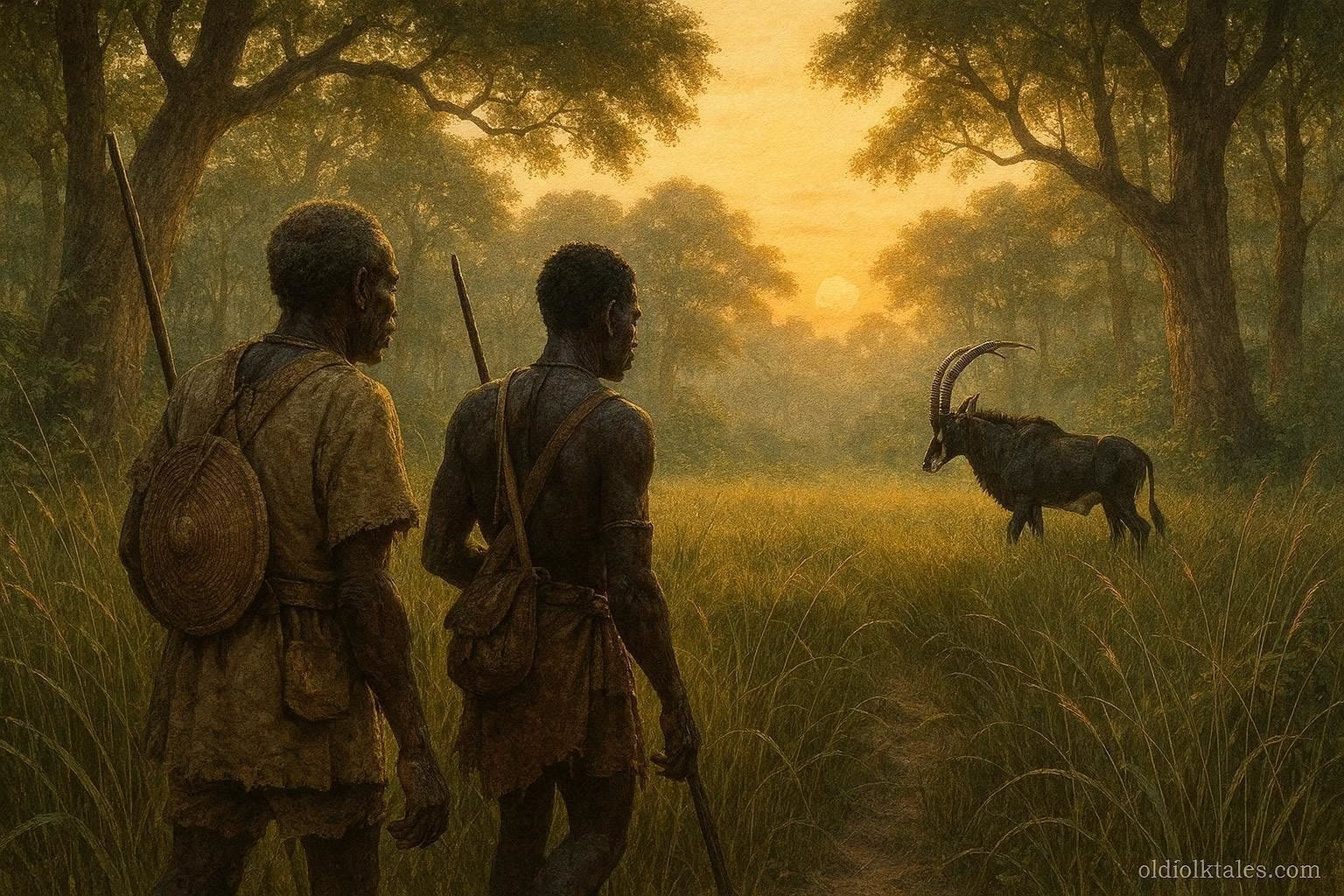
Several weeks later, Kalombo led a small group through an area of woodland where the vegetation opened into tall grass.
The hunters moved carefully, watching the ground and listening for movement. Suddenly, one of the younger men noticed shapes beyond the grass.
A small group of giant sable antelope had emerged into the open.
The animals moved with quiet confidence. Their dark coats contrasted with the surrounding vegetation, and the curved horns of the mature male made an impressive sight.
The apprentices were astonished. Although they had heard descriptions of giant sable, seeing the animals at close range was different from listening to stories about them.
One young hunter instinctively reached for his weapon. Another began preparing to move closer.
Kalombo raised his hand to stop them.
He asked the group to remain still and observe the herd from a distance. The animals appeared undisturbed, and there was no immediate need to approach them.
The apprentices waited as the giant sable moved through the grass. After a short time, the herd continued into the woodland and disappeared from view.
One of the young men was disappointed. He had hoped to demonstrate his skill by bringing home an animal from such a remarkable encounter.
Kalombo explained that not every sighting needed to end in a kill. The hunters had encountered the animals, observed their behaviour and left them undisturbed. That, too, was a valuable outcome.
He reminded the apprentices that they had entered the animals’ habitat. The forest was not theirs alone, and their presence did not give them an automatic claim to everything they found.
The group resumed its journey without pursuing the herd.
As they walked, Kalombo explained that animals needed suitable places to feed, move and reproduce. When people hunted without restraint or damaged the habitats on which wildlife depended, the consequences could extend far beyond a single expedition.
The young men began to see that protecting wildlife was connected to the future of the forest itself.
Knowledge Beyond the Hunt
Kalombo’s lessons gradually expanded beyond tracking and hunting.
He taught the apprentices to pay attention to streams and other sources of water. People and animals depended on them, particularly during periods when rainfall was limited. Polluting or damaging these places could affect the entire area.
He also encouraged the young men to recognise the importance of trees and other vegetation. Fruit-bearing plants provided food for people and wildlife, while trees offered shelter and contributed to the structure of the woodland.
The apprentices learned to think about the wider consequences of their actions. Cutting down trees without considering the effects could alter the landscape. Hunting without restraint could reduce the animals available in the future. Wasting food ignored the effort required to obtain it.
Kalombo did not claim that every part of nature could be understood through a single rule. Conditions changed, and different situations required different decisions. What mattered was learning to observe carefully, consider the evidence and avoid acting recklessly.
He also encouraged children to join elders on shorter walks through the woodland. They did not carry hunting weapons on these outings. Instead, they learned to recognise useful plants, observe animal tracks and understand the differences between habitats.
The children asked many questions. Kalombo and the other experienced villagers answered what they could and admitted when they did not know something.
These walks helped the younger generation develop familiarity with the land around them. They learned that knowledge grew through observation, experience and the willingness to listen to those with greater understanding.
For Kalombo, passing on this knowledge was part of his responsibility to the community. The forest would continue to change, but future generations would be better prepared if they learned to recognise its signs and respect its limits.
The Injured Antelope
One afternoon, a violent storm swept across the area. Strong winds broke branches from trees, and heavy rain left parts of the woodland covered with fallen vegetation.
The following day, a group of children walked along a familiar path with an older relative. Near a cluster of trees, they discovered a young antelope trapped beneath fallen branches.
The frightened animal struggled, but the branches prevented it from escaping. The children were unsure how to help and feared that approaching too quickly might injure it further.
They hurried to find Kalombo.
The old hunter accompanied them back to the place where they had discovered the animal. He examined the situation from a safe distance and considered how the branches could be moved without causing additional harm.
He instructed the children to remain calm and give the animal space. With assistance from the accompanying adult, he carefully shifted the lighter branches that were trapping it.
The young antelope struggled briefly as the obstruction was removed. Once it had enough room, it rose and moved away into the woodland.
The children watched until it disappeared.
They were pleased that the animal had escaped and expected Kalombo to praise them for their discovery. He thanked them for seeking help rather than acting carelessly.
He explained that compassion required judgement as well as good intentions. Rushing towards a frightened animal could have caused further injury, while a calm and careful response gave it a better chance of escaping.
The incident stayed in the children’s memories. They had learned that respecting wildlife did not mean approaching every animal or attempting to interfere with every situation. Sometimes the best response was to keep a safe distance and seek suitable assistance.
Kalombo was pleased that they had acted thoughtfully. He hoped they would carry that lesson into their future decisions, whether they were in the forest or among their neighbours.
A Forest Worth Protecting
As the years passed, the people of the surrounding communities continued to depend on their environment in different ways. Hunters provided food, families gathered useful plants, and children learned about the landscape from older relatives.
Kalombo’s apprentices became experienced hunters themselves. They remembered his advice when they planned expeditions and when younger people asked them to teach hunting skills.
Some recalled the day they had seen the giant sable herd. Others remembered the injured antelope and the importance of approaching wildlife carefully.
They shared these experiences with younger hunters, explaining why knowledge and restraint mattered as much as courage.
The forest also faced challenges that could not be solved by individual hunters alone. Changes in land use, habitat damage and illegal hunting could threaten wildlife even when some community members acted responsibly.
Kalombo encouraged the villagers to recognise that protecting a forest required cooperation. Families needed to consider how they used natural resources, while community leaders and conservation workers had important roles in protecting habitats and preventing illegal hunting.
The giant sable made these concerns especially important. Its survival depended on the protection of suitable habitat and effective conservation measures. Its presence in Cangandala became a reminder that a country’s natural heritage could be lost without sustained attention and care.
The villagers understood that no single person could guarantee the future of the forest. Each individual could, however, contribute through responsible choices and by teaching others to respect the environment.
Kalombo grew older and eventually stopped joining the longest hunting expeditions. Younger hunters continued to visit him, asking for advice about animal tracks, changing conditions and difficult decisions.
He reminded them that strength and speed were useful, but neither could replace good judgement.
The most capable hunter, he told them, was not necessarily the one who returned with the largest catch. It was the one who understood what the community needed, used resources responsibly and considered the consequences of every decision.
When Kalombo died, the villagers remembered his knowledge and the patience with which he had taught them. The hunters recalled his lessons about restraint, while the children remembered his care for the injured antelope.
His influence continued through the people who passed his teachings to others.
The Lesson of Cangandala
The real history of Cangandala gives the story’s concern for wildlife particular significance. The area became a protected reserve before being designated a national park in 1970. Conservation efforts have since played an important role in protecting the giant sable antelope, a species whose survival has faced serious challenges.
The history of the animal shows that admiration alone cannot protect wildlife. Conservation requires practical action, suitable habitat, monitoring and efforts to prevent illegal hunting.
Kalombo’s story offers a fictional way to reflect on these responsibilities. His experiences illustrate how patience, observation and restraint can guide people’s relationship with the natural world.
The forest provides resources, but it is also home to creatures whose survival depends on conditions that people can influence. Protecting it means considering both present needs and future consequences.
Every generation inherits an environment shaped by earlier decisions. The choices people make today influence what remains for those who follow.
The hunters of Cangandala therefore leave behind a lesson that extends beyond hunting. Respect for nature begins with understanding that people are part of a wider living world, and that lasting prosperity depends on caring for the resources and habitats on which life depends.
Explore our complete Africa Folktales
Moral Lesson
Responsible use of nature requires patience, restraint and respect for wildlife. Protecting the environment today helps preserve its resources and living creatures for future generations.
Knowledge Check
1. Why is Cangandala important to Angola’s wildlife?
It contains protected habitat important to the survival of the giant sable antelope, a species endemic to Angola.
2. What did Kalombo teach his apprentices before hunting techniques?
He taught them to observe carefully, recognise animal signs and exercise patience.
3. Why did Kalombo stop the young hunters from pursuing the giant sable herd?
He wanted them to observe the animals without disturbing them unnecessarily and understand that not every encounter needed to end in a kill.
4. What did the children learn from the trapped antelope?
They learned to remain calm, seek help and avoid actions that might cause further harm to a frightened animal.
5. Why did Kalombo encourage the community to protect the forest?
People and wildlife depended on its resources and habitats, which could be damaged by careless use.
6. What is the main lesson of the story?
People should use natural resources responsibly and protect wildlife so that future generations can continue to benefit from a healthy environment.
Source
A contemporary tale inspired by documented research on Angola’s giant sable antelope and the conservation history of Cangandala National Park, including The Giant Sable Antelope: Angola’s National Icon.
Explore More Angolan Folktales
- The Eagle and the Candimba: A Shocking Betrayal
- The Bangão Crocodile: A Fearless Fight for Justice
- Sudika-Mbambi: The Invincible Hero
- The River Spirit’s Three Questions
- The Cave of the Sleeping Ancestors
- The First Soba’s Staff
- Sona: The Sand Drawings of Wisdom
- The Caravan Leaders of Bié