When a new Mwata was chosen to lead the Lunda kingdom, the people gathered to witness the investiture. Elders prepared the royal insignia, messengers brought news from distant settlements, and families travelled to the royal centre for the ceremony. Yet the greatest test of the new ruler would come after the celebrations, when disputes, hardship and difficult decisions demanded more than the appearance of authority.
Preparing for the Investiture
Across the woodlands and plains of Central Africa, Lunda political traditions developed around royal authority, established customs and relationships between rulers and their communities. The kingdom’s history was preserved through accounts of its rulers, their succession and the events that shaped their authority. Royal insignia also held an important place in the expression of political power.
Within this setting, the people of one Lunda settlement prepared for the investiture of a new Mwata. The previous ruler had died, and the elders had completed the deliberations required to recognise his successor. Now the chosen man had to assume the responsibilities attached to the office.
News of the coming ceremony travelled between settlements. Messengers informed local leaders, while families made arrangements to attend. Elders prepared to receive visitors, and craftsmen worked on the objects required for the occasion.
The royal centre gradually filled with people. Some had travelled from nearby villages, while others had crossed considerable distances to witness the change of leadership. Traders brought goods to exchange, relatives greeted one another, and visitors discussed the responsibilities awaiting the new ruler.
The occasion was important to the whole community. Decisions made at the royal court could affect land use, trade, relations between settlements and the resolution of disputes. A new ruler therefore inherited more than a title. He entered a network of obligations that connected him to the people under his authority.
The Meaning of the Royal Insignia
In the days before the ceremony, craftsmen prepared the objects associated with the royal court. Those responsible for the regalia inspected each item with care, ensuring that everything required for the investiture was ready.
Ceremonial objects were not simply ornaments to be displayed before an audience. In Lunda and neighbouring Central African royal traditions, insignia could express political authority, dynastic continuity and the standing of a ruler. Their meanings depended on the particular object, office and tradition in which they were used.
As the preparations continued, the elders met with the man who would soon become Mwata. They explained the expectations attached to his position and reminded him that the welfare of the kingdom would often depend on his judgement.
A ruler might possess wealth, command the respect of his followers and receive visitors from distant places. None of these things, however, guaranteed that he would govern wisely.
Explore more stories from our Angolan Folktales Collections archive.
The elders spoke about the consequences of careless decisions. A judgement made without hearing both sides of a dispute could create lasting resentment. A ruler who favoured his relatives over other families might weaken the trust that held the community together. Even a decision intended to settle one problem could create another if he failed to consider its wider effects.
The future Mwata listened without interruption. He had spent years observing the work of those who governed before him, but now he understood that observing leadership was different from carrying its responsibilities himself.
He asked the elders to continue advising him after the ceremony. Their experience, he recognised, would remain valuable when he faced problems that no single person could resolve alone.
The elders welcomed his willingness to listen. They knew that a new ruler would make mistakes if he believed that receiving authority meant he no longer needed counsel.
The Day of the Ceremony
Before sunrise on the appointed day, the royal centre began to stir. Families prepared for the gathering, visitors found places among the assembled people, and those responsible for the ceremony made their final arrangements.
The future Mwata prepared to meet the elders and community representatives. He wore the clothing appropriate to the occasion and approached the gathering with dignity. His manner was composed, but he understood the significance of the moment.
The ceremony began with the elders taking their places. Those who had come from distant settlements stood among the local families, while respected members of the community gathered close enough to witness the proceedings.
An elder addressed the assembly. He spoke of the kingdom’s history, the responsibilities of its rulers and the importance of preserving the institutions that connected one generation with the next.
He reminded the people that the authority of the Mwata affected the entire kingdom. The ruler’s decisions could encourage cooperation, settle disagreements or deepen divisions. His conduct would influence how people understood the office he held.
The elder then turned towards the chosen successor and spoke of the duties before him. The new ruler would need to consider the needs of different communities, respect established procedures and seek counsel when a matter exceeded his knowledge.
The future Mwata listened carefully. He understood that the gathering was not merely an occasion to recognise his position. It was also a public reminder of the obligations that accompanied it.
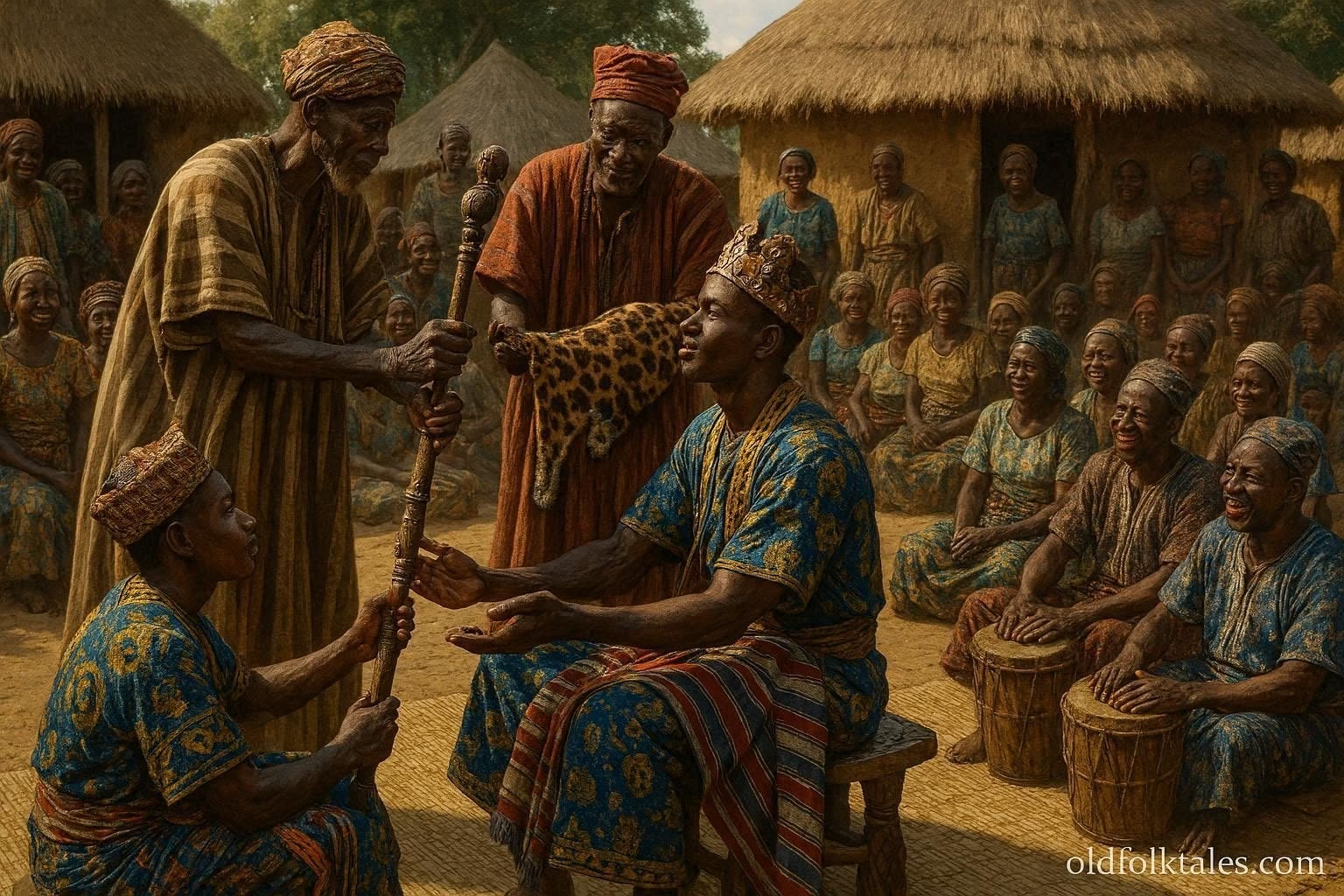
The elders proceeded with the investiture according to the ceremony prepared for the occasion. Royal insignia were presented, and the assembly witnessed the formal recognition of the new ruler.
When the proceedings were complete, the gathering welcomed the Mwata. Music and celebration followed, and families shared food with visitors. People exchanged greetings, while elders recounted memories of earlier rulers and the challenges their communities had faced.
For the younger members of the gathering, the ceremony offered an opportunity to observe an important public institution. They saw how a change of leadership brought together families, representatives and people from different settlements.
The celebrations continued into the day. Yet beneath the music and greetings lay a question that only time could answer. Would the new Mwata put the principles discussed during the ceremony into practice when difficult choices confronted him?
A Dispute over Farmland
The answer began to emerge several weeks later.
Two neighbouring villages became involved in a dispute over farmland near a seasonal river. For years, families from both communities had cultivated parts of the area. The river provided water during the growing season, and the surrounding soil supported crops on which many households depended.
Changes in the river’s course had made the boundary less clear. Each village believed that its people had legitimate claims to the disputed land. As the planting season approached, anxiety grew among the farmers.
Some younger men urged their leaders to act quickly. They feared that delaying would allow the neighbouring village to claim more land. Others worried that a confrontation would damage relationships that had taken years to build.
Word of the disagreement reached the Mwata. He knew that an immediate decision might satisfy one side while leaving the other convinced that it had been treated unfairly.
Rather than issuing an order from the royal centre, he invited representatives of both villages to explain their claims. He asked the elders familiar with earlier agreements to attend and encouraged farmers who had worked the land for many years to share their knowledge.
The meeting began with each community presenting its concerns. Representatives explained how their families had used the fields, while older witnesses described the arrangements they remembered from previous years.
The Mwata listened to both sides. He did not allow the confidence of one speaker or the anger of another to determine the outcome. When the accounts differed, he asked further questions and gave the witnesses time to clarify their statements.
The elders helped identify the customs and earlier arrangements relevant to the dispute. The discussion gradually moved away from accusations and towards the practical question of how the land could be used without exposing either community to unnecessary hardship.
After considering the evidence and advice, the Mwata announced his judgement. The disputed area would be allocated according to the established arrangements the elders had identified, with access organised to allow both communities to continue farming where their claims were recognised. The village representatives would also meet again if changes to the river created further uncertainty.
Neither side received everything it had initially demanded. Nevertheless, the decision offered a workable arrangement and gave both communities a reason to cooperate.
The representatives accepted the judgement, and the farmers returned to their fields. The agreement did not remove every difference between the villages, but it prevented the dispute from becoming a wider conflict.
The Mwata recognised that a fair judgement did not always make everyone completely satisfied. Its value lay in giving people a decision they could understand, supported by careful listening and consideration of their circumstances.
The elders were pleased that he had sought their knowledge rather than treating their experience as irrelevant. The people also began to see that the lessons discussed during the investiture could guide the everyday work of governing.
When the Harvest Failed
The farmland dispute was not the last challenge to test the new ruler.
Some time later, a severe drought affected several districts. The rains failed to arrive when expected, and crops that normally provided food for families grew poorly. Water became harder to obtain, and the harvests fell below what many households needed.
The consequences spread quickly. Farmers worried about feeding their children, and families with little stored grain feared that their supplies would run out before the next growing season. Communities that had enjoyed better harvests in previous years now faced uncertainty.
The Mwata received reports from different settlements. He understood that the situation required more than encouraging words. If the kingdom’s resources were distributed carelessly, some communities could suffer severe shortages while others retained supplies they could share.
He called on local leaders and experienced elders to assess the needs of the affected areas. They discussed which settlements had suffered the greatest losses, what food remained available and how supplies could reach families facing the most serious shortages.
The Mwata encouraged communities with larger reserves to assist those whose harvests had failed. He also urged local leaders to organise the distribution carefully so that food reached households in need rather than remaining with the most influential families.
Those with available grain contributed what they could. Other communities shared tools and helped households prepare fields for the next planting season. Leaders coordinated their efforts, recognising that no settlement could be certain of remaining free from hardship in the future.
The Mwata knew that these measures could not bring rain or restore the lost harvest. He also understood that promises alone would not feed hungry families. His responsibility was to organise the available help, make difficult decisions openly and prevent competition from worsening the crisis.
Some households still endured hardship, and the kingdom could not remove every consequence of the drought. Yet cooperation helped more families endure the season than would have been possible if each community had acted only for itself.
The experience strengthened the relationships between settlements. People who had shared their limited supplies saw the value of cooperation, while those who received assistance understood the importance of contributing when circumstances improved.
For the Mwata, the drought revealed another part of leadership. Justice was not limited to settling disputes. It also required attention to the different circumstances of the people and responsible use of the resources available to them.
The Lessons of a Reign
As the years passed, the Mwata continued to face decisions that demanded patience and judgement. Some concerned disagreements between families, while others required cooperation among settlements. Not every problem had an easy solution, and not every decision pleased everyone.
He learned to consult experienced advisers without surrendering his own responsibility to decide. He also learned that listening did not mean postponing every difficult choice. Once the relevant concerns had been considered, a ruler still had to act and accept responsibility for the consequences.
The elders continued to offer guidance, and the people watched how the Mwata applied the lessons of his investiture. His reputation grew through the decisions he made rather than through the ceremony that had first recognised him.
Children who had attended the investiture grew older and brought their own families to later public gatherings. They remembered the royal insignia and the formal proceedings, but they also heard accounts of the farmland dispute and the response to the drought.
These experiences gave the ceremony a meaning that extended beyond its formal conclusion. The investiture marked the beginning of the Mwata’s responsibility, while his actions showed whether he could fulfil it.
The kingdom’s traditions connected the present with earlier generations, preserving memories of rulers and the institutions through which authority was recognised. Yet traditions could not govern by themselves. Each new ruler had to interpret his responsibilities and make decisions in the circumstances of his own time.
The Mwata came to understand that authority was not a reward that placed him above the community. It was an office that required him to consider the needs of others, seek sound advice and exercise judgement with care.
His reign was remembered in this tale not because every difficulty disappeared, but because he sought practical solutions rather than allowing disagreements and hardship to divide the people.
The investiture had given him the office. His conduct gave that office its meaning.
Explore our complete Africa Folktales
Moral Lesson
True leadership requires more than a title or ceremonial honour. A good leader listens carefully, makes fair decisions, accepts responsibility and works for the welfare of the community.
Knowledge Check
1. What was the purpose of the investiture?
It formally recognised the new Mwata and marked the beginning of his responsibilities as ruler.
2. Why did the elders speak to the future Mwata before the ceremony?
They wanted him to understand the responsibilities of leadership, including fairness, careful judgement and the importance of seeking advice.
3. What caused the dispute between the two neighbouring villages?
Changes in the course of a seasonal river made the boundaries of farmland less clear, leading both villages to claim parts of the disputed area.
4. How did the Mwata approach the farmland dispute?
He listened to representatives from both villages, consulted experienced elders and considered earlier arrangements before announcing a decision.
5. How did the kingdom respond to the drought?
Communities shared available food, assisted settlements facing shortages and coordinated their efforts to help families endure the difficult season.
6. What is the central lesson of the tale?
Leadership earns respect through responsibility, fairness, wise judgement and service to the community.
Source
A contemporary tale inspired by documented Lunda kingship and royal investiture traditions in Central Africa. The characters and events are fictional.
Explore More Angolan Folktales
- The Bangão Crocodile: A Fearless Fight for Justice
- Sudika-Mbambi: The Invincible Hero
- The River Spirit’s Three Questions
- The Cave of the Sleeping Ancestors
- The First Soba’s Staff
- Sona: The Sand Drawings of Wisdom
- The Caravan Leaders of Bié
- The Coronation of an Olosoma