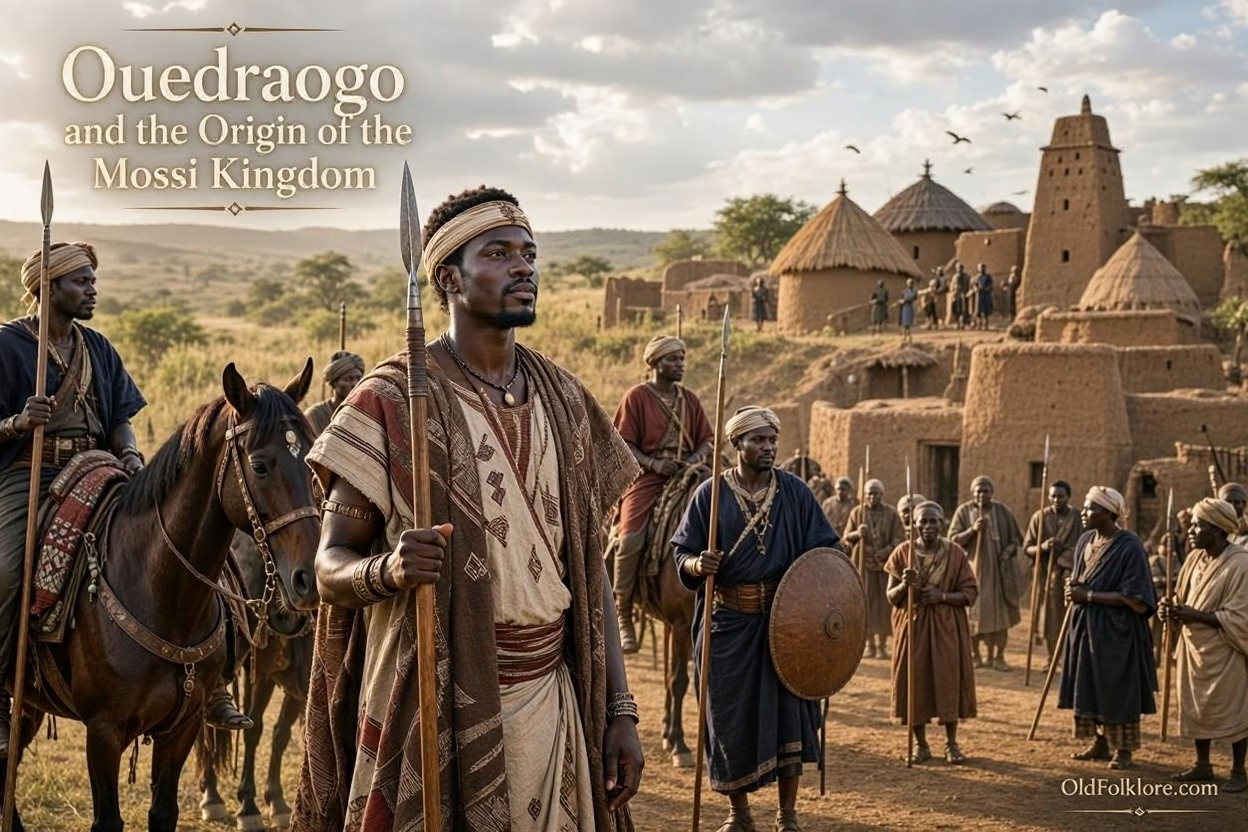
Long ago, before the Mossi kingdoms became powerful political states in the savannah lands of West Africa, traditions were preserved about the ancestors who established their royal lineages. Among the most important figures in these accounts was Ouedraogo, the son of Princess Yennenga and the hunter Rialé.
Through his mother’s royal ancestry and the support he received from his maternal grandfather, Ouedraogo became associated with the emergence of a new political community. His journey towards Tenkodogo, his leadership and the settlement of his descendants formed an important part of the traditional explanation of Mossi origins.
Although different versions of the story exist, Ouedraogo remains remembered as a founding ancestor whose family became connected to several important kingdoms in the region.
The Young Man with a Royal Heritage
Ouedraogo was born into a family whose background brought together two different worlds. His mother, Yennenga, was a princess from the royal household of Gambaga, while his father, Rialé, was a hunter.
Yennenga had left her father’s kingdom after a disagreement over her future. She eventually met Rialé, and their union produced a son whom they named Ouedraogo. His name is commonly associated with a male horse or stallion, reflecting the importance of the horse in the traditional account of his mother’s journey.
Ouedraogo grew up away from the royal court where his mother had spent her early life. However, his mother’s ancestry remained an important part of his identity. He was the grandson of a powerful ruler, even though he had not been raised within that ruler’s household.
As he grew older, Ouedraogo became increasingly aware of the family history that connected him to Gambaga. His mother knew that her departure had left an unresolved relationship with her father. She also understood that her son had a connection to a royal family whose influence extended beyond the place where he had been born.
The story of Ouedraogo therefore became more than an account of an ordinary young man growing up with his parents. It became a tradition about ancestry, inheritance and the formation of a new ruling family.
The Return to His Grandfather
In the traditional account recorded by Yamba Tiendrebeogo, Yennenga eventually sought to restore her relationship with her father. Her departure from Gambaga had been a serious matter, and returning with her son required careful consideration.
She approached her father and sought his acceptance. The matter was not immediately settled. The ruler took time to consider the situation before consulting his council.
Explore more stories from our Burkinabe Folktales Collections archive
After seven days of deliberation, he agreed to recognise his grandson and provide him with substantial support. The gifts included horses, cattle, sheep, money and men of war.
This was an important turning point in Ouedraogo’s life. The young man was no longer connected to his grandfather’s kingdom only through his mother’s stories. He had received recognition and resources from the royal household itself.
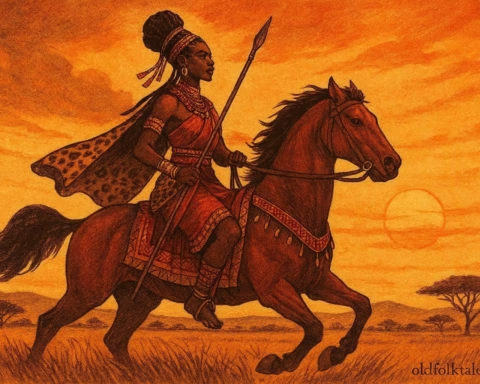
The horses were particularly significant. In the savannah regions of West Africa, horses were valuable in warfare, travel and the demonstration of political authority. A group of mounted followers could provide a leader with considerable influence over neighbouring communities.
The men who accompanied Ouedraogo also gave him the means to establish relationships and exercise authority beyond his immediate family.
The gifts were therefore more than expressions of affection towards a grandson. In the founding tradition, they represented the support that helped Ouedraogo begin a new political journey.
The Rise of a Leader
As Ouedraogo matured, he became associated with military expeditions and journeys across neighbouring territories. He travelled with his warriors and developed relationships with communities along the way.
The tradition describes him as a respected leader whose followers accompanied him on horseback. His royal ancestry gave him a connection to an established ruling family, while his growing influence helped him establish his own position.
His leadership was remembered through the expansion of his following and the establishment of a settlement that would become central to Mossi political history.
Ouedraogo eventually moved towards the region of Tenkodogo. His arrival there is traditionally associated with the beginnings of an important political centre.
The area was not an empty territory waiting for a new ruler. Different communities already lived across the region, with their own leaders, customs and claims to the land. The emergence of Mossi political authority therefore involved relationships with existing populations, not simply the arrival of one family.
In the traditional account, Ouedraogo established authority through his followers and the relationships he developed with neighbouring groups. His settlement became associated with the beginnings of a ruling lineage that would grow in influence over subsequent generations.
Tenkodogo became an important centre in the history and traditions of the Mossi people.
The Settlement at Tenkodogo
Tenkodogo occupies a significant place in the traditional accounts of Mossi origins. It is remembered as the settlement where Ouedraogo established his authority and where the early ruling family developed.
The name Ouedraogo became associated with the ancestry of the Mossi ruling houses. His descendants were remembered as leaders who extended their influence into neighbouring territories and established political centres of their own.
The growth of this family was not a single event. It took place through successive generations, as different branches developed their authority and formed relationships with surrounding communities.
Ouedraogo’s position as a founding ancestor gave his descendants a shared connection. However, they did not all remain in one settlement or govern the same territory.
As the family expanded, different members became associated with different regions. Their descendants formed political lineages that later traditions connected to the development of the Mossi kingdoms.
The story therefore presents Tenkodogo as an important starting point, rather than suggesting that all the later kingdoms appeared at once.
The Three Sons of Ouedraogo
One of the most important parts of the founding tradition concerns Ouedraogo’s sons. Accounts commonly name Zoungrana, Raoua and Diaba among his descendants.
Their names are significant because each became connected to a different branch of the family’s political history.
Zoungrana is traditionally remembered as the son who remained closely connected to his father’s settlement at Tenkodogo. After Ouedraogo’s death, he is associated with succeeding to his father’s position there.
His descendants later became connected to the political development of the region around Ouagadougou. One of the most important figures in this branch was Oubri, who is remembered as the founder of the Ouagadougou royal dynasty.
Raoua is associated with a northern branch of the family. In some accounts, his descendants became connected to Zandoma and the later political traditions of Yatenga.
Diaba, also known in some versions as Diaba Lompo, is associated with the eastern territories and the traditions surrounding Fada N’Gourma.
These accounts show how the descendants of one founding family became connected to different political centres. They also explain why the names of Ouedraogo’s descendants appear in traditions concerning several kingdoms.
However, the genealogies are not identical in every source. The relationships between early rulers and the exact order in which different political territories developed remain subjects of historical discussion.
The important point in the traditional story is that Ouedraogo’s family became associated with the emergence of several ruling lineages.
The Rise of the Mossi Kingdoms
The development of the Mossi kingdoms took place over generations. The political communities that emerged were connected through traditions of ancestry, military leadership and relationships between ruling families and local populations.
Tenkodogo became associated with the descendants of Zoungrana. Other branches of the family were linked to territories that later developed into important political centres.
The tradition of Raoua is connected to Zandoma and the northern political history of the region. The later history of Yatenga involved its own rulers, institutions and political developments.
The descendants of Zoungrana were also associated with the emergence of Oubritenga. Oubri, remembered as a grandson of Ouedraogo, became an important figure in the traditions explaining the establishment of the Ouagadougou kingdom.
Oubri’s name is particularly important because the kingdom of Ouagadougou later became one of the most influential Mossi states. Its ruler eventually held the title of Mogho Naba, a position that became central to the traditional political organisation of the Mossi.
Diaba Lompo is associated with the traditions of Fada N’Gourma, although the political history of that region also involved relationships with other communities and ruling groups.
These developments were not simply the result of one person’s actions. They reflected a long process in which different families, communities and political authorities interacted. Military expansion, alliances, settlement and the absorption of existing populations all contributed to the changing political landscape.
Nevertheless, Ouedraogo’s name remained central to the traditions that connected these developments to a shared ancestry.
A Legacy Passed Through Generations
As the Mossi kingdoms developed, the memory of Ouedraogo continued to provide an important foundation for royal identity.
His descendants traced their authority through the founding traditions associated with him. The story connected different ruling families to a common ancestor and helped explain the relationship between their political histories.
The importance of ancestry in these traditions went beyond remembering the names of earlier rulers. It provided a way of explaining the right to govern, the relationship between different royal houses and the historical connections between neighbouring territories.
The later kingdom of Ouagadougou became particularly prominent under the Mogho Naba institution. Its rulers exercised considerable authority, although the political relationship between Ouagadougou and the other Mossi kingdoms was complex and changed over time.
Tenkodogo, Yatenga and other political centres also maintained their own histories and ruling traditions. They were connected through aspects of the wider Mossi political world, but they were not simply provinces permanently controlled by one ruler.
Ouedraogo’s traditional role as a founding ancestor therefore remained important even as the political organisation of the region became more complex.
The Enduring Story of Ouedraogo
Today, Ouedraogo remains one of the most recognised figures in the traditional history of Burkina Faso. His name is closely associated with the beginnings of Mossi royal ancestry and the settlement at Tenkodogo.
His story is remembered alongside that of Yennenga, whose journey and marriage to Rialé gave rise to the family lineage. Yet Ouedraogo’s own part of the tradition focuses on his development as a leader, his connection to his maternal grandfather and the expansion of his descendants.
Through the generations, his family became associated with important political centres and royal institutions. The traditions surrounding his sons and grandson Oubri helped explain the emergence of several Mossi kingdoms.
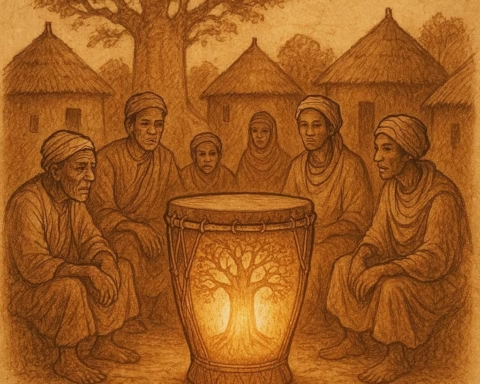
The story also reflects the importance of oral tradition in preserving collective memory. Accounts of early rulers were passed down through generations, giving communities a way to explain their ancestry and political institutions.
Although historians continue to examine the dates, genealogies and relationships contained in these accounts, Ouedraogo remains a central figure in the traditional explanation of Mossi origins.
His legacy is not remembered only through the settlement associated with his name. It also survives through the descendants and royal traditions that connect different parts of Burkina Faso’s history.
From the journey of Yennenga to the establishment of Ouedraogo’s family at Tenkodogo, the founding story describes how a royal lineage became connected to the emergence of a wider political world.
Explore our complete Africa Folktales collection.
Moral of the Story
Ouedraogo’s story teaches that leadership carries responsibilities beyond personal ambition. It reminds us that the decisions and efforts of one generation can influence the lives of those who follow. His traditional legacy also highlights the importance of family connections, cooperation and the preservation of shared history.
Knowledge Check
1. Who were Ouedraogo’s parents?
His mother was Princess Yennenga, and his father was the hunter Rialé.
2. Who was Ouedraogo’s maternal grandfather?
He was the ruler of Gambaga, traditionally identified as Nédéga.
3. What gifts did Ouedraogo receive from his grandfather?
He received horses, cattle, sheep, money and men of war.
4. Which settlement became closely associated with Ouedraogo?
Tenkodogo.
5. Name three sons traditionally associated with Ouedraogo.
Zoungrana, Raoua and Diaba.
6. Why is Ouedraogo important in Mossi traditional history?
He is remembered as a founding ancestor whose descendants became associated with several Mossi royal lineages and kingdoms.
Source
Adapted from Mossi oral traditions recorded by A. A. Dim Delobsom in L’Empire du Mogho-Naba (1932).
Explore More Burkinabe Folktales
- The Origin of Mossi Blacksmiths: A Story of Three Brothers
- The Child Marked by the Spirit World
- Yennenga the Warrior Princess
- The Hare, the Dog and the Hyena
- Hare and the Bull
- The Hare and the Hyena