In a small Mossi village in Burkina Faso, two men lived very different lives. Néré was poor but generous, while Wanga possessed great wealth but struggled to share even the smallest portion of it. Their differences became clear when an unusual camel arrived in the village, bringing a mysterious gift that transformed the lives of everyone who heard it sing.
At first, the camel’s beautiful voice brought happiness and abundance. However, when greed entered the hearts of the villagers, the gift that had united them threatened to disappear. They would soon discover that true prosperity depended not on possessing a blessing but on knowing how to share it.
The Arrival of the Singing Camel
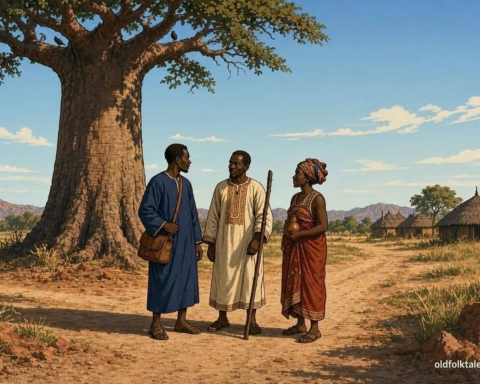
Long ago, in a village surrounded by open grasslands and scattered baobab trees, there lived two men named Néré and Wanga.
Néré owned very little. His small house stood near the edge of the village, and he earned his living through farming and occasional work for his neighbours. Although he was poor, he never turned away anyone who needed assistance. When a traveller asked for water, Néré shared what he had. When a neighbour struggled with farm work, he offered his hands. He believed that a person should never become so concerned with personal comfort that others were left to suffer.
Wanga, on the other hand, was one of the wealthiest men in the village. He owned cattle, goats, large fields and several storage houses filled with grain. Yet his wealth had not made him generous. He disliked lending anything, feared that others would take advantage of him and measured every relationship by what it could bring him.
One afternoon, as villagers returned from their farms, a strange camel appeared along the dusty path leading into the settlement.
It was tall and strong, with a coat that shone warmly beneath the afternoon sun. Its steps were slow, and its expression was calm. Nobody knew where it had come from or who owned it.
The children were the first to approach. They stood at a distance, watching it curiously. Some adults followed, wondering whether the animal had escaped from a passing trader.
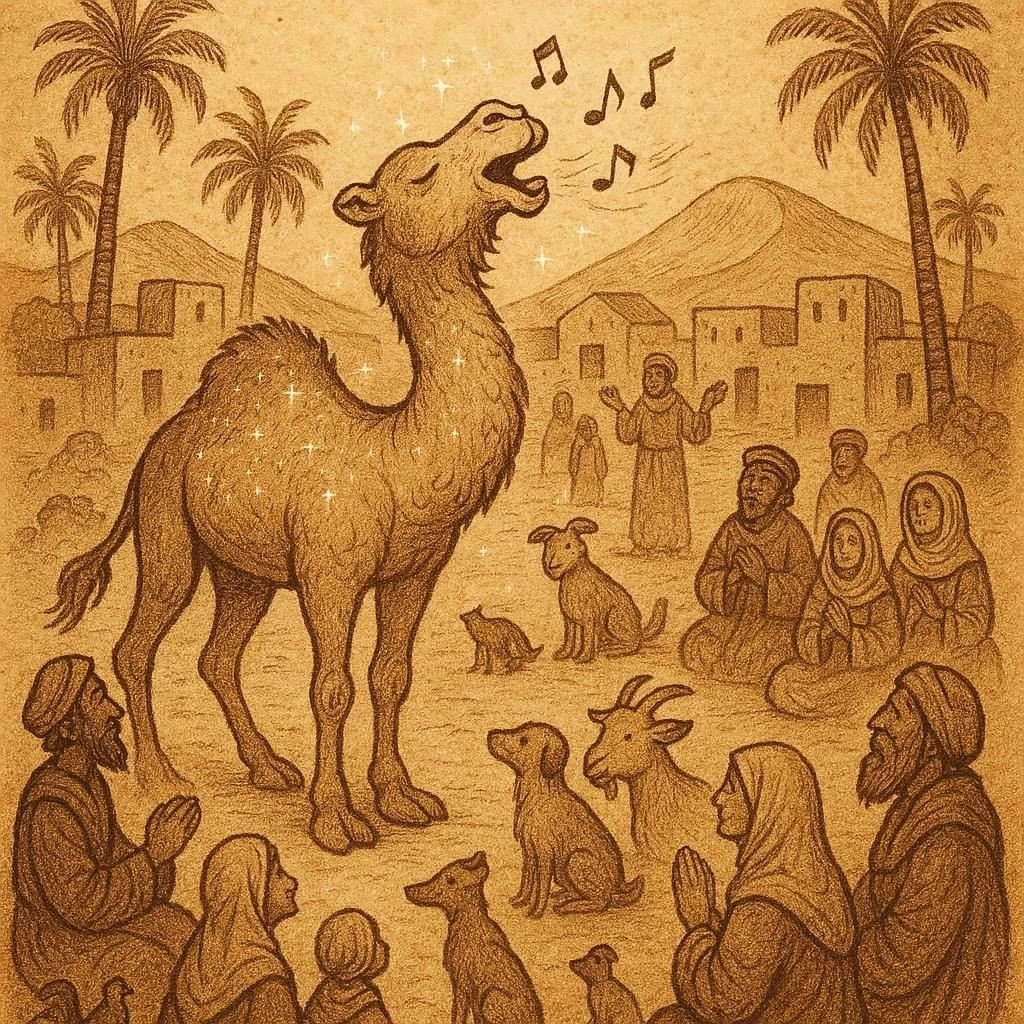
Then the camel lifted its head and began to sing.
Its voice was unlike anything the villagers had ever heard. The melody rose gently into the air, carried across the fields and seemed to settle over the village like a comforting breeze. People stopped their work to listen. Even the animals became quiet.
When the song ended, the villagers looked at one another in amazement.
Nobody knew how an ordinary-looking camel could produce such beautiful music.
Néré stepped forward and placed a small bundle of fresh leaves before the animal. He did not ask where it came from or what it could do for him. He simply welcomed it.
The camel lowered its head towards him, as though acknowledging his kindness.
A Gift That Changed the Village
The camel remained in the village, and its singing soon became part of everyday life.
Whenever it sang in the morning, the villagers worked with renewed enthusiasm. Farmers who had struggled with their fields began to notice healthier crops. The village well, which had often provided little water during difficult periods, seemed to serve the community more reliably. People felt encouraged, and disputes that had once caused bitterness became easier to settle.
Explore more stories from our Burkinabe Folktales Collections archive.
The villagers believed the camel had brought them a remarkable blessing.
Néré took responsibility for caring for it. He made sure it had enough food and water and found a comfortable place where it could rest. Other villagers also contributed. Some brought fresh leaves, while others offered grain or helped keep the animal’s resting place clean.
Wanga watched everything with growing interest.
He noticed that the villagers were becoming more prosperous and that visitors were travelling from neighbouring settlements to hear the camel sing. Traders stayed longer, children played happily, and the village became known for its unusual visitor.
One day, Wanga approached Néré.
“Tell me,” he said, “how did you persuade this camel to stay here? Does it sing because you feed it? Does it understand your words?”
Néré smiled.
“I do not know why it sings. I only know that it has brought happiness to our village. We should care for it and allow everyone to enjoy its gift.”
Wanga considered this answer.
He began to imagine how much wealth he could acquire if he controlled the camel. He thought of charging visitors for every song and keeping the money for himself. He also imagined taking the animal to his own compound, where nobody could approach it without his permission.
Instead of appreciating the blessing, Wanga saw an opportunity to become even richer.
The Desire to Own the Blessing
As the weeks passed, the camel attracted more visitors. People came from distant settlements, bringing small gifts and hoping to hear its beautiful voice.
The villagers welcomed them. Some visitors shared food, while others exchanged news and stories. The camel’s presence had created friendships between people who might never otherwise have met.
However, Wanga grew increasingly dissatisfied.
He believed the villagers were allowing strangers to benefit from something that belonged to their community. He argued that the camel should be protected from outsiders and that its songs should be reserved for those who lived in the village.
One evening, he gathered several influential men and presented his proposal.
“We must stop allowing strangers to come here whenever they please,” he said. “The camel is valuable. If we control its songs, we can decide who deserves to hear them. We could demand payment from visitors and become wealthier than every neighbouring village.”
Some men agreed because they were attracted by the promise of money. Others were uncomfortable but remained silent.
Néré objected.
“The camel has harmed nobody,” he said. “Why should we turn its gift into something that divides us? The happiness it brings is greater when everyone can enjoy it.”
Wanga dismissed his words.
“Your generosity will leave us with nothing. Wealth belongs to those who know how to protect it.”
Soon, the men who supported Wanga began building a fence around the place where the camel rested. They restricted access and instructed visitors to leave unless they could pay.
The camel noticed the sudden change.
People who once greeted it warmly now argued over who could approach it. Children were turned away, and travellers were made to wait outside the fence. Even Néré was prevented from caring for it as freely as before.
The animal became quiet.
When the Music Disappeared
At first, the villagers believed the camel was simply tired.
They waited for its familiar morning song, but none came. The following day, it remained silent again.
Without the music, the village gradually lost its cheerful atmosphere.
The farmers became worried when their fields no longer seemed to flourish as they had before. The animals grew restless, and the water supply became less dependable. Visitors stopped coming because there was nothing left to hear.
Wanga became angry.
He ordered the camel to sing, offering it better food and promising to build a more comfortable shelter. Yet the animal remained silent.
He then accused Néré of somehow interfering with its gift.
Néré refused to argue. Instead, he approached the camel quietly and placed water before it.
“My friend,” he said, “I do not know what has troubled you, but I wish you peace. Nobody should be forced to give what they no longer wish to give.”
The camel looked at him.
For the first time in several days, it made a sound. But instead of the joyful melody everyone remembered, it released a low and sorrowful note.
The villagers gathered around the fence. They listened as the sound travelled through the settlement, reminding them of the happiness they had once shared.
An elderly villager stepped forward.
“We have made a mistake,” he said. “We welcomed this animal when its gift benefited us, but we forgot to respect it when we began thinking only of ourselves.”
Others lowered their heads in agreement.
Wanga stood among them, unable to deny his part in what had happened.
The Return of the Song
The villagers removed the fence and allowed the camel to move freely again. They also agreed that visitors would no longer be turned away simply because they came from another settlement.
Wanga approached Néré and admitted that his desire for wealth had blinded him.
“I believed that keeping the camel to ourselves would make us powerful,” he said. “Instead, I helped destroy the happiness we once enjoyed.”
Néré listened without insulting him.
“We cannot demand blessings while refusing to show kindness,” he replied. “Let us learn from what has happened.”
The villagers then gathered around the camel, not to demand another song but to show that they were willing to care for it without expecting payment.
They brought food and water, repaired its shelter and gave it space to rest.
That evening, as the sun disappeared beyond the distant fields, the camel raised its head.
A beautiful melody filled the air once more.
The villagers listened in silence before breaking into joyful laughter. Children danced, elders smiled, and the people welcomed visitors who had gathered outside the settlement.
The following days brought renewed hope. The farmers returned to their work with determination, neighbours helped one another and the village gradually recovered its cheerful spirit.
Wanga also began to change. He shared grain with families who had little and offered assistance to people who needed it. His wealth remained considerable, but he finally understood that possessions alone could not make a person respected or happy.
Néré continued caring for the camel, never claiming ownership of its mysterious gift.
The camel remained in the village for a long time. Its songs became a reminder that blessings should be treated with gratitude rather than selfishness.
Whenever someone suggested keeping a good thing entirely for themselves, the elders remembered the days when the camel fell silent.
And so the villagers passed on the lesson to their children: a blessing becomes more meaningful when it brings happiness to others.
Explore our complete Africa Folktales collection
Moral of the Story
The Tale of the Singing Camel teaches that generosity creates unity, while greed can destroy the very blessings people hope to protect. True wealth is not measured only by possessions but also by kindness, cooperation and the willingness to share with others. A community becomes stronger when its members care for one another instead of seeking personal gain at everyone else’s expense.
Knowledge Check
1. Who were Néré and Wanga?
Néré was a poor but generous man, while Wanga was a wealthy but greedy man.
2. What unusual ability did the camel possess?
The camel could sing beautiful melodies that brought happiness and prosperity to the village.
3. Why did Wanga want to control the camel?
He wanted to keep its gift for himself and use it to acquire more wealth.
4. What happened when the villagers restricted access to the camel?
The camel stopped singing, and the village gradually lost the happiness and prosperity it had enjoyed.
5. How did the villagers respond when they realised their mistake?
They removed the fence, apologised through their actions and allowed everyone to enjoy the camel’s presence.
6. What is the main lesson of the story?
Generosity and cooperation strengthen a community, while greed and selfishness can destroy shared blessings.
Source
Creatively adapted from the central themes of generosity and greed in the Mossi folktale Le Génie du baobab (Zin-Damba Naab) by Jean-Noël Sibiri Ouédraogo, published by L’Harmattan in 2003.
Explore More Burkinabe Folktales
- The Origin of Mossi Blacksmiths: A Story of Three Brothers
- The Child Marked by the Spirit World
- Yennenga the Warrior Princess
- Ouédraogo and the Origin of the Mossi Kingdom
- The Hare, the Dog and the Hyena
- Hare and the Bull
- The Hare and the Hyena