Long ago, seven young girls went into the bush to gather firewood. Among them was a girl who had lost her parents and lived with the difficulties that often accompanied her condition. Although she joined the others in their daily activities, she had learned to remain observant and careful.
One day, while the girls were returning home, dark clouds gathered overhead, and heavy rain threatened to trap them far from their village. Searching for shelter, they discovered a lonely house belonging to an old woman. They entered, hoping to escape the storm and continue their journey the following morning.
The woman welcomed them warmly, but the girls did not know the danger hidden behind her hospitality. As night approached, the orphan noticed something that the others had failed to see. Her quick thinking would become their only chance of escaping the frightening situation.
The Seven Girls Go into the Bush
In a Kusaal community in Burkina Faso, seven girls once set out together to collect firewood. They travelled away from their homes and entered the surrounding bush, where they could find branches and pieces of wood for domestic use.
Among the seven girls was an orphan. She had lost her parents and did not enjoy the same family protection that the other children had. Nevertheless, she joined her companions in their everyday activities and worked alongside them.
The girls spent time gathering the wood they needed. They moved through the bush, collecting suitable branches and preparing their loads for the journey home.
After completing their work, they began making arrangements to return to their village. They expected to follow the familiar paths and reach home before nightfall.
However, the weather suddenly changed.
Dark clouds gathered in the sky, and the threat of heavy rainfall became increasingly obvious. The girls looked around and realised that they were far from home. They could not easily identify the correct path through the bush, and the approaching storm made the journey more difficult.
They began moving quickly, searching for a house or another safe place where they could take shelter.
The girls continued running for some time until they eventually discovered a small house belonging to an old woman who lived alone in the wilderness.
The Old Woman’s House
The old woman was known for eating human beings. Because of her frightening behaviour, people had driven her away from their community. She had consequently settled in a lonely part of the bush, where she lived in a small, single-room house.
When the seven girls reached her home, the old woman was not there. They saw the building as an opportunity to escape the approaching storm and entered to find shelter.
They waited inside until the old woman returned.
Explore more stories from our Burkinabe Folktales Collections archive.
When she arrived and discovered the visitors, she greeted them and welcomed them into her home. The girls responded politely, and she offered them places to sit.
The rain continued for a long time. The girls remained indoors, grateful that they had found somewhere to shelter from the weather.
Eventually, the storm passed. However, darkness had already begun to settle over the surroundings.
The girls wanted to continue their journey home, but the old woman advised them against travelling at that hour.
She explained that they might lose their way in the darkness and struggle to find their village. Instead, she suggested that they remain in her house for the night. By morning, when there was enough light, they would be able to recognise the path and return home safely.
The girls considered her advice and agreed to stay.
The old woman prepared food, which they ate together. After the meal, the visitors settled down to rest, believing that they were safe.
None of them realised that the old woman’s kindness was not genuine.
A Terrifying Discovery at Midnight
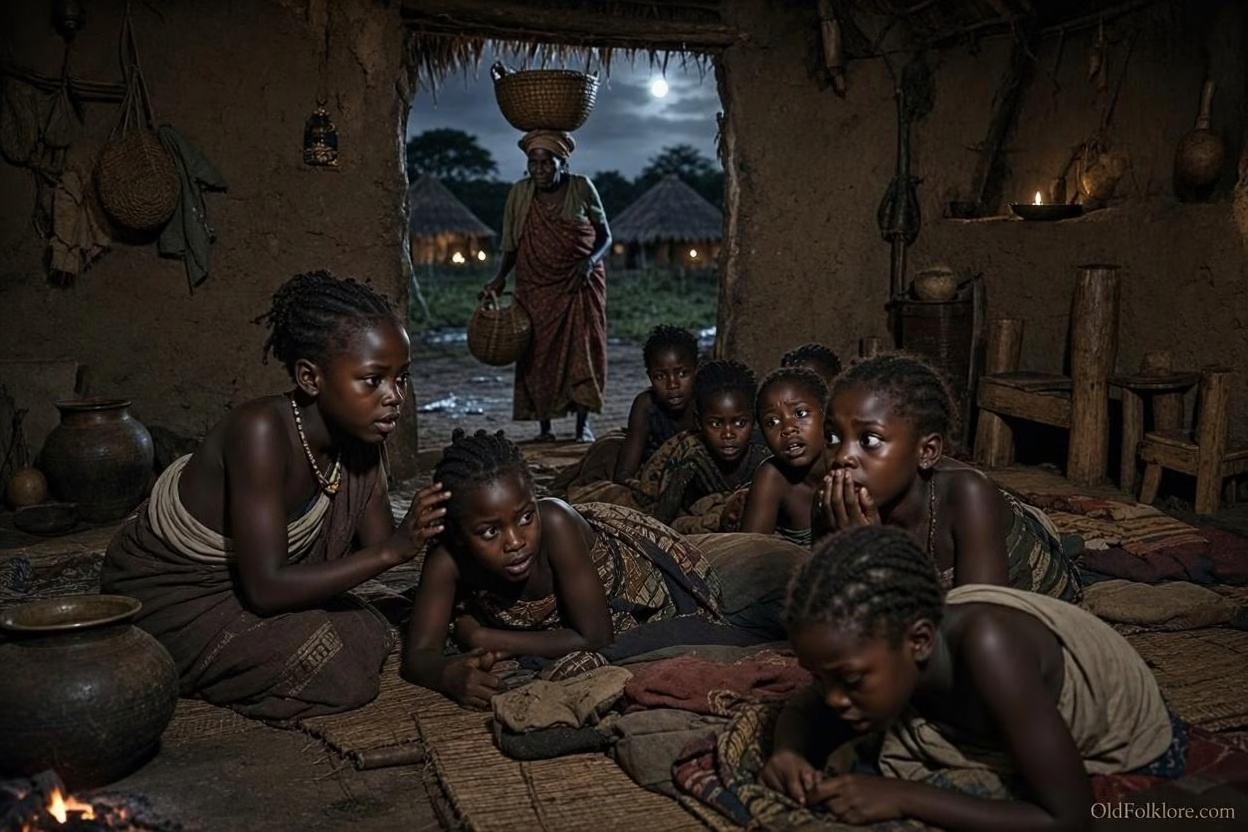
As the night grew quieter, the old woman waited until she believed the girls were asleep.
Towards midnight, she got up and took a large knife. She began sharpening its blade while singing a frightening song.
Her words repeatedly declared that the knife would eat meat that night. She sang about the knife as a weapon that would cut human beings and satisfy its hunger.
The sound of the sharpening blade and the strange song filled the quiet house.
Most of the girls were asleep and did not notice what was happening. However, the orphan was still awake.
She had not allowed herself to fall completely asleep because she wanted to understand the unusual activity taking place in the room.
From where she lay, she watched the old woman sharpening the knife. She listened carefully to the song and began to understand that the visitors were in danger.
The old woman had welcomed them, fed them and offered them shelter, yet she was preparing to harm them.
The orphan knew that she had to act quickly. She could not confront the woman directly because she was only a child and the old woman had a dangerous weapon.
Instead, she decided to use her intelligence.
The First Request for Food
The orphan got up and approached the old woman.
She addressed her respectfully, calling her mother, and asked what she was doing.
The old woman did not explain why she was sharpening the knife. Instead, she asked the child what people at home usually did to help her fall asleep after eating.
The question gave the orphan an opportunity to think of a way to delay the woman.
She explained that her mother usually prepared a meal of Bambara beans and ordinary beans in the evening. The beans were cooked together until they became soft and were then mixed with oil. After eating the meal, she would feel satisfied and return to sleep.
The old woman listened.
She then stopped what she was doing, went to prepare the food and gave it to the orphan.
The girl ate the meal and returned to her sleeping place.
The old woman believed that she had successfully settled the child’s request. She expected the girl to fall asleep so that she could continue with her earlier plan.
However, the orphan remained alert.
She understood that she had gained only a little time. The old woman had not abandoned her intention, and the danger had not passed.
The Second Request
After some time, the old woman believed that the orphan was asleep.
She picked up the knife again and resumed sharpening it. Once more, she began singing about the weapon and the meat it would consume.
The orphan immediately got up.
She approached the old woman and again asked what she was doing.
The woman did not provide an answer. Instead, she repeated her earlier question, asking what people usually did to help the girl sleep.
The orphan now introduced another request.
She explained that, after eating, people at home would normally fetch water for her. They would take a basket to the river, collect water and bring it back so that she could drink. Once she had drunk the water, she would return to sleep.
The old woman accepted the explanation.
She took a basket and went to the river to fetch water for the child.
However, the basket was not suitable for carrying water. As the woman tried to bring it up from the riverbank, the water escaped through its openings.
She had to return to the river and try again.
Each time she collected water, it disappeared before she could carry it home. She repeated the journey several times, but she could not complete the task.
Meanwhile, the orphan understood that the woman would spend a considerable amount of time trying to bring the water back.
The Orphan Wakes Her Companions
While the old woman continued making unsuccessful journeys to the river, the orphan quietly woke the other six girls.
She explained what she had witnessed.
She told them about the knife, the frightening song and the old woman’s repeated attempts to prepare for something terrible.
She also explained how she had managed to delay the woman by requesting food and then asking her to fetch water with a basket.
The girls listened with growing fear.
Until that moment, they had believed that the old woman was simply a lonely person who had offered them shelter during the storm. They had not suspected that their lives were in danger.
The orphan explained that the woman was still away at the river and that they should use the opportunity to escape.
She warned them that the old woman would eventually realise what had happened and return to the house.
The girls understood the urgency of the situation.
They got up, prepared to leave and hurried out of the house.
They did not wait for the old woman to return. Their safety depended on putting as much distance as possible between themselves and the dangerous shelter.
The Old Woman Discovers Their Escape
The old woman continued trying to carry water from the river.
Each attempt ended in failure because the basket could not retain the water. She repeatedly returned to the river, hoping that another attempt would succeed.
Eventually, she realised that she had wasted too much time.
She also understood that the orphan had deliberately misled her.
The woman abandoned the task and hurried back to her house.
When she arrived, she discovered that the room was empty.
The seven girls had disappeared.
She looked around, but there was no sign of the visitors she had welcomed earlier. The old woman realised that the orphan had recognised her intentions and used the opportunity to help the others escape.
She began clapping her hands in frustration and lamenting that the child had outsmarted her.
Her plan had failed because she had underestimated the intelligence of the youngest and most vulnerable member of the group.
The orphan’s alertness had saved not only her own life but also the lives of her six companions.
The Origin of a Traditional Relationship
The Kusaal narrative ends by explaining a traditional relationship between orphans and wealthy people.
According to the story, an orphan and a rich person now live together because of what happened in earlier times. The tale explains that wealthy people once hesitated to live with orphans because an orphan was considered to have nothing.
The account presents the orphan girl’s intelligence as the reason for a change in that relationship. Although she lacked the family support and material advantages enjoyed by others, she demonstrated a quality that the dangerous old woman did not possess: the ability to observe a situation, think carefully and act wisely.
The story therefore gives the orphan an important role. She is not simply a helpless child waiting for someone to rescue her. She becomes the person who recognises the danger and saves everyone.
Her companions survive because she remains attentive when the others are unaware of what is happening.
Explore our complete Africa Folktales collection.
Moral of the Story
The story teaches that intelligence, alertness and courage can help people overcome dangerous situations. The orphan girl did not possess physical strength or authority, but she used careful observation and quick thinking to protect herself and her companions. Her experience also reminds us not to judge people by their family background or material possessions. Although she was an orphan, she demonstrated wisdom that proved valuable to everyone. The tale encourages people to remain observant, think before acting and recognise that even the youngest or most disadvantaged person can make an important contribution to the lives of others.
Knowledge Check
1. How many girls went into the bush to collect firewood?
Seven girls went into the bush to collect firewood.
2. Who among the seven girls was an orphan?
One of the seven girls had lost her parents and was identified in the story as the orphan.
3. Why did the girls enter the old woman’s house?
Heavy rain threatened their journey home, so they searched for shelter and entered the old woman’s house.
4. What did the orphan discover during the night?
She saw the old woman sharpening a knife and singing about using it to cut and eat human flesh.
5. How did the orphan delay the old woman?
She first requested a meal of Bambara beans and ordinary beans, then asked the woman to fetch water from the river using a basket that could not hold it.
6. How did the seven girls escape?
The orphan woke her companions, explained the danger and persuaded them to leave while the old woman was still at the river.
Source
Adapted from the Kusaal folktale “The Orphan and the Rich Person”, told by N’Deogo Francis and recorded in Zabré, Burkina Faso, in January 2012. The narrative appears in Urs Niggli’s Collection of 30 Texts of the Burkina Kusaal Language, published by the Société Internationale de Linguistique (SIL), Burkina Faso, in 2012.
Explore More Burkinabe Folktales
- Ouédraogo and the Origin of the Mossi Kingdom
- The Tale of the Singing Camel
- The Origin of the Mossi Kingdom’s Drum
- The Trickster Hare and the Sacred Baobab Tree
- The Beautiful Daughter and the Crocodile
- The Naba Zid-Wendé and the Creation of the World