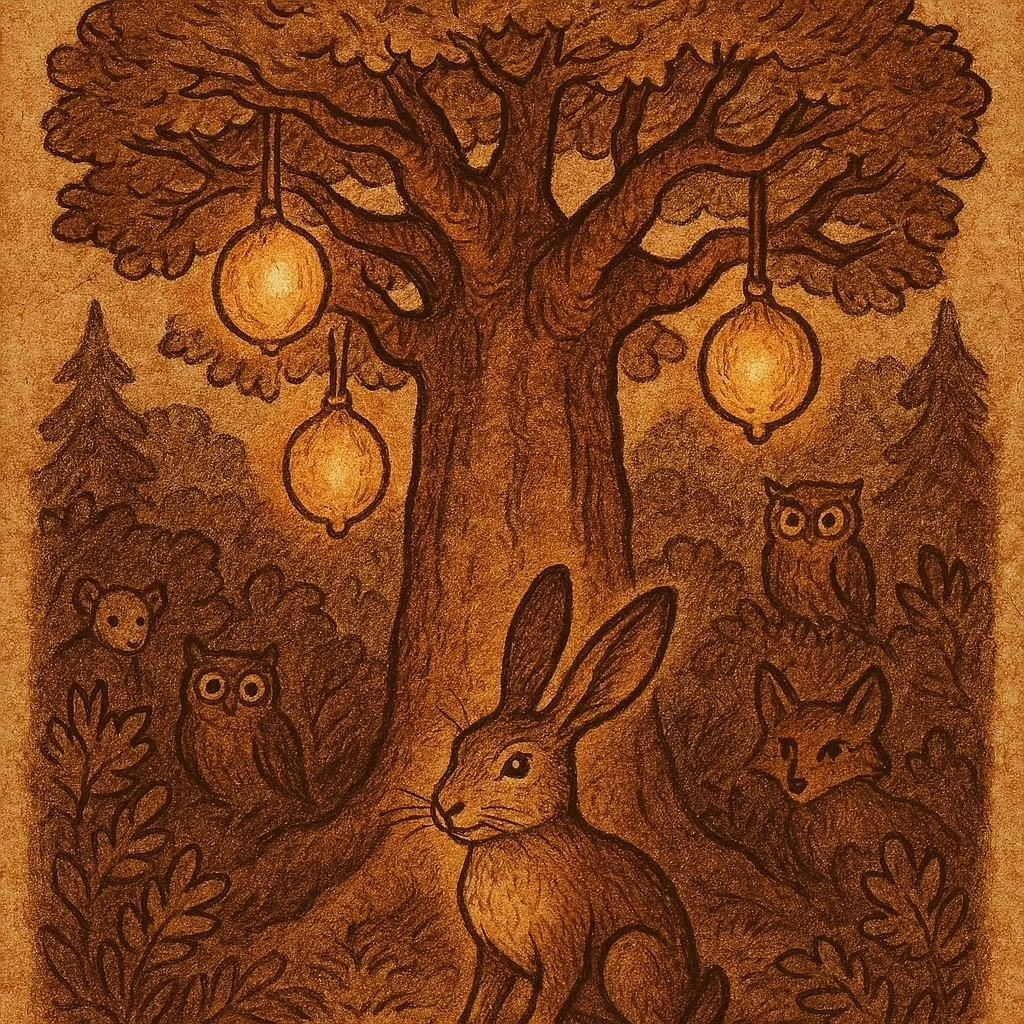
In a village surrounded by open grassland and scattered trees, a mighty baobab stood at the edge of the forest. Its enormous trunk had witnessed generations of villagers grow old, raise families and pass down their traditions. People regarded it with great respect because they believed that powerful spirits watched over the tree and protected the life that gathered around it.
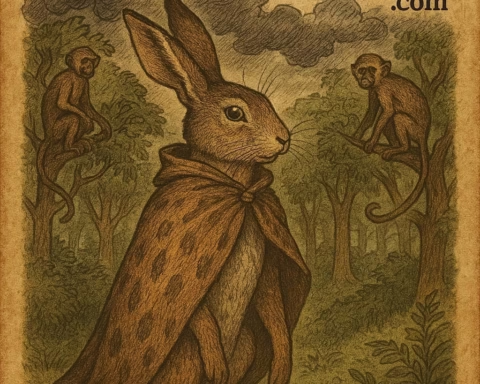
Among the animals living nearby was a hare famous for his intelligence and quick thinking. He could escape danger, solve difficult problems and persuade other animals to believe almost anything he said. However, his cleverness often served his selfish desires. When he discovered the delicious fruits growing on the sacred baobab, he became determined to obtain them, even if he had to deceive the spirits guarding the tree.
The Sacred Baobab
The baobab was the oldest tree in the village. Its thick branches spread across the sky, offering shade to travellers and shelter to birds. During the dry season, animals gathered beneath it to escape the heat, while villagers rested nearby after working in their farms.
When the tree produced fruit, the villagers waited patiently for the appointed time to gather it. They believed that its abundance was a blessing that should be treated with gratitude. No one was permitted to take its fruits carelessly or damage its branches. The elders taught the younger generation that the tree was not simply a source of food. It represented the relationship between the community, the natural world and the unseen forces they believed protected it.
The animals also understood that the baobab was special. Birds nested among its branches, insects found shelter in its bark, and smaller creatures fed on fallen fruits. Even the oldest tortoise warned the younger animals never to disturb the tree unnecessarily.
The hare, however, paid little attention to these warnings.
He was known throughout the forest for finding ways around rules. Whenever another animal succeeded through patience or hard work, the hare searched for a quicker method. He believed that intelligence gave him the right to obtain whatever he desired.
One morning, as he searched for food, he noticed the baobab covered with ripe fruits. Their bright skins stood out among the green leaves, and their sweet smell drifted through the air.
The hare stopped and stared.
“What beautiful fruits!” he exclaimed. “If I could take some for myself, I would have enough food for many days.”
He looked around. The ground beneath the tree was empty, and no animal appeared to be watching him.
“I am clever enough to collect them without anyone knowing,” he whispered.
He approached the trunk and began planning how to reach the branches.
The Hare’s First Attempt
The hare first decided to climb the baobab. He examined the rough trunk and searched for places where he could place his paws.
He jumped against the tree and tried to pull himself upwards. At first, he managed to climb a short distance, but the trunk was too broad and difficult to grip. Each time he found a foothold, his paws slipped against the bark.
He tried again, using all his strength. Just as he reached a small opening between two branches, the tree shook.
A strong movement ran through its branches, sending leaves and small twigs falling around him. The hare lost his grip and tumbled backwards onto the grass.
He quickly stood up and looked around.
“What was that?” he muttered.
A deep voice seemed to come from among the leaves.
“Why do you disturb the tree?”
The hare’s ears rose sharply. He looked towards the branches but could not see anyone.
“Who is speaking?” he asked.
“We are the spirits who guard this tree. You have approached it without respect.”
The hare swallowed nervously. He had heard stories about the spirits, but he had never expected to hear them speak.
“I only wanted to climb,” he replied. “I did not mean to cause trouble.”
“Then leave the tree in peace,” the voice answered.
The hare stepped away, but his desire for the fruit remained.
He had failed once, but he was not ready to surrender.
A Clever Plan
After resting beneath a smaller tree, the hare began considering another way to reach the fruit.
He noticed several long vines hanging from nearby branches. An idea immediately came to him.
He gathered the vines and tied them together, making a long rope. He then fastened one end to a strong branch within reach and pulled the other end towards himself.
His plan was to swing from the rope and reach the lower branches of the baobab.
He moved backwards, took a running start and leapt into the air. His paws caught the vine, and for a moment he swung towards the fruit.
Explore more stories from our Burkinabe Folktales Collections archive.
He was almost successful. One of the ripe fruits was close enough for him to touch.
But before he could grasp it, the branch shook violently.
The vine slipped from his paws, and the hare fell into a patch of soft grass. He rolled several times before coming to a stop.
His body ached, and his pride suffered even more.
“This tree is more difficult to defeat than I expected,” he complained.
The leaves rustled above him.
“Cleverness cannot make you the owner of what does not belong to you,” the voice warned.
The hare looked up.
“Why will you not allow me to take just one fruit?” he asked.
“Because you have not come with an honest purpose,” the spirits replied.
The hare lowered his head. He understood that the spirits could see through his actions, but he still hoped to find another way.
The Hare Tries to Deceive the Spirits
This time, the hare decided that strength and climbing would not help him. He would use the one ability he trusted most: his tongue.
He sat beneath the baobab, arranged his face into a respectful expression and began speaking.
“Great spirits of the sacred tree,” he called, “I have come because I admire your generosity. Your fruits are famous throughout the forest, and I wish to taste one so that I can tell the other animals about your kindness.”
The leaves moved gently in the breeze.
The hare continued.
“I will not take many. One fruit will be enough. I promise to tell everyone how wonderful this tree is and how generously its guardians provide for the creatures of the forest.”
For a moment, everything became quiet.
Then the spirits answered.
“Clever hare, your words are pleasing, but your heart tells a different story. You have not come to honour the tree or share its blessings. You want the fruit because you desire it for yourself.”
The hare’s ears drooped.
“You have tried to climb the trunk, and when that failed, you made a rope to reach the branches. Now you have returned with flattering words. Do you believe that changing your method will change your intentions?”
The hare could not answer.
The spirits continued.
“Intelligence is a gift, but it becomes dangerous when it is used to deceive others. A creature who thinks only of himself may gain something for a moment, but he loses the trust and respect of those around him.”
The hare stared at the ground. For the first time, he began to understand that his repeated attempts had not demonstrated wisdom. They had only revealed his selfishness.
The Hare Learns His Lesson
After a long silence, the hare finally spoke.
“I am sorry,” he said. “I wanted the fruit because it looked delicious, and I thought only of myself. I tried to take it without permission, and when I failed, I attempted to deceive you with flattering words.”
He raised his head towards the branches.
“I now understand that the tree provides shelter and food for many creatures. I should not behave as though everything I desire belongs to me. Please forgive me.”
The wind moved gently through the branches. A few leaves fell around him.
The spirits answered.
“An apology has meaning when it is followed by a change in behaviour. You must remember that the gifts of the earth are not yours alone. They sustain many lives, and those who receive them should show gratitude and consideration.”
The hare nodded.
“I will remember,” he promised.
For a while, nothing happened. Then a ripe fruit loosened from one of the lower branches and fell gently onto the grass in front of him.
The hare looked at it with surprise.
“May I take it?” he asked.
“The fruit is yours to receive,” the spirits replied. “But remember the lesson you have learned.”
The hare carefully picked it up. He was hungry and had long desired to taste the fruit. Nevertheless, he did not immediately begin eating.
Instead, he remembered the other creatures that depended on the baobab. He also remembered the tortoise, who had often shared food with him even when the hare had nothing to offer in return.
He decided that the fruit should not become another reason to think only of himself.
A Different Kind of Cleverness
The hare carried the fruit towards the village. Along the way, he met a small mouse searching for food beneath the dry leaves.
“Where did you find that?” the mouse asked.
“At the sacred baobab,” the hare replied. “The spirits allowed me to receive it after I admitted that I had behaved selfishly.”
The mouse looked surprised.
“Did you climb the tree?”
“No. I tried, and I failed. Then I tried to swing towards the branches, and I failed again. Finally, I tried to deceive the spirits with flattering words. That failed too.”
The mouse laughed softly.
“Then what happened?”
“I learnt that cleverness is not the same as wisdom.”
The hare broke the fruit into portions and shared some with the mouse. Further along the path, he met the tortoise and offered him a share as well.
The tortoise accepted it gratefully.
“I am glad to see you sharing,” he said. “You have always been clever, but sometimes you forget that other creatures have needs too.”
The hare nodded.
“I thought being clever meant finding a way to get whatever I wanted. Now I understand that true wisdom also means knowing what is right.”
When the other animals heard what had happened, they gathered to listen. The hare told them about his failed attempts, the warning from the spirits and the fruit that had been given to him.
He did not hide his mistakes or pretend that he had acted honourably from the beginning.
The animals appreciated his honesty. Some laughed at the thought of him falling from the tree, while others praised him for admitting his wrongdoing.
From that day, the hare became more careful about the way he used his intelligence. He remained quick-thinking and resourceful, but he gradually learnt to consider how his actions affected others.
The sacred baobab continued to stand at the edge of the village, providing shade and nourishment to the creatures around it. The villagers continued to treat it with respect, teaching their children that nature’s gifts should never be taken for granted.
And whenever the hare passed beneath its branches, he remembered the day his clever tricks failed and an honest apology opened the way to forgiveness.
Explore our complete Africa Folktales collection.
Moral of the Story
Cleverness is valuable, but it should always be guided by honesty, humility and respect. The hare believed that his intelligence could help him obtain anything he wanted, but his attempts to deceive the spirits only brought him failure. He learnt that the gifts of nature should be treated with gratitude and consideration for others. True wisdom is not simply knowing how to get what one desires; it is understanding when to act with patience, honesty and generosity.
Knowledge Check
1. Who is the main character in the story, and what is he known for?
The main character is the hare, who is known for his intelligence, quick thinking and trickery.
2. Why did the villagers regard the baobab tree as sacred?
They believed that spirits protected the tree and respected it as a source of nourishment and shelter for the community and animals.
3. What were the hare’s first two attempts to obtain the fruit?
He first tried to climb the trunk and later used vines to swing towards the branches, but both attempts failed.
4. How did the hare try to persuade the spirits to give him the fruit?
He praised the spirits and claimed that he wanted the fruit to share the tree’s goodness with other creatures, although his original intention was selfish.
5. What made the spirits finally give the hare a fruit?
The hare admitted his selfish intentions, apologised and promised to respect the tree and its gifts.
6. What important lesson did the hare learn?
He learnt that cleverness must be guided by honesty, respect and consideration for others.
Source
Creatively inspired by the Mossi storytelling tradition documented in Alain-Joseph Sissao’s Folktales from the Moose of Burkina Faso (2010), edited by Nina Tanti, which includes the hare as a familiar trickster figure.
Explore More Burkinabe Folktales
- The Origin of Mossi Blacksmiths: A Story of Three Brothers
- The Child Marked by the Spirit World
- Yennenga the Warrior Princess
- Ouédraogo and the Origin of the Mossi Kingdom
- The Tale of the Singing Camel
- The Origin of the Mossi Kingdom’s Drum