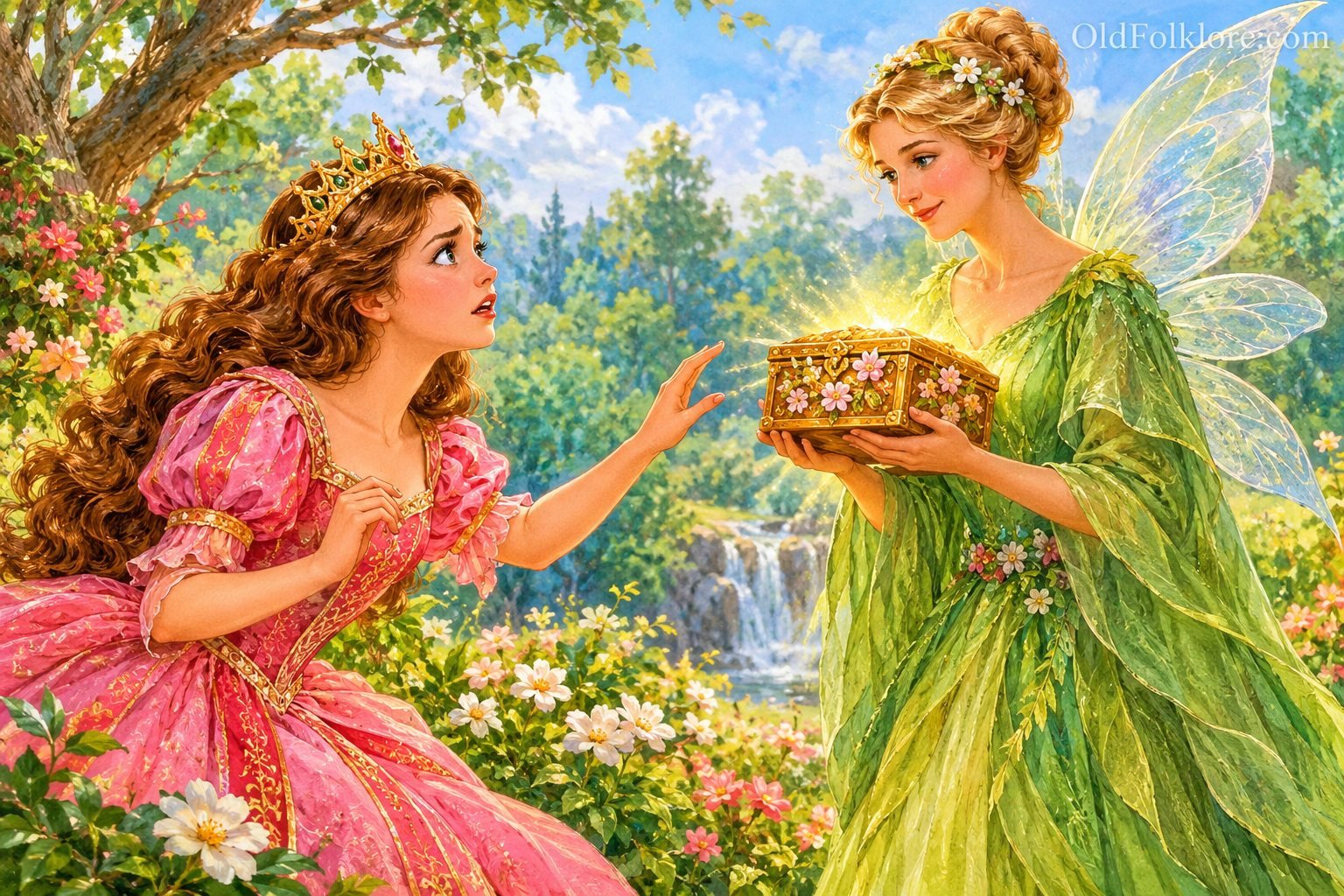
Long ago, a king and queen had suffered the heartbreak of losing nearly all their children. Only one little daughter remained, and the queen was determined to find the finest nurse in the world to care for her.
A royal announcement was made, and nurses travelled from distant lands to present themselves at the palace. There were so many applicants that the queen arranged to examine them in a shady wood, where they could approach her one at a time.
Among the women stood an unusual stranger with dark skin, an unpleasant appearance, and a language nobody understood. The queen immediately dismissed her, wondering why such a woman had even dared to offer herself as a nurse. The stranger muttered something under her breath and walked away, but instead of leaving, she concealed herself inside a hollow tree to watch what happened.
The queen chose a beautiful, rosy-cheeked woman as her first nurse. Almost immediately, a snake hidden in the grass bit the unfortunate woman, and she collapsed as though dead. The queen tried again, but an eagle dropped a tortoise upon the head of her second choice, killing her. The third woman was equally unfortunate. As she hurried forward, she struck her face against a tree branch and blinded herself with a thorn.
Horrified, the queen decided that some evil power was at work and abandoned the selection. As she prepared to return to the palace, she heard dreadful laughter behind her. The strange woman emerged from her hiding place, laughing at the disasters and mocking the royal couple.
Explore more stories from our Andrew Lang’s Colour Fairy Books collection.
The queen was about to have her arrested when the stranger revealed her true nature. With a few movements of her wand, she summoned a blazing chariot pulled by winged dragons and flew away, threatening revenge.
The king immediately recognised her.
It was Fairy Carabosse, who had hated him ever since he had played a cruel trick on her as a boy by putting sulphur into her porridge.
The queen was overcome with regret. Had she known the stranger’s identity, she would have tried to win her friendship rather than dismiss her. But the damage was done, and the king feared that Carabosse would take revenge on their daughter.
He summoned his counsellors, and after a secret meeting, they decided to invite every fairy within a thousand leagues to the child’s christening. The ceremony’s date would remain a secret so that Carabosse could not discover it.
The queen prepared elaborate presents for the invited fairies. Each was to receive a blue velvet cloak, an apricot-coloured satin petticoat, high-heeled shoes, sharp needles and golden scissors.
When the christening day arrived, only five fairies managed to attend. They gathered around the little Princess and began bestowing their gifts.
The first promised that she would be extraordinarily beautiful. The second granted her the ability to understand anything explained to her, however difficult it might be. The third promised her a voice as sweet as a nightingale’s. The fourth declared that she would succeed in everything she attempted.
The fifth fairy was just about to give her blessing when a terrible rumbling came from the chimney. Carabosse tumbled down, covered in soot, and announced her terrible gift:
The Princess would be the unluckiest of the unlucky until she reached her twentieth birthday.
The queen and the other fairies begged her to reconsider, reminding her that the child had done nothing to deserve such cruelty. Carabosse refused to listen. The fifth fairy, who had not yet bestowed her gift, could only promise that Mayblossom would enjoy a long and happy life once the unhappy years were over.
Carabosse laughed and disappeared up the chimney.
Afterwards, the oldest fairy advised the royal couple to keep the Princess away from the world until her twentieth birthday. The king therefore ordered the construction of a heavily guarded tower. It had no windows, and candles provided its only light. Its entrance lay beneath the ground, protected by iron doors and guards stationed at regular intervals.
The Princess was named Mayblossom because she was as fresh and lovely as spring. She grew into a beautiful young woman, charming in both appearance and manner. Her parents visited regularly and delighted in her progress, but whenever she begged to leave the tower, they refused.
Her nurse tried to make her confinement bearable by describing the world outside. Thanks to the second fairy’s gift, Mayblossom understood everything perfectly, although she had never experienced any of it herself.
The king and queen congratulated themselves on having defeated Carabosse’s prediction. They believed that their daughter was happy and safe, and that the fairy’s curse would come to nothing.
As Mayblossom approached her twentieth birthday, her portrait was sent to neighbouring courts so that a suitable husband could be found. The whole kingdom looked forward to her release. Then news arrived that King Merlin was sending an ambassador named Fanfaronade to request her hand in marriage for his son.
The Princess’s nurse told her all about the approaching visit. She described the ambassador’s magnificent procession so enthusiastically that Mayblossom became desperate to see it.
She could no longer bear her imprisonment. She complained that she had never seen the sun or stars with her own eyes, nor had she ever seen a real horse, monkey or lion. She feared that her parents might never release her, despite their promises.
Her nurse, the nurse’s daughter, the cradle-rocker and the nursery maid all began crying as they listened. Seeing that they pitied her, Mayblossom insisted that she would starve herself unless they found a way for her to witness the ambassador’s arrival.
Eventually, they gave in. They scratched and scraped at the tower wall until they made a tiny opening, barely large enough to admit a slender needle.
Mayblossom pressed her eye against it and saw daylight for the first time. She was so fascinated by the outside world that she remained at the opening until Fanfaronade’s procession appeared.
The ambassador rode at its head on a magnificent white horse. His clothes glittered with pearls and diamonds, his boots appeared to be made of solid gold, and scarlet feathers waved from his helmet.
Mayblossom was completely captivated. She immediately decided that she would marry Fanfaronade himself rather than the prince he represented. She reasoned that even a modest home with the ambassador would be preferable to a luxurious palace with another man.
When Fanfaronade arrived at the palace, preparations began to present the Princess to him. The streets were covered with carpets, and crowds gathered to welcome her.
A dwarf arrived bearing gifts from the five fairies: a crown, a sceptre, a magnificent golden robe, a beautifully embroidered petticoat decorated with butterfly wings and a splendid casket of jewels. Mayblossom barely noticed these treasures, for her thoughts were entirely occupied with the ambassador.
Dressed in her magnificent garments, she walked through the streets while the people admired her beauty. Her procession included numerous royal relatives and princesses from neighbouring kingdoms.
Suddenly, the sky darkened. Thunder rumbled, and rain and hail poured down upon them. Before Mayblossom could cover herself, a terrible chorus of crows, ravens, owls and other ill-omened birds filled the air. A huge owl swooped down and placed a hideous scarf woven from spiderwebs and decorated with bats’ wings around her shoulders.
Mocking laughter followed. Everyone recognised another of Carabosse’s tricks.
The queen tried desperately to remove the scarf, but it clung to Mayblossom as though it had been nailed to her. She lamented that even the enormous quantities of sweets, sugar and Westphalia hams she had sent to Carabosse had failed to soften the fairy’s anger.
Just then, Fanfaronade approached with the king. The ambassador, who was usually full of speeches, became speechless at the sight of the beautiful Princess. Mayblossom greeted him warmly and suggested that they hurry inside before the wicked fairy enjoyed watching them stand in the rain.
Fanfaronade recovered his composure and offered a charming compliment about her beauty.
Mayblossom then surprised him by confessing that she had fallen in love with him from the moment she saw him riding into the town. She wished to marry him instead of his royal master, even though she knew he was not a prince. She was willing to give up her royal comforts for a simple life with him.
The ambassador could hardly believe his good fortune. He squeezed her hand so tightly that it hurt, but Mayblossom did not complain.
When they entered the palace, the king asked his daughter whether she was willing to marry King Merlin’s son. Mayblossom quietly agreed, as did the queen, and preparations for the wedding began.
A magnificent banquet was held, followed by dancing and a ballet. Eventually, the guests became so exhausted that they fell asleep wherever they were sitting.
Only Mayblossom and Fanfaronade remained awake.
Seeing their opportunity, the Princess suggested that they escape together. She took her father’s dagger, which was kept in a diamond sheath, and her mother’s precious neck-handkerchief. Fanfaronade carried a lantern, and the two slipped out into the streets before making their way to the shore.
There they found an old boatman asleep in his little boat. Mayblossom ordered him to take them away. Although he was astonished by the sight of the richly dressed Princess, he obeyed.
The night was dark, but the carbuncle hidden in the queen’s handkerchief shone with the brightness of many torches. When Fanfaronade asked where she wished to go, Mayblossom replied that she did not care, provided they remained together.
Fanfaronade, however, feared returning to King Merlin’s court, where he might be punished for abandoning his mission. Mayblossom therefore chose Squirrel Island, a lonely place where nobody was likely to find them.
Meanwhile, back at the palace, the king and queen awoke and began preparing for the wedding. The queen asked for her precious handkerchief, but it was nowhere to be found. Then the king discovered that his dagger was also missing.
They searched the entire palace, opening forgotten boxes and chests, but found neither object. Matters became even worse when the nurse announced that Mayblossom had disappeared. The ambassador was missing too.
The queen fainted from the shock, and the king summoned his counsellors to discuss the disaster.
The Prime Minister suggested that Carabosse might still be responsible, pointing out that the Princess’s twenty years of misfortune had not yet ended. He also remarked that Mayblossom and Fanfaronade had seemed unusually interested in one another.
The queen refused to believe that her well-brought-up daughter could fall in love with an ambassador. But the nurse finally confessed everything, including the tiny hole they had made in the tower wall and Mayblossom’s determination to marry Fanfaronade.
The queen was furious with the women who had helped her daughter escape. Before she could say much more, Admiral Cocked-Hat called for an expedition to recover the Princess.
Search parties were organised. Some travelled by sea, while others went from kingdom to kingdom, beating drums and offering valuable rewards to anyone who could reveal the couple’s whereabouts.
The naval expedition eventually noticed a strange light shining over Squirrel Island. It was the carbuncle in the queen’s handkerchief.
The boatman had received a hundred gold pieces from the fugitives in exchange for his silence. Unfortunately, while rowing away, he found himself surrounded by the royal fleet. The admiral’s men searched him and discovered the newly minted coins, which had been produced for the Princess’s wedding.
The boatman pretended to be deaf and dumb, but the admiral threatened to have him flogged. Frightened by the threat, the old man confessed that he had taken a lady and a gentleman to Squirrel Island.
The admiral immediately ordered his ships to surround the island.
While this was happening, Mayblossom and Fanfaronade were discovering that their romantic escape was not quite the happiness the Princess had imagined.
After arriving, Mayblossom had fallen asleep beneath a tree, exhausted by their journey. Fanfaronade, who was hungry, woke her angrily and complained that there was nothing to eat.
Mayblossom could not understand how he could be unhappy when they were together. She offered to search for food, but he responded with such cruelty that she hurried into the woods in distress.
She searched among the bushes and brambles, tearing her clothes and hurting her hands, but found nothing.
The following day, their situation had not improved. Mayblossom declared that she would gladly remain hungry if only she could find something for him to eat.
Fanfaronade replied that he would not mind if she starved either. When she reminded him that he had professed to love her, he explained that his feelings had been different when he was comfortable and well fed. Hunger and thirst, he complained, changed everything.
Heartbroken, Mayblossom sat beneath a white rose bush and wept. She envied the roses because they could simply blossom in the sunshine without anyone treating them cruelly.
Her tears fell upon the roots, and suddenly the bush began to tremble. A little voice came from one of its prettiest buds, telling her to look inside the hollow trunk of a nearby tree, where she would find a honeycomb. The rose warned her not to share it with Fanfaronade.
Mayblossom hurried to find the honey, but despite the warning, she carried it straight to the ambassador. She told him that she could have eaten it herself but preferred to share it with him.
Fanfaronade snatched the honeycomb and ate every bit. He did not offer her even a small piece. When she asked for some, he mocked her, claiming that the honey was too sweet and would spoil her teeth.
Once again, Mayblossom went away in tears.
She sat beneath an oak tree, whose leaves rustled gently above her. The tree took pity on her and revealed a full pitcher of milk, advising her to drink it all and leave nothing for Fanfaronade.
But Mayblossom could not forget how thirsty the ambassador must be after eating so much honey. She took the pitcher to him and begged him to leave a little for her.
He drank the entire contents and smashed the pitcher against a stone. Then he cruelly remarked that since she had eaten nothing, she could not possibly be thirsty.
Mayblossom finally began to understand how badly she had misjudged him. She regretted disappointing her parents and running away with a man she scarcely knew.
She wandered deeper into the woods until she reached a thorn tree where a nightingale was singing. The bird directed her to a hiding place containing sugar, almonds and little tarts, but advised her not to give any to Fanfaronade.
This time Mayblossom followed the advice. She ate the food herself.
When Fanfaronade noticed that she had found something to eat and had not shared it, he became furious and chased after her. In desperation, Mayblossom took out the queen’s carbuncle, which possessed the magical power to make its holder invisible whenever danger threatened.
She disappeared from his sight and, once safe, gently reproached him for his cruelty.
By this time, Admiral Cocked-Hat had sent a messenger named Jack-the-Chatterer-of-the-Straw-Boots to inform the king that the fugitives had reached Squirrel Island. The king consulted a magical book that described the entire world and discovered that the island was uninhabited.
He immediately ordered the admiral to land.
When the preparations for the attack began, the noise reached the Princess. She realised that Fanfaronade was in danger and rushed to protect him. Although he had shown her little kindness, she was still willing to defend him.
She instructed him to stand behind her while she held the carbuncle and used her father’s dagger to protect them.
As the soldiers landed, they could see neither the Princess nor the ambassador. Mayblossom moved among them, touching them one by one with the dagger until they fell unconscious upon the sand. The admiral, realising that his men were facing an enchantment they could not overcome, ordered an immediate retreat.
Once the danger had passed, Fanfaronade began thinking of a way to escape from Mayblossom. He wanted the magical carbuncle and the dagger for himself and decided that the easiest way to obtain them was to get rid of her.
As they walked along the cliffs, he suddenly pushed her, hoping she would fall into the sea. But Mayblossom moved aside in time. Fanfaronade lost his balance, plunged over the edge and disappeared beneath the water, never to be seen again.
The Princess stood in horror at what had happened when she heard a rushing sound overhead.
Two magnificent chariots were approaching from opposite directions. One glittered brightly and was drawn by swans and peacocks. Its occupant was a beautiful fairy whose radiance resembled sunlight. The other was drawn by bats and ravens and carried a hideous little dwarf dressed in snakeskin, with a large toad perched upon her head.
The chariots collided in the air, and their occupants began a fierce battle. The beautiful fairy fought with a golden lance, while the dwarf wielded a rusty pike.
Before long, the fairy gained the advantage. The dwarf’s chariot turned away, and Carabosse fled in defeat.
The victorious fairy descended to Mayblossom and explained that Carabosse had intended to claim the Princess permanently because she had left her tower four days before her twentieth birthday. The fairy had defeated her and ended her power over the Princess.
Mayblossom thanked her with all her heart.
The fairy immediately sent one of her peacocks to the palace to fetch a magnificent new dress for the Princess, whose own clothes had been torn by the brambles. Another peacock carried a message to Admiral Cocked-Hat, assuring him that it was now safe to land.
The admiral arrived with his men, including Jack-the-Chatterer, who had managed to bring along the roasting spit carrying the admiral’s dinner.
When the admiral saw Mayblossom and the beautiful fairy, he recognised the Princess at once and joyfully knelt before her. She introduced him to her rescuer and explained how Carabosse had finally been defeated.
The fairy was pleased to receive his thanks. Noticing the delicious smell of the roasting meat, she asked where it was coming from. Jack-the-Chatterer promptly presented the admiral’s dinner, and everyone gathered beneath the trees for a cheerful feast.
Afterwards, the peacock returned with Mayblossom’s new clothing. The fairy dressed her in a splendid robe of green and gold brocade, decorated with pearls and rubies. Her golden hair was adorned with diamonds, emeralds and flowers.
The fairy then invited the Princess into her golden chariot and took her to the admiral’s ship. Before departing, she asked Mayblossom to send her greetings to the queen and reveal that she had been the fifth fairy who attended the christening.
The fleet fired its guns in celebration, raised its anchors and sailed home.
The king and queen were waiting at the harbour. When they saw their daughter, they embraced her with overwhelming joy. Mayblossom could hardly find an opportunity to apologise for her escape and her unfortunate choice of Fanfaronade.
But her troubles were finally over.
Just then, King Merlin’s son arrived with a magnificent escort of a thousand horsemen and thirty bodyguards dressed in gold and scarlet. Having received no news from his ambassador, he had become concerned and decided to travel to the kingdom himself.
The Prince was far more handsome and courageous than Fanfaronade had ever been. Mayblossom found that she liked him very much, and this time her affection was not misplaced.
Their wedding was celebrated immediately with extraordinary splendour. The kingdom rejoiced, and the unhappy adventures of the Princess were soon forgotten.
Explore our complete Historic Folklore & Fairy-Tale Collections archive.
Moral
Do not mistake outward beauty, impressive appearances or flattering words for genuine goodness. True affection is revealed through kindness, consideration and loyalty, particularly when circumstances become difficult. Mayblossom learns that choosing someone wisely requires more than admiration.
Knowledge Check
1. Why did Fairy Carabosse curse Princess Mayblossom?
She held a grudge against the king because he had humiliated her as a child by putting sulphur into her porridge.
2. What gifts did the five fairies give Mayblossom?
They granted her extraordinary beauty, exceptional understanding, a beautiful singing voice, success in her undertakings and, after Carabosse’s curse, a promise of a long and happy life once her twenty years of misfortune had ended.
3. Why did Mayblossom fall in love with Fanfaronade?
She became captivated by his magnificent appearance and splendid procession when she saw him entering the town.
4. What did the Princess discover about Fanfaronade on Squirrel Island?
She discovered that he was selfish and unkind. He refused to share food with her, showed no concern for her suffering and eventually attempted to push her into the sea to steal her magical possessions.
5. What was the magical power of the queen’s carbuncle?
It could make its holder invisible whenever danger threatened.
6. Who defeated Carabosse in the final confrontation?
The beautiful fifth fairy, who had attended Mayblossom’s christening, defeated Carabosse and freed the Princess from her claim.
7. What is the central lesson of the story?
Appearances can be misleading, and genuine love must be recognised through a person’s behaviour rather than outward charm.
Source
The story is adapted from “The Princess Mayblossom”, based on La Princesse Printanière by Madame Marie-Catherine d’Aulnoy, a French literary fairy tale. It appears in The Red Fairy Book, edited by Andrew Lang, first published in London by Longmans, Green, and Co. in 1890, pages 13–29.
Explore More Andrew Lang’s Colour Fairy Books
- Prince Hyacinth and the Dear Little Princess
- The Bronze Ring: A Classic Fairy Tale
- Why the Sea Is Salt: The Blue Fairy Book
- The Death of Koschei the Deathless: The Red Fairy Book
- Thumbling
- The Wedding of Mrs Fox
- The Elves
- The Robber Bridegroom’s Terrifying Secret