In an Angolan village, a curious boy named Mwepu watches skilled elders create intricate geometric drawings in the sand. Fascinated by their movements, he begins learning the practice known as sona. As his skills improve, he discovers that the drawings can communicate stories, preserve knowledge and encourage careful thinking. Years later, he uses the lessons he has learnt to help two neighbouring families resolve a disagreement.
The Curious Boy and the Village Elders
In eastern Angola, where the Lunda Cokwe and neighbouring communities have long practised the art of sona, knowledge can be communicated through carefully constructed drawings in the sand. These designs do more than decorate the ground. They can illustrate stories, communicate ideas and preserve knowledge that one generation passes to another.
In a village surrounded by woodland and cultivated fields, a boy named Mwepu developed a deep fascination with this remarkable practice.
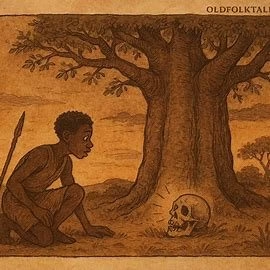
Every afternoon, after helping his family with their daily tasks, he hurried to the gathering place beneath a large tree. There, experienced practitioners demonstrated their skill to children and other interested villagers.
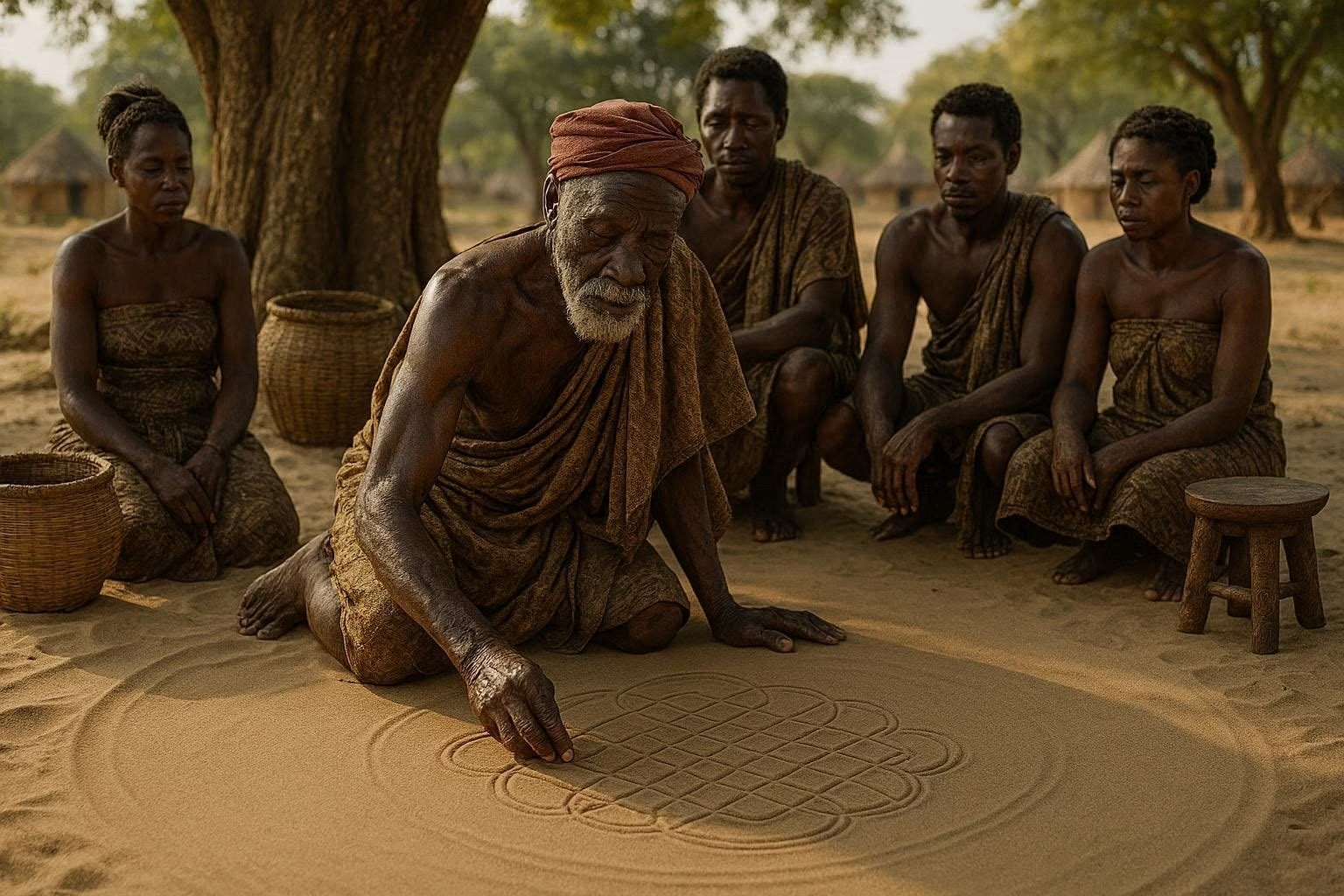
They prepared a smooth surface and marked a series of carefully spaced points. Using their fingertips, they traced lines around the points to create intricate geometric figures. Some designs were completed in a continuous movement, requiring the artist to plan each turn before beginning.
Mwepu watched closely.
One drawing reminded him of an animal moving through the bush. Another resembled a woven net, while a third formed an arrangement of lines that seemed almost impossible to follow. The designs varied in appearance, but each required concentration and an understanding of how the individual parts fitted together.
The boy tried to memorise every movement. He watched the practitioners’ fingers and studied the spaces between their lines, hoping to understand how they could produce such balanced patterns without constantly stopping to reconsider their work.
Yet observation alone did not answer all his questions.
One afternoon, Mwepu approached an elderly practitioner who had spent many years learning and teaching sona.
“Grandfather,” he asked, “how can a few lines in the sand carry so much meaning?”
The elder looked at him thoughtfully.
“A drawing may appear simple when you first see it,” he replied. “But understanding it requires you to look beyond its surface.”
Mwepu considered the answer. Until then, he had admired the designs mainly for their appearance. He had not thought deeply about their purpose or the knowledge they could communicate.
The elder invited him to sit beside the prepared ground.
He marked several points and began tracing a pattern around them. His finger moved carefully, following a route that connected the spaces into a balanced figure.
When he finished, he asked Mwepu what he had observed.
“I see a pattern,” the boy answered.
“What else do you see?”
Mwepu studied the drawing again. He noticed that the lines were not arranged randomly. Their positions followed a plan, and changing one part could alter the appearance of the entire design.
“The lines belong together,” he said.
The elder smiled.
“You are beginning to understand. A skilled practitioner must consider the whole design, not merely the next line.”
That afternoon, Mwepu discovered that learning sona required more than a good memory. It demanded observation, planning and patience.
He returned home determined to learn more.
Learning the Language of the Sand
From that day, Mwepu attended the lessons regularly.
The elders introduced him to different designs and explained how sona could accompany stories, proverbs, riddles and accounts of everyday life. Through these examples, he began to appreciate the relationship between a drawing and the knowledge it communicated.
Some patterns were associated with animals and their movements. Others helped illustrate situations involving people, relationships or choices. The drawing provided a visual structure through which a storyteller could communicate an idea to an audience.
Explore more stories from our Angolan Folktales Collections archive.
Mwepu discovered that a design could mean more than its outward appearance suggested. To understand it fully, a learner needed to know the story or idea associated with it.
The elders encouraged the children to observe carefully and ask questions when they did not understand something. They did not expect every learner to master the patterns immediately.
Mwepu’s first attempts were difficult.
He prepared the sand and marked his points, but his finger often wandered away from the intended route. Sometimes he turned too early, leaving the design unfinished. On other occasions, he concentrated so intensely on one section that he forgot how it connected with the rest.
Frustrated, he brushed away the drawing and tried again.
After several unsuccessful attempts, he wondered whether he would ever become skilled enough to create the patterns he admired.
His teacher noticed his disappointment.
“Why are you upset?” the elder asked.
“I know what the finished drawing should look like,” Mwepu replied, “but my hands cannot follow the path.”
The elder nodded.
“Knowing the destination is not the same as knowing the route. You must learn to follow each part without forgetting the whole.”
He demonstrated the design again, explaining how its points and lines related to one another. Rather than urging Mwepu to work faster, he encouraged him to examine the arrangement before beginning.
Mwepu followed this advice.
Before tracing a pattern, he studied the positions of the points and imagined how the lines would move across the surface. He began to recognise repeated arrangements and understand why certain turns were necessary.
His movements gradually became steadier.
Mistakes still occurred, but he no longer treated every unsuccessful attempt as a reason to abandon the lesson. Instead, he examined what had gone wrong and began again.
The elders explained that the same approach could help people solve problems beyond the drawing ground. Careful observation could reveal what haste concealed, while patience allowed a person to consider possibilities before making a decision.
Mwepu began to recognise that sona was not simply an art to admire. It was a practice through which learners could develop skills of observation, memory and reasoning.
The Visiting Master
One season, an experienced sona practitioner arrived from a neighbouring settlement. His reputation had spread because of the intricate designs he could create and the stories he knew how to communicate through them.
The village elders welcomed him, and children gathered eagerly for his demonstration.
The visitor prepared the ground and marked a series of points with great care. He studied their arrangement before beginning the drawing.
Then he moved his fingers across the sand.
His hand followed a deliberate route, tracing lines around the points until the figure emerged. The movement appeared smooth and confident, although Mwepu could see that every turn followed a carefully considered arrangement.
When the practitioner finished, the children leaned forward to examine the design.
Mwepu was astonished. He recognised some of the principles he had been learning, but the visitor had combined them in a way he had never attempted.
The visiting master invited the children to study the drawing before discussing it.
Some noticed the symmetry of the figure. Others examined the route taken by the line or compared the arrangement with patterns they had seen before.
When Mwepu offered his observations, the visitor listened and encouraged him to explain his reasoning.
The boy realised that learning did not end when a practitioner completed a design. Careful examination could reveal new details, even to someone who had watched the entire process.
The visitor explained that the finished pattern represented only part of the work. Before making the first mark, a skilled practitioner had to understand the arrangement and consider how the lines would connect.
Mwepu remembered those words.
He began paying greater attention to the planning that preceded each drawing. Rather than copying movements mechanically, he tried to understand why they worked.
This change improved his progress.
He became more confident when approaching unfamiliar designs and more willing to examine difficult sections instead of guessing. His teachers encouraged him to explain what he had learnt, helping him recognise the difference between repeating a movement and understanding its purpose.
As his knowledge grew, Mwepu also became more interested in the stories associated with the drawings. He listened as elders explained how sona could help communicate ideas and preserve knowledge through oral teaching.
He began to understand why the practice mattered to the community. A drawing could disappear when the sand was disturbed, but the knowledge it communicated could remain with the people who learnt and shared it.
A Lesson Beyond the Drawing Ground
Years passed, and Mwepu became an accomplished practitioner. Younger learners began gathering around him just as he had once gathered around the elders.
He taught them to prepare the sand carefully, arrange the points and consider the route of each line before beginning. When a student made a mistake, he encouraged the learner to examine the drawing and try again.
He also explained the importance of understanding the meaning associated with a pattern. A learner who copied a figure without understanding its purpose had acquired only part of the knowledge.
Mwepu believed that patience was essential to learning. He reminded his students that they did not need to master every design in a single afternoon. Each lesson offered an opportunity to improve their skills and understanding.
One dry season, a disagreement arose between two neighbouring farming families.
For many years, the families had cultivated separate plots near a shared path. The boundary between their land was marked by features that had become difficult to recognise as the seasons passed. After heavy rain altered part of the ground, each family claimed that the other had moved the boundary.
At first, the disagreement remained a private matter. Each household explained its position to relatives and neighbours, hoping to gain support.
Soon, however, the argument spread. People who had previously worked together began taking sides, and ordinary conversations became uncomfortable.
The village elders recognised that the dispute needed attention before it damaged relationships throughout the community.
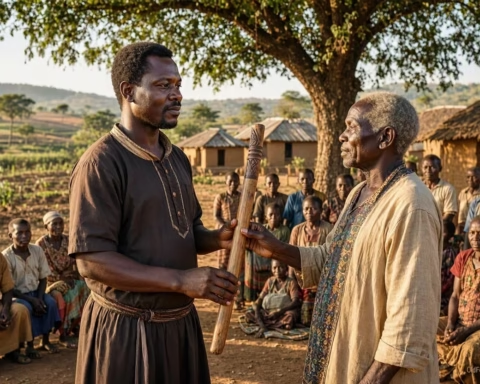
They invited both families to a meeting beneath the tree where Mwepu taught sona.
The farmers arrived prepared to defend their claims. Each believed that the other household was refusing to recognise what had always been understood.
The elders allowed both sides to explain their accounts, but the discussion soon became repetitive. Whenever one family described its recollection of the boundary, the other challenged the details.
Mwepu listened quietly.
He understood that the disagreement involved more than a strip of farmland. Each family feared losing something it believed belonged to it, and neither wanted its account dismissed.
After the elders had heard both sides, Mwepu asked permission to demonstrate a sona pattern.
He prepared a smooth patch of ground and marked a series of points. Then he traced a figure that required careful attention to the relationship between its different sections.
When the drawing was complete, he invited the families to examine it.
At first, they saw only a geometric pattern. Mwepu asked them to describe how its separate parts related to the whole.
They began pointing out the connections, noticing that no single section could be understood fully without considering the arrangement around it.
Mwepu then invited them to think about their own dispute. The families had concentrated on defending their individual claims, but their livelihoods and relationships were connected. A settlement that ignored the needs of one household could create further difficulties for the other.
The drawing did not reveal the true boundary of the farms, nor could it establish which family had the stronger claim. That question still required evidence and careful examination.
Instead, it helped the families recognise the need to listen to one another rather than repeat their accusations.
The elders resumed the discussion. They asked questions about the previous boundary, consulted people familiar with the land and considered the information each household had provided.
With the discussion calmer, the families were finally able to consider a practical settlement.
They agreed to establish a clear boundary that both could recognise and to preserve access to the shared path. The elders ensured that the arrangement addressed the concerns raised by both households.
The families accepted the agreement.
Their dispute did not vanish from memory, but the immediate tension eased. They returned to their farms with a clearer understanding of the arrangement and a willingness to maintain their relationship as neighbours.
The villagers appreciated Mwepu’s contribution. He had not used the drawing to decide who was right. Instead, he had used it to encourage the careful thought and cooperation needed to reach a fair settlement.
For Mwepu, the experience demonstrated that the lessons learnt through sona could be useful beyond the drawing ground.
Preserving Knowledge for Future Generations
As Mwepu grew older, he continued teaching the younger members of his community.
He explained the designs, shared the stories associated with them and encouraged learners to understand the principles behind their construction. He knew that preserving sona required more than remembering the appearance of its patterns. Learners also needed to understand the knowledge, stories and cultural meanings that gave the practice its significance.
The children sometimes asked why they should spend so much time learning drawings that could disappear with a gust of wind or a passing foot.
Mwepu reminded them that the sand was only the surface on which the knowledge was expressed. The drawing could be erased, but the lesson could remain in the memory of the person who learnt it.
He encouraged the children to share what they understood with others and to respect the knowledge passed to them by experienced practitioners.
Over time, the learners developed their own skills. Some became confident in constructing geometric figures, while others became interested in the stories and ideas communicated through them.
Each learner approached the practice differently, but all were encouraged to observe carefully and take their lessons seriously.
Beyond the village, researchers and educators also studied sona. They examined its geometric structures and explored how traditional sand drawings could contribute to discussions about mathematics, art and education.
These studies helped introduce the practice to wider audiences, but Mwepu understood that its importance could not be reduced to geometry alone. Sona also carried cultural knowledge and offered a way for people to express ideas, preserve collective memory and strengthen their connection with earlier generations.
Whenever he began a lesson, Mwepu remembered the first question he had asked his teacher.
He had wanted to know whether the drawings were simply beautiful.
Now he understood that their significance extended far beyond their appearance. Their lines could communicate stories, preserve knowledge and encourage people to examine relationships between different parts of a larger whole.
The drawings were temporary, but what people learnt from them could endure.
And so Mwepu continued teaching, ensuring that each new learner had an opportunity to discover the meaning behind the patterns.
Explore our complete Africa Folktales
Moral Lesson
Wisdom grows through patience, observation and a willingness to learn. Knowledge becomes more valuable when people preserve it, share it with others and apply its lessons thoughtfully to everyday challenges.
Knowledge Check
1. What is sona?
Answer: Sona is a tradition of creating geometric drawings in the sand, practised by the Lunda Cokwe and neighbouring peoples in eastern Angola.
2. Why was Mwepu fascinated by the drawings?
Answer: He admired the intricate patterns and wanted to understand how practitioners created them and what they communicated.
3. What did Mwepu learn from his early mistakes?
Answer: He learnt to plan carefully, observe the arrangement of the points and lines, and treat mistakes as opportunities to improve.
4. What did the visiting sona practitioner teach Mwepu?
Answer: He showed Mwepu the importance of understanding a design’s structure and planning the route before beginning to draw.
5. How did Mwepu help the farming families?
Answer: He used a sona drawing to encourage them to consider their relationships and listen to one another, helping the elders guide them towards a fair settlement.
6. Why is sona important to the communities that practise it?
Answer: It provides a means of artistic expression and helps communicate stories, preserve knowledge and collective memory, and pass cultural traditions to future generations.
Source
A contemporary adaptation inspired by the documented sona tradition of the Lunda Cokwe and neighbouring peoples in eastern Angola, as recognised by UNESCO’s Intangible Cultural Heritage programme in 2023.
Explore More on Algerian Folktales
- The Hidden Storehouse: An Angolan Folktale of Famine and Greed
- The Eagle and the Candimba: A Shocking Betrayal
- The Bangão Crocodile: A Fearless Fight for Justice
- Sudika-Mbambi: The Invincible Hero
- The River Spirit’s Three Questions
- The Cave of the Sleeping Ancestors
- The First Soba’s Staff