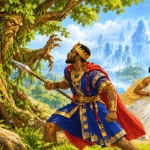
Mohamed ben Soltan is a prince whose journey begins with a warning from an old woman and leads him into a world of ogres, dangerous challenges and unexpected betrayal. Determined to find a young woman he has been told he will never marry, Mohamed leaves home and travels through unfamiliar places with a companion. Along the way, he encounters a mysterious ogress, a strange singing bird and a powerful ogre whose life depends on a hidden object. Even after overcoming these dangers, Mohamed discovers that the greatest threat to his future may come from his own family.
The Prince Who Terrified His City
A sultan had a son named Mohamed ben Soltan. Although he was a prince, his behaviour brought fear and suffering to the people living under his father’s rule.
Mohamed rode through the city on horseback, killing people as he went. The inhabitants could no longer endure his violence. They gathered together and considered how they might persuade him to leave their city so that they could live without constant fear.
They promised a large herd of animals to anyone who could accomplish this difficult task.
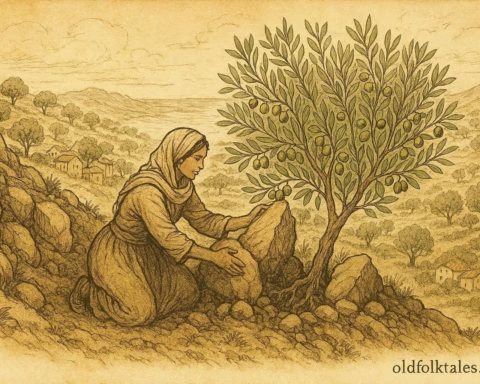
Among the inhabitants was an old woman who believed she could find a way to change the prince’s course. She gathered some small bladders and went to a fountain, where she intended to fill them using the cup of an acorn.
The task required care, and she needed space to work. While she was at the fountain, Mohamed arrived with his horse to give the animal water.
He ordered the old woman to move aside. She refused to leave, and the prince allowed his horse to pass over the bladders, crushing them.
The old woman was angry at the destruction of her belongings. She turned to the prince and spoke of a young woman named Thithbirth. If Mohamed had married her, she said, he would not have caused such damage. She then declared that he would never marry the young woman because many horsemen had already died because of her.
Her words struck the prince deeply. Rather than dismissing the warning, Mohamed took it as a challenge. He returned home, gathered provisions and set out to find the woman he had been told he could never marry.
A Companion and a Strange Encounter
During his journey, Mohamed met a man travelling along the same route. The two decided to continue together.
Their travels brought them to a disturbing sight. They encountered an ogress standing beside the body of her son. She explained that the sultan had hanged the young man and cut off his foot with a sword.
The travellers took one of the dead man’s rings and continued their journey.
When they reached a town, they offered the ring to the governor. The governor examined it and asked them to bring him another ring like it.
The request sent Mohamed and his companion back across the country they had already travelled. Their search took them along unfamiliar routes, and they eventually encountered a pilgrim who had travelled around the world.
The pilgrim had seen many places, but the travellers had not yet crossed the sea. They decided to make their way towards it.
When they reached the shore and attempted to embark, a whale blocked their passage. Unable to continue across the water, they turned back.
On their return journey, they encountered the ogress again. This time, they took the second ring from her dead son and resumed their travels.
The journey had become a succession of strange encounters, and Mohamed was still far from the woman he intended to find.
The Singing Bird and Its Deadly Warning
Eventually, the two travellers came upon a place where sixty dead bodies lay. A singing bird guarded them.
The travellers stopped and listened. The bird sang a warning that anyone who spoke there would be turned into stone and die.
Its song also spoke directly of Mohamed ben Soltan. It declared that he would never marry Thithlirth, the woman he sought, because ninety nine horsemen had already died because of her.
Mohamed remained silent until the following morning. He understood that speaking in such a place could bring the very fate the bird described.
When morning came, he and his companion continued towards the town where Thithlirth lived.
Explore more stories from our West African Folk-Tales collection.
By the time they arrived, hunger had begun to trouble them. Mohamed’s companion asked him to sing the words they had heard from the bird.
Mohamed repeated the song.
Thithlirth heard it and wanted to know where he had learnt it. The companion explained that they had heard the song from a bird in the countryside.
The young woman then demanded that Mohamed bring the bird to her. She threatened to have him killed if he failed.
Mohamed had already faced warnings, strange encounters and obstacles on his journey. Now he had to capture a creature whose song carried a dangerous message.
Capturing the Singing Bird
Mohamed took a lantern and a cage and carried them to the tree where the bird perched.
He placed the cage on a branch where the bird usually settled. The bird called out, questioning whether Mohamed truly believed he could capture it.
Mohamed did not abandon his plan. He waited.
The following day, the bird entered the cage, and Mohamed carried it away.
When the travellers appeared before Thithlirth, the bird announced that they had come to buy her. Her father then set a condition for Mohamed. If the prince could identify his daughter, she would belong to him. If he failed, he would be killed.
The challenge was not simple. Thithlirth resembled ninety nine other young women, making a total of one hundred women who looked alike.
Mohamed could not identify her by appearance alone.
Thithlirth gave him a clue. She would ride a lame horse.
When the women were presented, Mohamed watched carefully and recognised the one riding the lame horse. He had passed the test.
Her father kept his promise and gave Thithlirth to Mohamed. He also provided a female attendant, a slave and another woman.
At last, the prince had found the bride he had travelled so far to seek. The warning of the old woman had not prevented him from reaching his goal.
The Ogre Who Stole the Bride
Mohamed and his companion set out on the return journey with the women.
At a certain point, the two men separated. Mohamed kept Thithlirth and the slave for himself, while his companion took the other two women.
Mohamed continued into the desert. At one point, he left his wife and the slave behind temporarily while he went away.
During his absence, an ogre appeared and carried Thithlirth away.
When Mohamed returned and discovered that his wife was missing, he immediately went in search of her. His journey now had a different purpose. He was no longer trying to win a bride. He was trying to rescue the woman he had already married.
He came upon some shepherds and asked whether they could tell him where the ogre lived.
The shepherds directed him to the ogre’s dwelling. When Mohamed arrived, he saw Thithlirth.
Soon, the ogre appeared.
Mohamed needed to find a way to defeat the creature and recover his wife. Instead of relying on strength alone, he asked the ogre where his life was hidden.
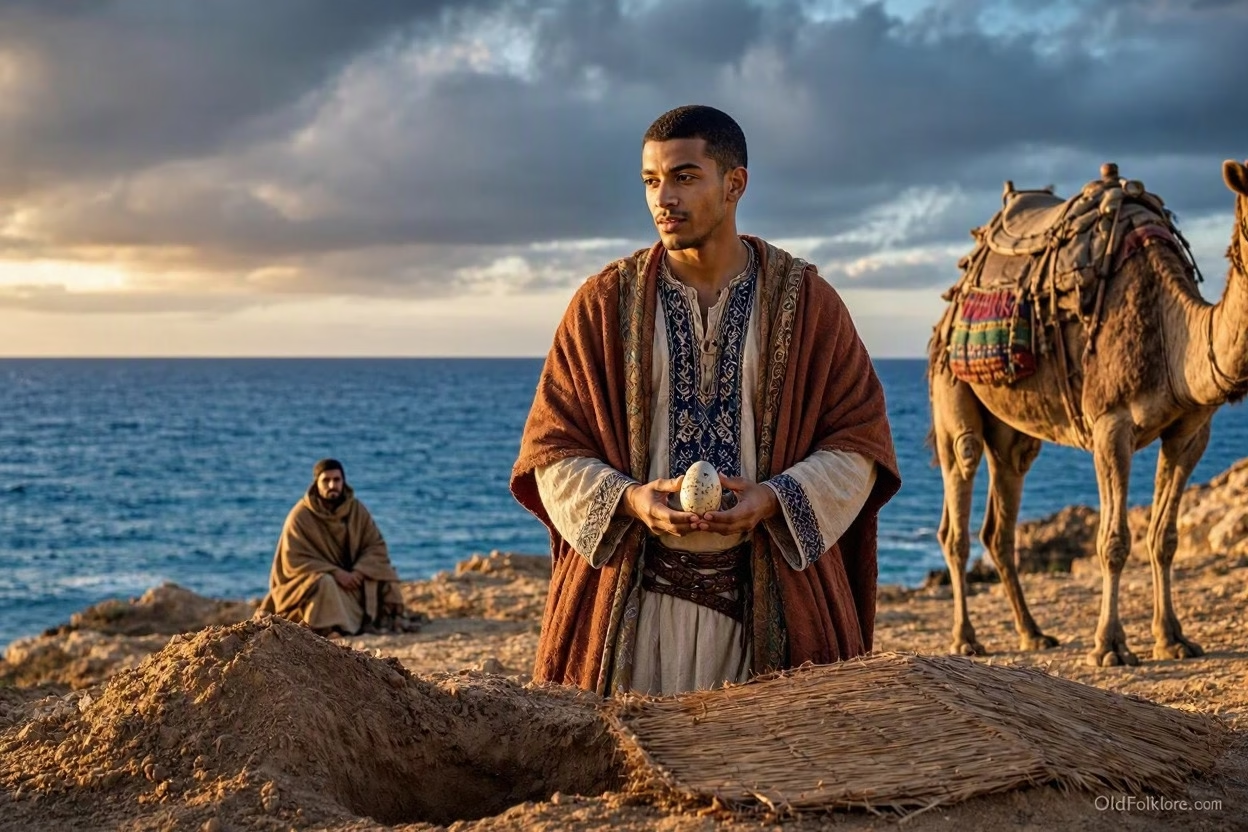
The ogre explained that his life was far away. It was contained in an egg, the egg was inside a pigeon, the pigeon was inside a camel, and the camel was in the sea.
The answer revealed a chain of concealment that seemed almost impossible to overcome. Mohamed would have to reach into the sea and find the creature containing the next part of the ogre’s secret before he could reach the egg itself.
The Secret of the Ogre’s Life
Mohamed went to the seashore and began digging a hole. He spread a mat over it and waited.
A camel emerged from the water and fell into the hole.
Mohamed opened the camel and retrieved the egg concealed within it. He then crushed the egg between his hands.
The ogre died.
By destroying the object in which the ogre’s life was hidden, Mohamed defeated the creature and freed Thithlirth from its control.
He took his wife and returned to the city of his father. There, he built himself a palace.
After the dangers of the journey, the prince had recovered his wife and established a home of his own. Yet his return did not bring lasting peace.
Betrayal in the Sultan’s Household
Mohamed’s father was a sultan, but the prince’s return created a new conflict.
The sultan had promised a herd of animals to anyone who would kill his son. When no one volunteered, he sent soldiers to surround Mohamed.
The sultan then approached one soldier privately and promised to make him rich if he killed the prince.
The soldier managed to get close to Mohamed. He blinded him and abandoned him in the countryside.
Mohamed was left without his sight, far from the protection of his palace. The danger he had faced on his travels had come from ogres and mysterious creatures. This time, the person responsible for his suffering was his own father.
As Mohamed struggled with his blindness, an eagle passed by and spoke to him. It told him not to do good to his parents, reminding him that his father had caused his suffering.
The eagle also offered a way for him to recover his sight. It instructed him to take bark from a nearby tree and apply it to his eyes.
Mohamed followed the instructions and was healed.
His recovery meant that he could see again, but it did not resolve the conflict between him and the sultan.
The story now reached its final and most disturbing confrontation.
The Final Confrontation
After Mohamed had regained his sight, his father announced that he intended to marry Thithlirth.
Mohamed told the sultan that he could not do so.
The sultan called upon religious authorities, seeking permission for the marriage. They refused to grant it.
The conflict between father and son could no longer be avoided. The sultan had attempted to have Mohamed killed, and now he wanted to take his son’s wife.
Mohamed killed his father.
He then celebrated his wedding for seven days and seven nights.
The tale ends with the prince having overcome the dangers that stood between him and his bride, including the ogre who had stolen her and the father who had turned against him.
His journey began with an old woman’s warning, but the warning did not determine the final course of his life. Mohamed continued despite the dangers, found the woman he sought and survived challenges that threatened to destroy him.
His story, however, does not offer a simple picture of good triumphing over evil. Mohamed’s determination brings him success, but the ending also reveals the terrible consequences of the struggle for power within his own family.
Explore our complete Algerian Folktales archive
Moral Lesson
Determination can help people overcome difficult challenges, but ambition and the desire for power can also lead to destructive choices. Mohamed ben Soltan’s journey shows that surviving external dangers does not guarantee peace when betrayal and conflict exist within a family.
Knowledge Check
1. Why did the inhabitants of the city want Mohamed ben Soltan to leave?
He rode through the city killing people, leaving the inhabitants afraid for their lives.
2. What warning did the old woman give Mohamed?
She told him that he would never marry Thithbirth because many horsemen had already died because of her.
3. How did Mohamed identify Thithlirth among one hundred similar looking women?
Thithlirth told him that she would ride a lame horse, allowing him to recognise her.
4. How did Mohamed defeat the ogre who stole his wife?
He discovered that the ogre’s life was hidden in an egg inside a pigeon, inside a camel in the sea. He retrieved and crushed the egg, causing the ogre to die.
5. How did Mohamed regain his sight after the soldier blinded him?
An eagle instructed him to apply bark from a nearby tree to his eyes, and he recovered his sight.
6. What happens at the end of the tale?
Mohamed kills his father after the sultan attempts to marry Thithlirth, then celebrates his wedding for seven days and seven nights.
Source
Adapted from “Moh’amed ben Soltan,” in Joseph Rivière’s Recueil de contes populaires de la Kabylie du Djurdjura, published by E. Leroux in Paris in 1882, beginning on page 187. The tale belongs to a collection of Kabyle oral traditions from Algeria.
Explore More Algerian Folktales
- The Cow of the Orphans: A Powerful Algerian Folktale
- The Seven Brothers: A Powerful Algerian Folktale
- The Orphan and His Cruel Uncle
- The Mule, the Jackal and the Lion
- Solomon and the House of Eggs
- The Lion and the Son of Woman