In a Mossi village in Burkina Faso, a family prepared to welcome a visiting relative. The children were pleased to see their aunt, who came to spend some time with them. Her visit appeared ordinary, but their mother knew that the woman possessed dangerous powers. She was a witch, and her intentions were not as loving as her family relationship suggested.
When the aunt eventually announced that she was returning home, the children’s mother became concerned. She did not want any of her children to accompany the woman, knowing that the journey could place them in danger. However, the aunt needed someone to go with her, and the mother decided to discover which child would be willing to make the journey.
She called the children one after another, using a familiar song that counted their intelligence from ten down to one. Each child was given the opportunity to answer whether they would accompany their aunt.
The Mother’s Song
The mother began with the eldest child.
“Yam-piga, ten intelligences, will you accompany your aunt?”
“I am Yam-piga, but I will not accompany my aunt,” the child answered.
She continued with the next child.
“Yam-wac, nine intelligences, will you accompany your aunt?”
“I am Yam-wac, but I will not accompany my aunt.”
One after another, the children responded in the same way. Yam-ni, Yam-yopoc, Yam-yumbe, Yam-nu, Yam-nase, Yam-tabo and Yam-yibu all refused to go with their aunt.
Explore more stories from our Burkinabe Folktales Collections archive.
Finally, the mother called the youngest child.
“Yam-yende, one intelligence, will you accompany your aunt?”
Unlike the others, Yam-yende agreed.
“I am Yam-yende, and I will accompany my aunt,” she replied.
The mother knew that the journey could be dangerous, but Yam-yende appeared willing to go. The aunt was also pleased to have someone accompany her. She gave the young girl a large basket to carry, and the two prepared to leave the village.
The First Transformation
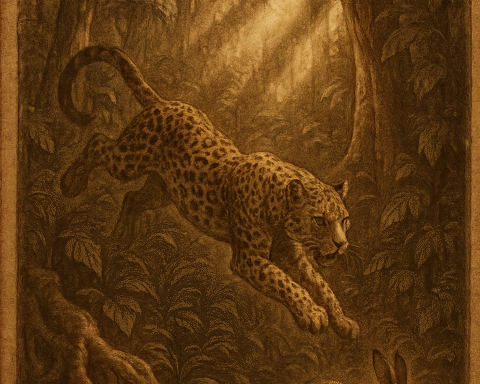
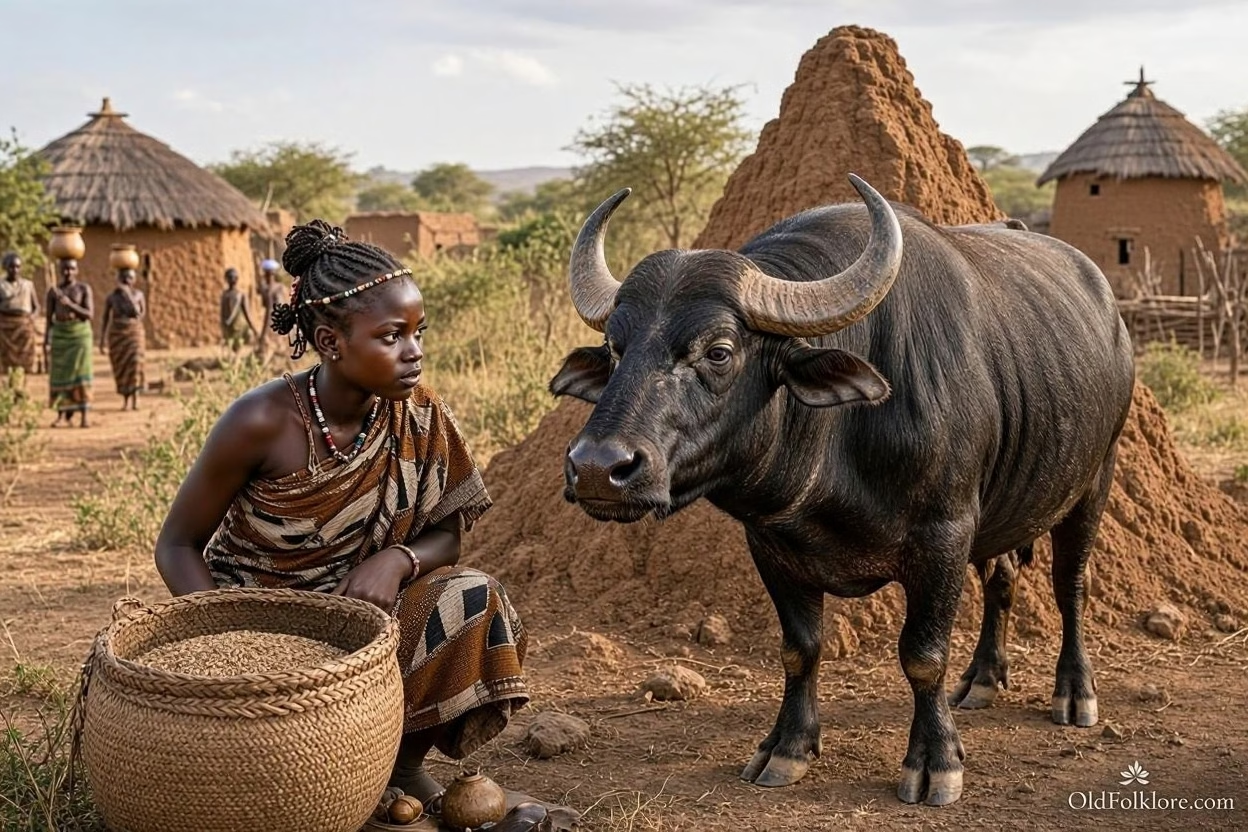
As they travelled along the path, the aunt noticed an anthill. She approached it and rolled herself inside. Through her witchcraft, she transformed into a huge buffalo.
The animal emerged with a frightening appearance. Its powerful body and sharp horns made it a dangerous creature. The aunt intended to use this form to attack Yam-yende and eat her.
However, the young girl was not easily frightened. She understood that the buffalo was not an ordinary animal and quickly used her own magical ability to escape.
Yam-yende transformed herself into a root beside the basket. She remained still, making it difficult for the buffalo to recognise her.
The aunt searched for the girl, moving around the basket and examining the ground. She expected to find Yam-yende nearby, but the transformation had concealed her successfully.
Unable to locate the child, the aunt eventually returned to her human form.
“Yam-yende, where have you gone?” she demanded.
The girl revealed herself and explained what had happened.
“When you changed into a buffalo to eat me, I became a root beside the basket.”
The aunt was surprised that the child had escaped her attack. She gave Yam-yende the basket again, and they continued their journey.
The Second Transformation
They had not travelled very far when the aunt noticed another anthill. She approached it and repeated her earlier action, rolling herself inside before transforming into a buffalo.
Once again, she intended to capture and devour the girl.
Yam-yende recognised the danger immediately. She knew that remaining in her previous form might not protect her a second time, so she chose another disguise.
This time, she transformed into a tiny fly and clung to the basket.
The buffalo searched for her, but the girl was no longer standing beside the basket as she had been before. The aunt searched the surrounding area, expecting to find the child in another hiding place.
After failing to discover her whereabouts, the aunt returned to her human form.
“Yam-yende, where did you go?” she asked angrily.
Yam-yende revealed that she had become a fly and hidden herself on the basket.
The aunt was frustrated by the girl’s ability to escape. Nevertheless, she had no choice but to continue the journey with her.
“Take the basket, and let us go on,” she said.
Yam-yende obeyed, and they resumed their journey.
The Third Transformation
After walking for some time, the aunt came across yet another anthill. She decided to make one more attempt to catch the girl.
She rolled inside the anthill and transformed into a buffalo for the third time. Her intention remained the same: she wanted to find Yam-yende and put an end to the girl’s repeated escapes.
But Yam-yende had already learnt that her aunt would continue using the same trick. Rather than becoming a root or a fly again, she chose a different form.
She transformed into a needle and concealed herself within the basket.
The aunt searched for the girl, but Yam-yende was difficult to discover. In her frustration, the aunt tore through the basket, hoping to expose the hiding place.
Even this attempt did not allow her to capture the child.
Once again, Yam-yende had escaped through her quick thinking. The aunt realised that she could not easily defeat the young girl, whose ability to change forms repeatedly frustrated her plans.
Yam-yende Returns Home
After three failed attempts, the aunt abandoned her efforts to capture Yam-yende. The young girl had proved that she could recognise danger and respond with intelligence.
The aunt finally allowed her to return home rather than continue the journey. Yam-yende went back to her family, having survived the dangerous journey through her cleverness and resourcefulness.
Her brothers and sisters were no longer the only children whose names were remembered. Yam-yende’s decision to accompany their aunt, despite the danger, became the central part of the tale.
The story celebrates a young girl who refused to surrender when faced with a powerful enemy. Although her aunt possessed frightening magical abilities, Yam-yende found ways to protect herself.
Her experience reminds listeners that intelligence is valuable in difficult situations. A person who observes danger carefully and thinks before acting may discover a way out even when the circumstances appear impossible.
Explore our complete Africa Folktales collection.
Moral of the Story
The story of Yam-yende teaches that intelligence, courage and resourcefulness can help people overcome difficult challenges. Yam-yende did not defeat her aunt through physical strength. Instead, she relied on quick thinking and her ability to adapt whenever danger appeared. Her repeated transformations demonstrate the importance of finding different solutions when one approach is no longer enough. The tale also reminds us not to underestimate children, because wisdom and cleverness are not determined by age or physical strength.
Knowledge Check
1. Who was Yam-yende?
Yam-yende was the youngest child in the family who agreed to accompany her aunt on the journey.
2. Why did the children’s mother become concerned when their aunt wanted to return home?
The mother knew that the aunt was a witch and feared that accompanying her could put one of the children in danger.
3. What happened when the aunt first entered an anthill?
She transformed into a large buffalo and attempted to capture Yam-yende.
4. What forms did Yam-yende take to escape her aunt?
She transformed into a root, a fly and finally a needle.
5. Why did the aunt fail to capture Yam-yende?
Yam-yende used her intelligence and ability to transform herself to avoid being discovered.
6. What is the main lesson of the folktale?
The story teaches that intelligence, courage and resourcefulness can help someone overcome danger.
Source
This folktale is associated with the Mossi oral tradition of Burkina Faso. A related narrative, “The Children and their Aunt,” appears as Story 19, page 47, in Alain-Joseph Sissao’s Folktales from the Moose of Burkina Faso, translated by Nina Tanti and published by African Books Collective in 2010.
Explore More Burkinabe Folktales
- Ouédraogo and the Origin of the Mossi Kingdom
- The Tale of the Singing Camel
- The Origin of the Mossi Kingdom’s Drum
- The Trickster Hare and the Sacred Baobab Tree
- The Beautiful Daughter and the Crocodile
- The Naba Zid-Wendé and the Creation of the World
- The Orphan Girl: How Intelligence Saved Seven Girls from Danger