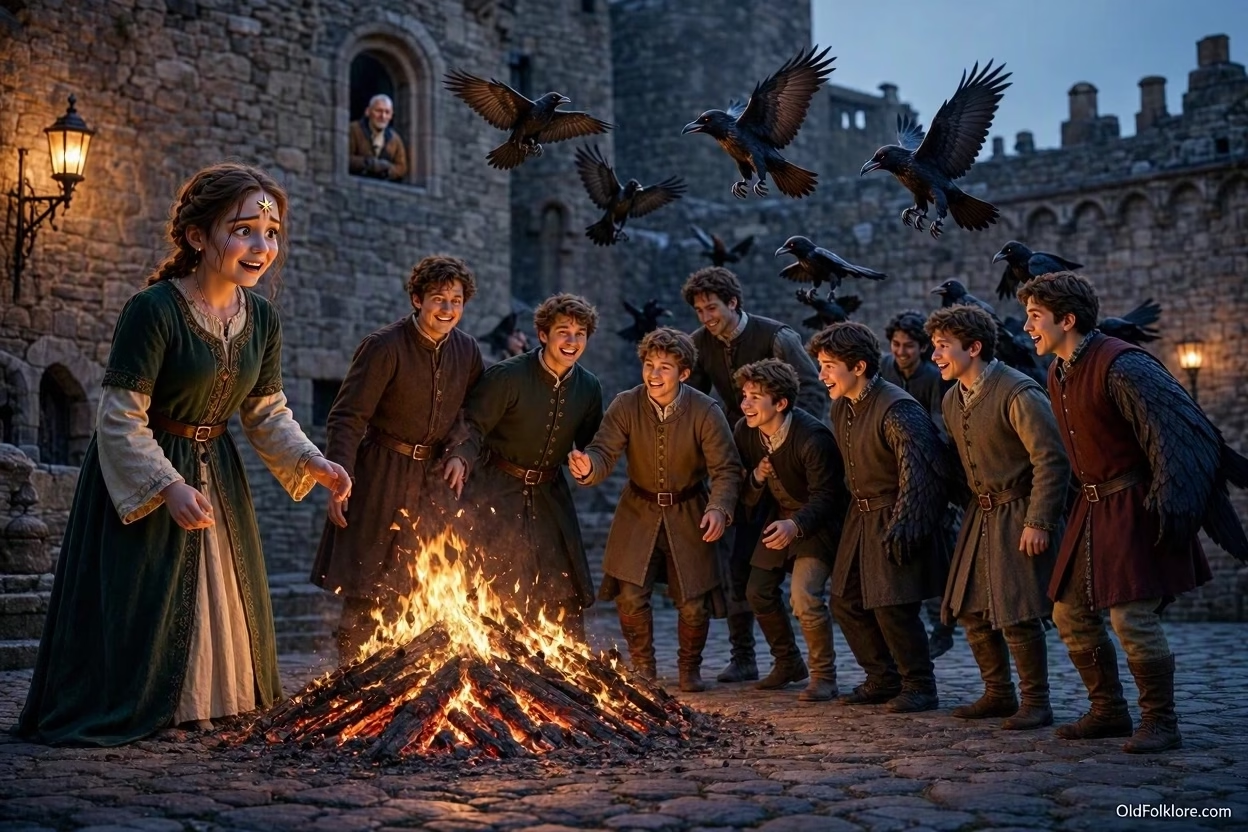
A king’s fear that his thirteenth child will be a daughter sets twelve brothers on a path of exile. When their little sister grows up, she leaves the palace to find them, unaware that her search will lead to another enchantment. After she accidentally transforms her brothers into ravens, she learns that only seven years of complete silence can save them. Her determination is tested when she becomes a queen and faces a false accusation that threatens her life just as the final moments of her trial approach.
The King’s Terrible Decision
Once upon a time, a king and queen lived happily together with their twelve sons. Their family seemed complete, but the queen was expecting another child. The king began to worry about what would happen if the baby were a girl.
He decided that if the queen gave birth to a daughter, his twelve sons would have to die. He wanted the kingdom and its possessions to pass to the girl alone, without being divided among her brothers.
To prepare for his terrible plan, the king ordered twelve coffins to be made. Each was filled with wood shavings and provided with a little pillow for the dead. He had the coffins placed in a locked room and gave the key to the queen, commanding her to tell no one what they contained.
The queen was horrified. She loved her sons and could not bear the thought of losing them. Day after day, she sat grieving over their fate, knowing that their lives depended on the sex of the child she was carrying.
Her youngest son, Benjamin, was especially close to her. He noticed her sadness and asked why she was so unhappy. At first, she refused to tell him, saying that she could not explain the cause of her sorrow. But Benjamin continued asking until she finally agreed to show him the secret room.
Explore more stories from our Brothers Grimm Tales collection.
When the queen unlocked the door, Benjamin saw the twelve coffins waiting inside. His mother explained that the king had prepared them for him and his eleven brothers. If she gave birth to a girl, all twelve boys would be killed and buried in those coffins.
Benjamin understood the danger immediately. Rather than surrender to despair, he comforted his mother and promised that the brothers would save themselves.
The White Flag and the Red Flag
The queen devised a plan to help her sons escape. She told them to leave the kingdom and hide in the forest, where they could watch the castle tower from the tallest tree they could find.
She would raise a white flag if the baby proved to be a boy. That signal would mean the brothers could return safely. If she raised a red flag, they would know that their new sibling was a girl and that their lives were in danger. They must then flee farther into the forest.
Before the boys departed, their mother blessed them and prayed for their protection. She hoped that in winter they would find warmth and that in summer they would be spared the worst of the heat.
The twelve brothers went into the forest and took turns watching from the highest oak. Each waited for news from the castle.
After eleven days, it was Benjamin’s turn to keep watch. He climbed the tree and looked towards the tower. There, to his horror, he saw a flag being raised. It was not white but blood-red.
The signal told him that his mother had given birth to a daughter.
Benjamin hurried to his brothers with the news. The boys were furious. They believed they were being condemned to death simply because their parents had welcomed a girl into the family. In their anger, they swore that they would take revenge on any girl they encountered.
They left the place where they had been watching the castle and went deeper into the forest, searching for somewhere to live beyond the reach of the king.
The Enchanted Hut
In the darkest part of the forest, the brothers discovered a small enchanted hut. It stood empty, and they decided to make it their home.
They agreed that Benjamin, the youngest and weakest of them, would remain at the hut to keep house while the other eleven went out to find food. The older brothers hunted hares, wild deer, birds and pigeons, bringing their catch back for Benjamin to prepare.
They lived this way for ten years. The brothers grew accustomed to their forest home, and time passed without seeming especially long.
Meanwhile, their little sister was growing up in the palace. She was kind-hearted and beautiful, with a golden star on her forehead.
One day, while the queen was doing a great washing, the princess noticed twelve men’s shirts among the clothes. They were too small to belong to her father, so she asked her mother who had worn them.
The queen’s heart filled with sorrow. She told her daughter that the shirts belonged to her twelve brothers, who had gone away and were wandering somewhere in the world.
The princess had never heard about them before. She asked where they were, but her mother could only say that God knew their whereabouts.
At last, the queen showed her daughter the locked chamber containing the twelve coffins. She explained the king’s plan and told her how the brothers had escaped before their sister was born.
The princess was deeply moved. Rather than accept that her brothers might remain lost for ever, she decided to search for them herself.
The Sister Finds Her Brothers
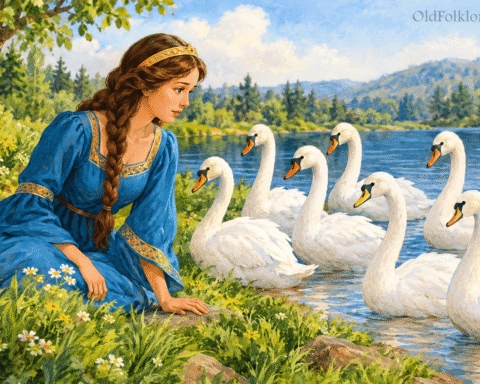
The princess took the twelve shirts and set out towards the great forest. She walked throughout the day and continued until evening, when she finally reached the enchanted hut.
Inside, she found a young man who was astonished to see a beautiful girl dressed in royal clothes, with a golden star on her forehead.
He asked where she had come from and where she was going.
The princess explained that she was the daughter of a king and was searching for her twelve brothers. She intended to continue travelling for as long as necessary, until she found them. Then she showed him the twelve shirts she had brought.
Benjamin immediately recognised her. He was the youngest of the brothers, and the girl standing before him was their long-lost sister.
The two embraced and wept with happiness at finding one another. After ten years apart, they had finally been reunited.
But Benjamin remembered a serious problem. He explained that he and his brothers had sworn to kill any girl they met because they blamed a girl for their exile. His sister was in danger if the others discovered her.
The princess answered that she would willingly die if her death could deliver her twelve brothers. Benjamin, however, did not want to harm her. He told her to hide beneath a large tub until the other brothers returned from hunting, promising that he would find a way to persuade them to spare her.
That evening, the eleven brothers came home and sat down to eat. They asked Benjamin what news he had, not realising that he knew something they did not.
Benjamin challenged them to promise that the first girl they encountered would not be killed. The brothers agreed, eager to hear what he had to tell them.
He then lifted the tub and revealed their sister.
The brothers were delighted. They embraced and kissed her, welcoming her with all their hearts. The promise Benjamin had secured protected her from the oath they had made in anger.
A Happy Life in the Forest
The princess stayed at the hut with Benjamin and helped him with the daily work. While the eleven brothers went out to hunt, she and Benjamin prepared the food and kept the house in order.
She collected wood for the fire, gathered herbs for vegetables and made sure that dinner was ready when the brothers returned. She also cleaned the hut and spread fresh, white coverings on their little beds.
The brothers were pleased with their sister’s care, and the family lived together in harmony. For the first time since their flight from the kingdom, the brothers had a home filled with affection and comfort.
One day, the family prepared a special meal. Everyone gathered together, and they ate and drank happily.
Near the enchanted hut stood a little garden containing twelve white lily flowers, which were also called students. The princess wanted to please her brothers, so she decided to pick the flowers and give one to each of them during the meal.
As soon as she plucked the twelve flowers, a terrible change took place.
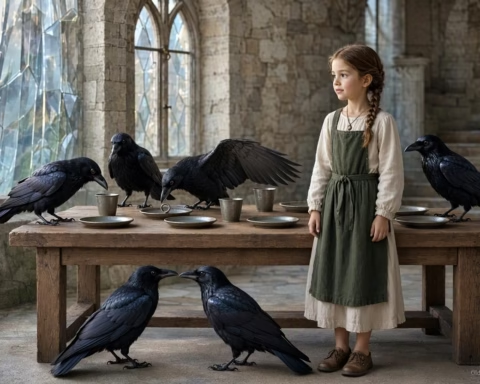
Her twelve brothers were transformed into ravens. They rose into the air and flew away over the forest. At the same moment, the enchanted hut and its garden vanished.
The princess was left alone in the wilderness, unable to understand how her loving family had disappeared so suddenly.
The Seven Years of Silence
As the princess stood weeping, an old woman appeared nearby. She asked what the girl had done and explained that the twelve white flowers had been her brothers. By plucking them, the princess had caused them to be changed into ravens for evermore.
The princess was devastated. She begged to know whether there was any way to deliver her brothers from the enchantment.
The old woman told her that only one way existed, and it would be extraordinarily difficult. The princess must remain completely silent for seven years. She must not speak or laugh, not even a single word. If she broke her silence when only an hour of the seven years remained, all her efforts would fail, and her brothers would be killed.
The princess accepted the challenge without hesitation. She believed she could save her brothers and was determined to endure whatever the task demanded.
She climbed a tall tree, sat among its branches and began to spin. She neither spoke nor laughed, holding firmly to her purpose.
Some time later, a king went hunting in the forest. His great greyhound ran towards the tree, barking and whining at the young woman sitting above.
The king followed the dog and looked up. He saw the beautiful princess, with her golden star shining on her forehead, and was captivated by her appearance. He called to her and asked whether she would marry him.
The princess could not answer because of her vow. She merely nodded her head.
The king climbed the tree, brought her down and placed her on his horse. He carried her home, where their wedding was celebrated with great splendour and rejoicing.
Although she had become a queen, she did not speak or smile. Her husband loved her, but her silence soon became a source of suspicion for others.
The Queen Is Falsely Accused
The king’s mother was a wicked woman. She began to speak against the young queen, accusing her of being a common beggar girl rather than a true princess. She suggested that the queen’s silence concealed a guilty secret.
At first, the king refused to believe these accusations. He knew that he loved his wife and had seen no reason to suspect her. But his mother continued to slander the queen, repeating her claims until he began to doubt the woman he had married.
The king’s mother argued that the queen’s inability to speak did not prevent her from laughing. If she never laughed, the older woman insisted, it must mean that she had a guilty conscience.
Eventually, the king allowed himself to be persuaded. He sentenced his wife to death.
A great fire was prepared in the courtyard, and the queen was bound to a stake. The king stood at a window above, watching with tears in his eyes. Although he believed the accusations against her, he still loved her and grieved over what was about to happen.
The flames began to rise around the queen. Her seven years of silence were almost complete, but she had not spoken a word or laughed once.
At that final moment, the last hour of the seven years expired.
The Brothers Return
As the flames threatened the queen, a whirring sound came from the air. Twelve ravens flew towards the place where she was bound.
They descended and touched the ground, and at once they became the queen’s twelve brothers.
The brothers rushed to the fire. They tore it apart and extinguished the flames, freeing their sister from the stake. Then they embraced and kissed her, rejoicing that she had completed the difficult task that had broken their enchantment.
The queen was finally able to speak. She explained to her husband why she had remained silent and why she had never laughed. Her silence had not been a sign of guilt; it had been the sacrifice required to save her brothers.
The king was overjoyed to learn that his wife was innocent. He welcomed her explanation and rejoiced that her brothers had returned.
The family was reunited, and the king and queen lived in harmony with the twelve brothers until the end of their lives.
The wicked stepmother was brought before a judge. Her punishment was severe: she was placed in a barrel filled with boiling oil and venomous snakes, where she died an evil death.
The tale ends with the princess’s long trial finally over. She has saved her brothers, endured the danger of a false accusation and proved that her silence was an act of love rather than a sign of wrongdoing.
Explore our complete Historic Folklore & Fairy-Tale Collections archive.
Moral Lesson
The story highlights the power of loyalty, courage and perseverance. The princess risks her safety to find her brothers and accepts seven years of silence to save them from an enchantment. Her determination continues even when she is falsely accused and faces death. The tale also warns against jealousy and malicious accusations, which can destroy trust and place innocent people in danger.
Knowledge Check
1. Why did the king order twelve coffins to be made?
He planned to kill his twelve sons if his thirteenth child was a girl, so that the kingdom and its possessions would pass to her alone.
2. How did the brothers learn that their new sibling was a girl?
Their mother arranged to raise a white flag if the baby was a boy and a red flag if the baby was a girl. Benjamin saw the red flag from his lookout in the forest.
3. How did the princess find her brothers?
She took their twelve shirts and travelled into the forest, where she eventually reached the enchanted hut and met Benjamin.
4. What caused the brothers to turn into ravens?
Their sister plucked twelve white lily flowers from the garden beside the enchanted hut, and the brothers were transformed into ravens.
5. What did the princess have to do to break the enchantment?
She had to remain completely silent and never laugh for seven years.
6. How were the brothers finally restored to human form?
They returned as ravens when the queen’s seven-year silence ended. They landed beside the fire, became human again and rescued their sister.
Source
“The Twelve Brothers” is tale number 9 in Household Tales by Jacob and Wilhelm Grimm, translated into English by Margaret Hunt and published in 1884. The story is also known by its German title, Die zwölf Brüder, and is commonly identified as Grimm tale KHM 9.
Explore More Brothers Grimm Tales
- Thumbling: A Grimm Fairy Tale
- The Wedding of Mrs Fox: Grimm Fairy Tale
- The Elves: A Grimm Fairy Tale
- The Robber Bridegroom’s Terrifying Secret
- Herr Korbes: A Strange and Deadly Grimm Tale
- The Seven Ravens: A Brothers Grimm Tale
- Hansel and Gretel: A Grimm Fairy Tale
- The Goose-Girl: A Grimm Fairy Tale