Many traditional animal tales use familiar creatures and everyday experiences to explain unusual features of the natural world. In these stories, animals may speak, bargain, demand compensation and respond to one another in ways that resemble human society. Why the Head of the Male Goat Smells So Strong is one such tale recorded in the Ikom district of Southern Nigeria. It follows a male goat whose belongings repeatedly pass into the possession of other creatures and people. Each time something belonging to him is taken, he insists on receiving compensation. His determination leads him through several communities until an unusual encounter with a dead body provides the traditional explanation for the strong smell associated with the head of a male goat.
The Goat and the Destroyed Mushrooms
Long ago, there lived a male goat who decided to grow mushrooms for his food. To prepare a suitable place, he cut down a large cotton tree and burnt it. After the tree had completely died, mushrooms began to grow on its trunk.
The goat was pleased when he saw them. The mushrooms were considered good food when prepared with palm oil, and he looked forward to gathering them for his meal. He had gone to the trouble of cutting down and burning the tree, so he regarded the mushrooms as something he had worked to produce.
Unfortunately, before he could collect them, an elephant came to the tree. The elephant rooted around the trunk and destroyed all the mushrooms. When the goat arrived and saw what had happened, he became very angry.
He went to the elephant and explained that he had cut down and burnt the cotton tree specifically to provide a place for mushrooms to grow. Since the elephant had destroyed the crop he intended to eat, the goat demanded compensation. He asked for fish or meat so that he could prepare soup.
The elephant replied that he did not particularly care for fish or meat and had none to give. Instead, he offered the goat some beans. Although this was not the compensation he had requested, the goat accepted the beans. He took them home, placed them inside a calabash on the floor and considered the matter settled.
The Rat Takes the Beans
During the night, while the goat was asleep, a rat entered his house. It discovered the beans in the calabash and ate them all.
When morning came, the goat noticed that the beans had disappeared. He suspected that the rat was responsible and demanded that it pay for what it had taken.
The rat did not deny the matter or refuse to compensate him. Instead, it agreed to give the goat one of its young ones. The goat accepted the young rat as payment and carried it home.
Explore more stories from our Ikom Folk Stories collection.
He placed the little creature on the ground just outside his house. Having received it as compensation, he expected to keep it. He sat down nearby and watched it.
Before long, a hungry hen came along. She noticed the young rat and swallowed it. The goat had now lost the compensation he had received from the rat, and he immediately demanded payment from the hen.
The hen gave him one of her chickens to settle the matter. The goat accepted the young chicken and allowed it to move about freely.
The Hawk Carries Away the Chicken
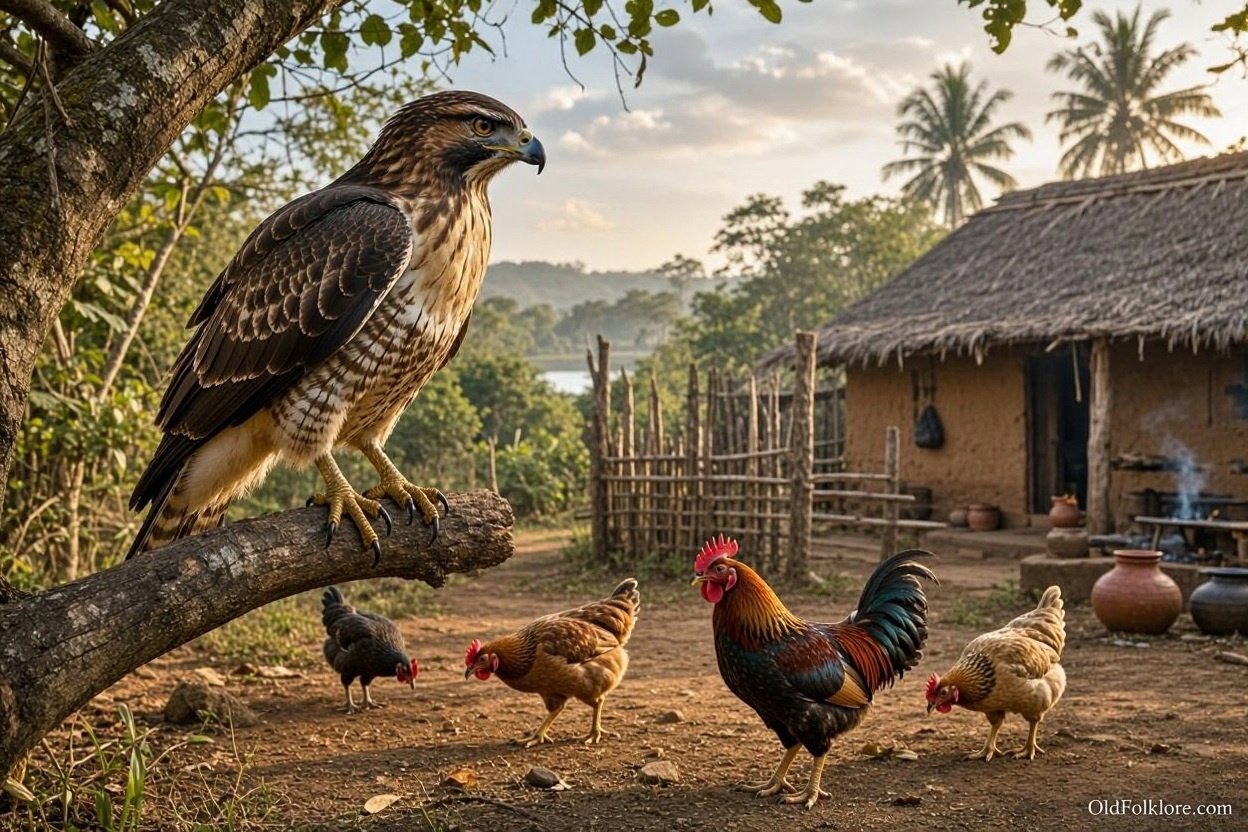
After receiving the chicken, the goat went out to find food for himself. While he was away, a hawk hovering nearby noticed the little bird.
The hawk swooped down, seized the chicken and carried it away. When the goat returned, he could no longer find the chicken he had received from the hen.
A sheep that had witnessed what happened told him that the hawk had taken it. The goat was once again faced with the loss of something that had been given to him as compensation. He decided that the hawk must also pay.
The following morning, he went to the hawk and demanded compensation for the chicken.
The hawk had nothing else to give him, so he removed one of the feathers from his wing and offered it instead. He explained that such feathers were valued by young men who enjoyed dancing and by fighting-men who wore them in their hair as decorations during public celebrations.
The goat was not particularly pleased with this arrangement. He had originally wanted food or something of greater value, but the hawk had no other payment to offer. Seeing no way to obtain anything else, the goat pretended to be satisfied and took the feather home.
The Feather at Inde
The next day, the goat heard that a great celebration was taking place at Inde. Young men who had returned from fighting were gathered there, and people were dancing.
Remembering what the hawk had said about the value of his feather, the goat decided to take it to the gathering. Perhaps someone who wanted to wear it would take possession of it, allowing him to demand another payment.
When he arrived at Inde, he placed the feather on the ground in a position where people could easily see it. He then walked around the town, eating some freshly fallen leaves from a ju-ju tree.
After some time, he returned to the place where the people were dancing. As he had expected, the feather was no longer where he had left it.
He looked among the people and soon discovered it. One of the fighting-men had taken the feather and placed it in his hair as a decoration.
The goat approached the man and explained that the feather belonged to him. He demanded payment for it.
The man accepted that the goat was entitled to compensation. He took the goat to his house and gave him a yam in satisfaction of his claim.
The Yam and the Farmer
The goat now possessed a yam instead of the feather. The following day, he travelled inland for a day’s journey from the river.
In the place he reached, the people grew koko yams, which the tale describes as inferior to the larger yams familiar in the goat’s country. The goat questioned why they cultivated such yams when better ones were available.
He showed them the large yam he had received from the fighting-man at Inde. He explained that in his own country people planted proper yams, while koko yams were used mainly during the hungry season when food was scarce.
After showing the yam to the people, the goat placed it on the ground. He then pretended to leave as though he had forgotten it. However, he did not go far away. He remained close enough to watch what would happen.
Before long, the owner of a nearby farm noticed the yam. Interested in growing the larger variety, the farmer picked it up, cut it and planted it in the ground.
When the farmer had finished, the goat approached him and asked where his yam was. The farmer explained that he had thought the goat had forgotten it, so he had planted it. Nevertheless, he was willing to pay for taking it.
The farmer called one of his wives and instructed her to bring a ball of camwood. He gave it to the goat as compensation for the yam.
The goat accepted the camwood and continued his journey.
The Camwood and the Marriage Preparation
The next day, the goat travelled into another country. According to the tale, the people there did not use camwood as part of their marriage ceremony.
The goat went from house to house looking for a girl who had recently undergone circumcision and was preparing to marry.
Eventually, he found a girl whose family was making arrangements for her marriage. He entered the house and asked the woman whether she was going to be married. She answered that she was.
The goat then questioned why she had not been rubbed with camwood. He showed her the ball he had received from the farmer and explained that, in his country, a woman could not be properly prepared for marriage without being rubbed all over with it.
The girl replied that no such custom existed in her country.
The goat left the camwood in the house and went away for a short time. When he returned, he discovered that the girl’s parents had taken it and rubbed their daughter all over with it.
Once again, something belonging to him had been used by other people. The goat demanded compensation for the camwood.
The girl’s mother gave him a sleeping-mat. The goat accepted it and prepared to continue his journey with his new possession.
The Sleeping-Mat and the Dead Slave
In the morning, the goat travelled to the next town carrying the sleeping-mat. He went to the chief’s house, where he received some food. Afterwards, he spread his mat on the ground and lay down to sleep.
The following day, one of the chief’s slaves died. When the people prepared to bury the body, the goat noticed that they were wrapping it in plantain leaves.
He told them that in his country dead people were wrapped in sleeping-mats before burial. Having made this observation, he went out for a walk.
When he returned, he discovered that his sleeping-mat had been taken. As he had expected, the people had used it to wrap the dead slave’s body.
The goat went to the chief and demanded payment for his mat.
The chief refused to take responsibility for the matter. He explained that the goat himself had said sleeping-mats were the proper way to wrap dead people. Therefore, the people had used his mat for the burial. If he wanted compensation, he should go and settle the matter with the dead body.
The goat followed this instruction. He approached the corpse and demanded that it return his sleeping-mat or pay him for it.
The dead body did not answer.
The Goat’s Final Revenge
The next day, the goat returned to the corpse and repeated his demand. Once again, there was no reply.
On the third day, he approached the dead body for the same reason. The corpse remained silent, and the goat became extremely angry.
He could no longer tolerate being directed from one person to another without receiving payment. The chief had told him to obtain compensation from the dead slave, but the body had refused to respond to his demands.
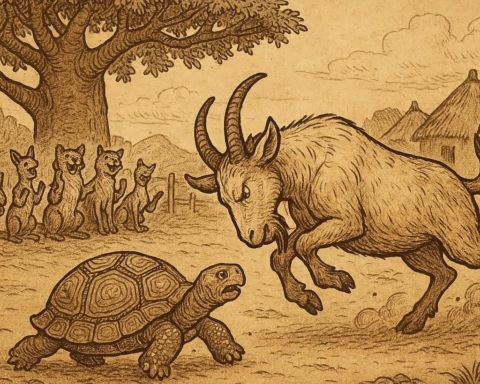
In his anger, the goat charged at the corpse and butted it repeatedly with his horns.
By this time, the body had become badly decomposed. As the goat struck it, the corpse was torn, and foul-smelling blood covered the goat’s head.
After taking his revenge, the goat returned to the town. The people noticed the terrible smell coming from him and told him that he smelled strongly of dead bodies.
The goat explained what had happened. He said that in every other town he had visited, people had paid him whenever something belonging to him was taken. In this town, however, the chief had sent him to demand payment from the dead slave. Since the corpse had refused to pay, he had attacked it with his horns.
He explained that the unpleasant smell had remained on his head.
The tale concludes that ever since that incident, the head of the male goat has had a strong smell.
Explore our complete Historic Folklore & Fairy-Tale Collections archive.
Moral Lessons
The story illustrates the consequences of taking what belongs to another person without permission. Throughout his journey, the goat insists that anyone who takes his property must provide compensation. The elephant, rat, hen, hawk, fighting-man, farmer and family preparing the girl for marriage all become part of this chain of exchanges.
It also highlights the importance of taking responsibility for one’s actions. Each character who takes something belonging to the goat is expected to settle the matter, even when the form of compensation differs from what he originally requested.
The goat’s determination is another important feature of the tale. He does not easily abandon his claims, but his final encounter with the corpse shows that insisting on payment without considering the circumstances can lead to an unpleasant outcome.
Finally, the story demonstrates how traditional animal tales use humour and imaginative explanations to make familiar features of the natural world memorable. Its explanation of the male goat’s smell belongs to the folklore recorded in the story rather than to a scientific account of animal odour.
Knowledge Check
1. What did the male goat do to prepare a place for mushrooms to grow?
He cut down a large cotton tree and burnt it.
2. Which animal destroyed the mushrooms growing on the tree?
An elephant rooted them up.
3. What did the rat give the goat as compensation for eating his beans?
The rat gave him one of its young ones.
4. What did the hawk give the goat after carrying away the chicken?
The hawk gave him one of its feathers.
5. What did the girl’s mother give the goat in exchange for the camwood?
She gave him a sleeping-mat.
6. What caused the strong smell on the male goat’s head?
The goat repeatedly butted a decomposing corpse, and foul-smelling blood covered his head.
Source
Adapted from “Why the Head of the Male Goat Smells so Strong”, Chapter XXI, pages 56–58, in Ikom Folk Stories from Southern Nigeria, collected and recorded by Elphinstone Dayrell and published in 1913.
Explore More Ikom Folk Stories
- The Partridge, Monkey, and Elephant
- Igiri and the Mushroom Baby
- How the Spider and Grasshopper Fell Out
- The Greedy Hare and the Tortoise’s Broken Shell
- Chief Alankor and the Giant Frog
- The Twin Child Saved by a Hawk
- Ewa Abagi and the Betrayal at the Cross River
- The Elephant, Hawk and Crab at the Birth of the River