When the eldest lady was called upon to explain her strange circumstances, she began by pointing to the two black dogs beside her.
“These two animals,” she told her listeners, “were once my eldest sisters. The other two women, one bearing marks of stripes upon her body and the other who serves as our attendant, are my sisters by another mother.”
She then began her story.
Her father had died first, leaving his daughters their respective shares of the family inheritance. After their mother’s death, the three daughters who shared the same mother received another inheritance of three thousand dinars. Each received one thousand dinars, including the youngest daughter, who would eventually become the narrator of this remarkable tale.
Her two elder sisters married and travelled with their husbands, who intended to make their fortunes through trade. They did not invite their younger sister to accompany them, leaving her behind as they departed.
Five years passed before either sister returned. Their husbands had squandered their fortunes, become bankrupt and abandoned them in distant lands. The eldest sister eventually came home dressed in rags, looking so miserable that her younger sister scarcely recognised her.
When she finally realised who the unfortunate woman was, she welcomed her warmly.
Explore more stories from our The Arabian Nights collection.
She arranged for her to bathe, provided her with fresh clothes and prepared food and drink for her. She also reassured her that she would never have to worry about money again.
Although the youngest sister had inherited only the same amount as the others, she had prospered through her work spinning and cleaning silk. She had accumulated considerable wealth and was happy to share it with her elder sister.
She reminded her that she was the eldest and had once occupied the place of their father and mother. There was no reason for her to feel ashamed or consider herself a burden.
Her sister remained with her for a year, and throughout that time they frequently thought about their other sister, wondering what had become of her.
Before long, the second sister also returned, in an even more miserable condition than the first. The youngest received her with the same generosity, giving her clothing, food, shelter and a share of her wealth.
For a while, the three sisters lived together peacefully.
Eventually, however, the two elder sisters announced that they wished to marry again. They could no longer bear the thought of living without husbands.
Their younger sister advised them against the idea. They had already experienced the difficulties of marriage, and she feared they would encounter the same misfortune again. Nevertheless, they refused to listen.
They married without her approval, although she still provided them with dowries and everything necessary for their new households.
Her fears soon proved justified. Their husbands deceived them, took whatever money and possessions they could find, and abandoned them once more.
Ashamed and desperate, the sisters returned to their younger sibling and begged her forgiveness. They admitted that although she was younger in age, she possessed greater wisdom. They promised never to marry again and asked to remain with her as dependants.
The youngest sister welcomed them without resentment. She increased her kindness towards them, and the three continued living together for another year.
The voyage to the mysterious city
After some time, the youngest sister decided to travel abroad to sell her merchandise. She purchased a large ship, loaded it with valuable goods and provisions, and prepared for a voyage towards Basra.
Before departing, she divided her money into two portions. One portion would accompany her, while the other she entrusted to a reliable person for safekeeping. She reasoned that if an accident befell the ship but they survived, they would still have something to return to.
She then asked her sisters whether they wished to remain at home or accompany her.
They chose to travel with her, unwilling to be separated from their benefactor.
The ship sailed for several days and nights. Unfortunately, the captain was careless and lost his way, taking them into unfamiliar waters.
For ten days, the wind carried them forward until the lookout spotted what appeared to be a distant city. The travellers rejoiced at the sight, but the captain admitted that he had never sailed those waters before and did not recognise the place.
They decided to enter the harbour and explore the city.
When they landed, the captain returned from his visit to the town with an unusual warning. He urged them to go and witness the extraordinary sight for themselves, while praying that they would be spared the wrath of Allah.
At the city gates, they discovered something terrifying. Men stood holding staffs, but as the travellers approached, they realised that the figures had been turned into black stones.
They entered the streets and found the same thing everywhere. The entire population had been transformed into stone. There were no living inhabitants, no fires burning in the houses and no signs of ordinary human activity.
Yet the markets remained filled with merchandise, gold, silver and valuable possessions. Everything had been left exactly where it was.
The travellers scattered throughout the streets, gathering whatever wealth they could find.
The youngest sister, however, continued towards the royal palace.
There she discovered a magnificent building filled with gold and silver vessels. In the great hall, she found the king seated upon an elaborate throne, surrounded by his officials and fifty armed guards. Their clothing was richly decorated, and their weapons remained in their hands.
But every one of them had become a black stone.
She continued through the palace until she reached the women’s apartments. There she found the queen lying among beautiful carpets and expensive ornaments. Her crown, necklaces and clothing remained splendid, but she too had been transformed into stone.
Beyond the apartments, the young woman discovered another chamber. It was decorated with marble, precious stones and magnificent carpets. At its centre stood a throne, while a large jewel, shining like the sun, illuminated an alcove.
Candles burned nearby, suggesting that someone might still be alive.
She explored the kitchens, storerooms and treasure chambers, but found no living soul. As evening approached, she became so absorbed in the palace that she lost her way.
Eventually, she returned to the illuminated chamber, settled upon a couch and attempted to sleep.
The prince who survived
Around midnight, she heard someone reciting the Koran in a beautiful but faint voice.
Delighted to discover that another living person might be present, she followed the sound until she reached a small prayer room.
Inside sat a handsome young man. A copy of the Koran rested before him, and he was reading from it by the light of two candles.
The young woman was astonished. He appeared to be the only living person in the entire city.
She greeted him, and he returned her greeting.
After exchanging words, she explained how she had arrived in the city and asked him to reveal what had happened to its inhabitants.
The young man listened carefully before agreeing to tell her his story.
He explained that the city had once belonged to his father, the king whose petrified body she had seen in the palace. The woman she had found in the royal apartments was his mother.
His parents and the people of the kingdom had worshipped fire instead of Allah. His father had ruled over them for many years without having a son until the young prince was born towards the end of his reign.
Among the people of the palace was an elderly woman who secretly followed Islam, although she outwardly practised the religion of the royal household. The king trusted her greatly because he considered her honest and dependable.
When the prince grew older, his father placed him under her care and instructed her to educate him in the beliefs and religious practices of their kingdom.
Instead, the old woman secretly taught him Islam. She instructed him in the ablution, the five daily prayers and the teachings of the Koran. She repeatedly reminded him to worship Allah alone and warned him never to reveal his beliefs to his father, who might kill him if he discovered the truth.
The prince obeyed her and kept his faith hidden.
Eventually, the old woman died, leaving him to continue his religious devotion alone.
Meanwhile, the people of the city became increasingly devoted to their fire worship.
One day, a terrifying voice sounded throughout the kingdom. It commanded the inhabitants to abandon the worship of fire and worship Allah instead.
The frightened citizens gathered before the king and asked him what they should do.
He dismissed their fears, insisting that they should remain faithful to their traditional beliefs.
A year later, the same mysterious voice sounded again. It returned once more the following year, repeating its warning.
Still, the king and his people refused to change.
Then, one morning, a terrible punishment descended upon the city. The king, the queen, their officials, the inhabitants and even their animals were transformed into black stones.
Only the prince escaped because he was occupied with prayer and devotion when the destruction occurred.
Since then, he had remained alone in the palace, spending his days fasting, praying and reading the Koran. Although he was grateful to have survived, loneliness had become a heavy burden.
The young woman listened with amazement. She had also become deeply attracted to him.
She invited him to leave the deserted kingdom and accompany her to Baghdad, where he could meet learned religious scholars and continue his education.
She promised to serve him faithfully and offered to make him her husband.
After much persuasion, the prince agreed.
Jealousy on the voyage home
The following morning, the young woman and the prince entered the royal treasure chambers and collected precious objects that were valuable but easy to transport.
They then returned to the harbour, where the captain, her sisters and the servants had been searching for her.
The travellers rejoiced at her return, and she explained everything she had discovered in the palace, including the fate of the kingdom and the survival of the young prince.
Her sisters listened with astonishment. However, when they noticed how affectionately their younger sister treated the handsome prince, jealousy took hold of them.
The youngest sister was delighted with her new companion. When her sisters asked what she intended to do with him, she openly declared that she wished to marry him.
She explained her intentions to the prince, who readily agreed.
She also told her sisters that she was content with the young man and that they could keep whatever share of her possessions they had collected during the voyage.
They appeared pleased with her decision, but inwardly they were planning something terrible.
After waiting for favourable winds, the travellers set sail towards Basra.
The young woman was happy. She had recovered valuable treasures, discovered an extraordinary kingdom and found a man she wished to marry.
But her sisters could not bear to see her happiness.
One night, while everyone aboard the ship was asleep, the two sisters carried their younger sibling, together with her bed, and threw her into the sea.
They also threw the young prince overboard.
Unable to swim, he sank beneath the water and drowned.
The young woman later said that she wished she had died alongside him, but her fate was different.
As the ship disappeared into the distance, she found a piece of timber floating nearby. She clung to it while the waves carried her through the darkness.
Eventually, the sea washed her ashore on an uninhabited island.
She spent the remainder of the night there. At sunrise, she dried her clothes, ate some fruit and drank from the island’s water.
Afterwards, she discovered a rough path leading towards the mainland. Following it, she eventually crossed a shallow passage and continued towards the nearest city.
The serpent and the dragon
When she was about two hours away from the city, she witnessed an extraordinary struggle.
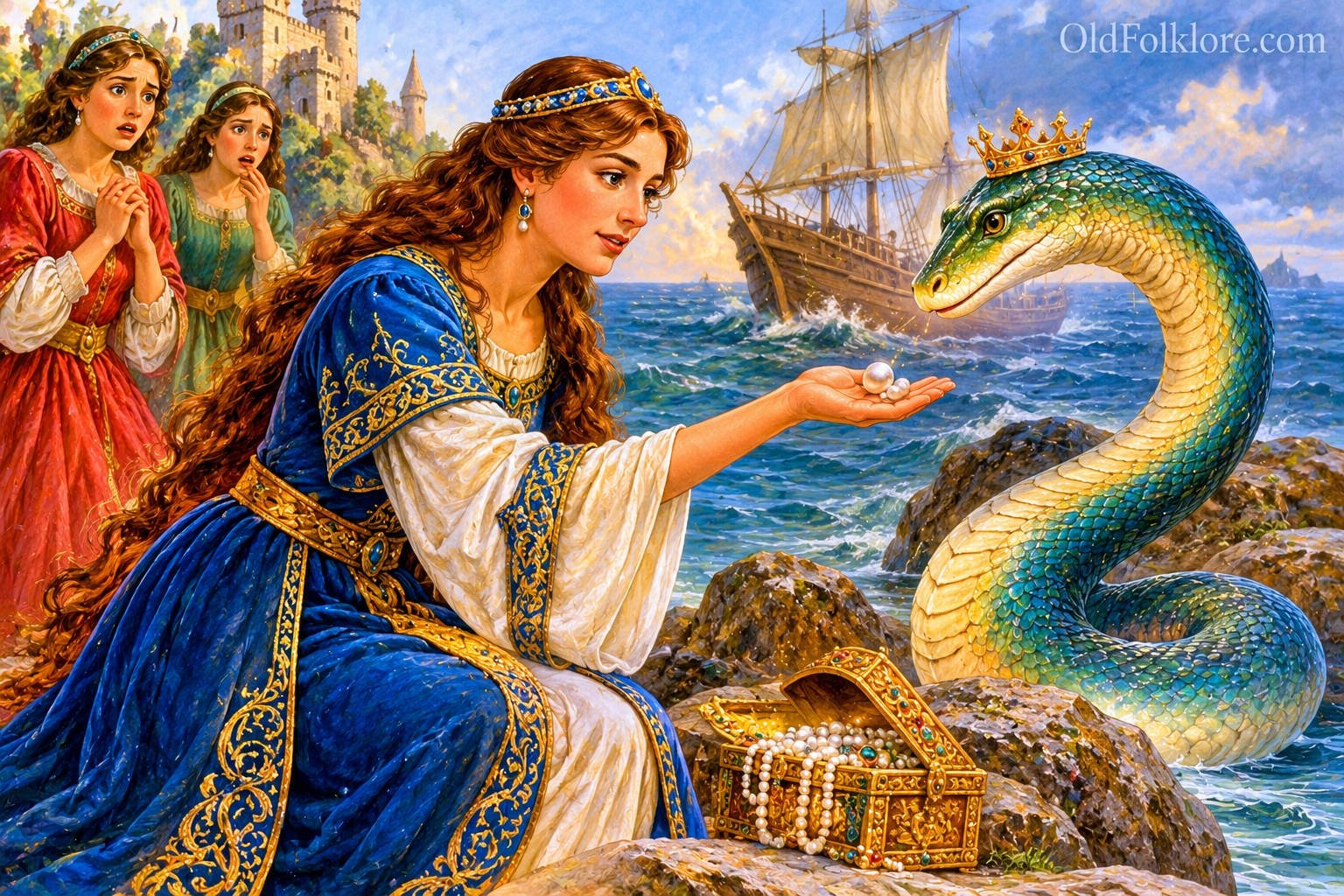
A gigantic serpent, as thick as a date palm, came rushing towards her. It twisted desperately from side to side, trying to escape a dragon pursuing it.
The dragon was much smaller, scarcely longer than two lances, but it was fast and determined. It eventually caught the serpent by the tail and began attacking it.
The serpent appeared helpless, and tears streamed from its eyes.
The young woman felt pity for the creature.
Picking up a stone, she called upon Allah for assistance and hurled it at the dragon’s head with all her strength.
The stone struck its target, killing the dragon instantly.
At that moment, the serpent opened a pair of wings and flew into the sky before disappearing from sight.
The young woman remained where she was, astonished by what she had witnessed. Exhausted from her ordeal, she eventually fell asleep.
When she awoke, she discovered a dark-skinned woman sitting beside her, gently massaging her feet. Standing nearby were two black dogs.
To her astonishment, the dogs were her own sisters.
The mysterious woman smiled when she saw her confusion.
She explained that she was the serpent the young woman had rescued. She was a female jinniyah, and the dragon had been a male jinn who hated her and wished to destroy her.
Grateful for the rescue, she had immediately flown to the ship from which the sisters had thrown their younger sibling.
She had removed all the merchandise and possessions aboard the vessel and arranged for them to be transported to the young woman’s house. She had then ordered her servants, the Marids, to sink the ship.
She also revealed that she had transformed the two wicked sisters into black dogs because she knew everything they had done to their younger sibling.
As for the young prince, he had drowned.
The jinniyah then carried the young woman and the two dogs through the air and deposited them on the roof of her house in Baghdad.
There, the young woman discovered that every possession from her ship had been safely restored. Nothing was missing.
But the jinniyah had one final command.
She swore by the seal-ring of Solomon that unless the young woman gave each of the two dogs three hundred lashes every day, she would return and imprison her beneath the earth forever.
She repeated her threat, warning that disobedience would result in the young woman suffering the same transformation as her sisters.
The terrified woman promised to obey.
From that day forward, she had no choice but to carry out the jinniyah’s command. Every day, she gave each dog the prescribed three hundred lashes, even though she pitied them and wept as she did so.
Her sisters understood that she was not acting out of personal cruelty. They knew the punishment had been imposed upon her by the supernatural being who had rescued her.
And that, she explained, was the reason behind her extraordinary circumstances.
Explore our complete Historic Folklore & Fairy-Tale Collections archive.
Moral
Kindness should never be mistaken for weakness, and generosity should not be repaid with betrayal. The story also reminds readers that jealousy can destroy relationships and that an unexpected act of compassion may bring help from the most unlikely source.
Knowledge Check
1. Why did the youngest sister’s elder sisters return home in poverty?
Their husbands squandered their money, became bankrupt and abandoned them in foreign lands.
2. What happened to the mysterious city?
Its inhabitants, including the king, queen and animals, had been transformed into black stones after refusing repeated warnings to abandon fire worship.
3. Why was the young prince spared?
He had secretly embraced Islam and was engaged in prayer and religious devotion when the destruction occurred.
4. How did the youngest sister lose the prince?
Her jealous sisters threw both of them into the sea while they were sleeping aboard their ship. The prince drowned.
5. Who was the serpent the young woman rescued?
She was a female jinniyah being pursued by a hostile male jinn in the form of a dragon.
6. Why were the two sisters transformed into black dogs?
The jinniyah punished them for betraying their younger sister and attempting to kill her.
7. Why did the youngest sister beat the dogs every day?
The jinniyah threatened to imprison or transform her if she failed to give each dog three hundred lashes daily.
Source
This retelling is based on “The Eldest Lady’s Tale,” an episode in The Book of the Thousand Nights and a Night, Volume I, translated and annotated by Sir Richard Francis Burton. .
Explore More On The Arabian Nights