An ancient oak tree stood proudly above the sea, watching generations of birds, insects and travellers come and go. At three hundred and sixty-five years old, it had witnessed countless changes in the forest, yet it considered its long existence entirely different from the brief lives of the creatures around it. One summer, it watched a tiny mayfly celebrate its single day of life and wondered how such a short existence could bring anyone lasting happiness.
As winter approached, the oak prepared for its annual rest. However, during the Christmas season, it experienced a remarkable dream in which its memories, the beauty of nature and the lives of the creatures it had watched seemed to rise together towards the heavens. What followed became the final chapter of its long existence. In The Last Dream of the Old Oak Tree, Hans Christian Andersen explores the meaning of time, the value of life, the beauty of nature and the mystery of eternity.
The Ancient Oak by the Sea
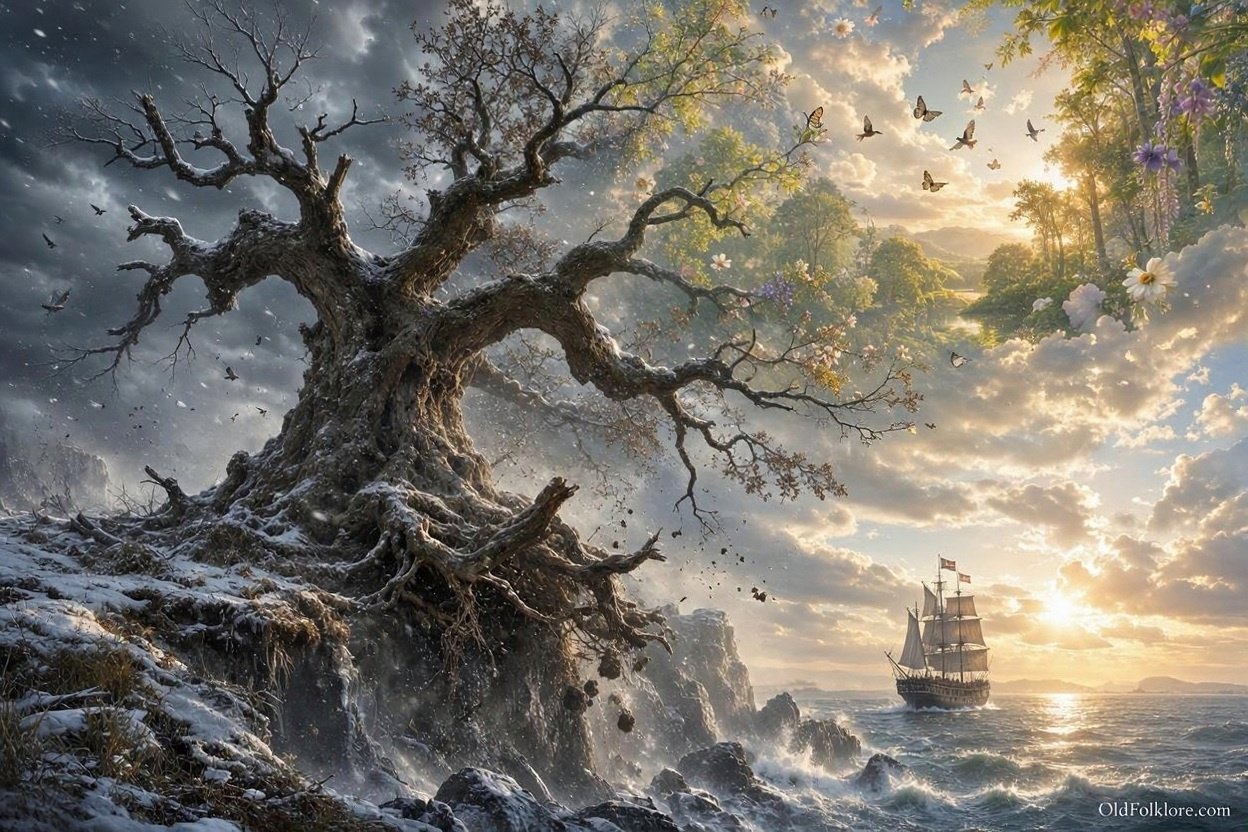
High above the steep shore of a forest, close to the open sea, stood an enormous oak tree. It was exactly three hundred and sixty-five years old.
To human beings, such an age would have seemed extraordinary. However, the passage of time was different for the tree. A single year in its life was comparable to just one day in the life of a human being.
People remained awake during the day and slept at night. The oak, on the other hand, stayed awake through three seasons: spring, summer and autumn. Winter was its season of rest, the equivalent of night after a long day.
Throughout the warmer months, the tree enjoyed the changing sights and sounds of the forest. Birds nested among its branches, insects danced around its leaves, and the wind carried the fragrance of flowers through its enormous crown.
Among the creatures that visited the oak was a tiny insect called the Ephemera, a fly whose entire life lasted only one day.
On warm summer afternoons, the little creature would dance around the tree’s crown before settling briefly on one of its fresh green leaves.
Whenever the oak watched the insect enjoying itself, it felt sorry for it.
“Poor little thing!” the tree would say. “Your whole life is but a single day! How very short! It is quite melancholy.”
The Ephemera never understood why the oak considered its existence so unfortunate.
“Melancholy! Why do you say that?” it would reply. “It is wonderfully bright, warm and beautiful all around me, and that makes me rejoice!”
The oak continued to insist that the insect’s life was terribly short.
It explained that although the Ephemera would disappear after a single day, the tree might live for thousands of those days. Its own existence extended through entire seasons, making it impossible for the little creature to understand the length of its life.
However, the Ephemera had a different understanding of happiness.
It explained that although its life lasted only one day, that day contained thousands of moments in which it could enjoy the world. It questioned whether all the beauty surrounding them would disappear simply because it died.
The oak admitted that the beauty of the world would continue long after its own existence had ended.
Explore more stories from our Hans Christian Andersen Tales collection
The little insect therefore believed that they experienced the same happiness, even though they measured time differently.
A Day Filled with Happiness
The Ephemera continued dancing through the warm air.
Its delicate wings, which seemed woven from gauze and velvet, carried it among the flowers and fragrant plants of the countryside.
The surrounding meadows were filled with the scents of wild roses, elderflowers, garden hedges, wild thyme, mint and daisies. The sweet fragrance overwhelmed the tiny creature, making its already joyful existence feel even more wonderful.
The day passed beautifully.
The little insect enjoyed the warmth of the sun, the pleasant breeze and the magnificent colours of the natural world. Every moment seemed to offer another reason to celebrate being alive.
Eventually, the sun began to sink towards the horizon.
The Ephemera grew pleasantly tired from all its dancing and enjoyment. Its delicate wings could no longer carry it through the air, so it slowly descended onto a soft blade of grass.
There, it gently lowered its head and fell asleep.
Its short life had come to an end.
The oak watched the little creature disappear and repeated its familiar expression of sorrow.
“Poor little Ephemera! That was a terribly short life!”
Yet the same event occurred every summer day.
One generation of Ephemera would dance, enjoy the warmth and fragrance of the forest, and die before another generation took its place. Each experienced the same happiness, and none seemed troubled by the brevity of its existence.
The oak continued observing them throughout the seasons, unable to understand how a creature with such a short life could be so completely satisfied.
The Arrival of Winter
The ancient tree remained awake through the spring morning, the bright midday of summer and the evening of autumn.
Eventually, winter approached.
The storms began moving through the forest, carrying their cold winds across the branches. One leaf after another loosened and fell from the oak.
The winds seemed to speak directly to the tree, bidding it farewell and encouraging it to rest.
They promised to rock it gently to sleep, shaking its old branches and filling the ground around its roots with snow.
The storms reminded the oak that it had completed another year of its existence. Although it was now three hundred and sixty-five years old, the winds considered it relatively young.
Soon the tree stood completely bare.
Its leaves had fallen, exposing the twisted and weathered branches that extended from its enormous trunk.
The snow gathered around its roots like a warm covering, and the old oak entered its winter sleep.
During this period of rest, it dreamed about the things it had experienced and the events that had taken place around it. Like human beings, the tree’s dreams were connected to its memories.
Memories from the Forest
Long before it became the greatest tree in the forest, the oak had been a small acorn.
That tiny seed had served as its cradle, and from it the enormous tree had gradually grown.
By human calculation, it had now lived through four centuries.
Its crown towered above every other tree in the forest and could be seen from far across the sea. Sailors frequently used it as a landmark when travelling along the coast, although the oak had no idea how many people depended on its presence.
The tree had become a familiar home for numerous creatures.
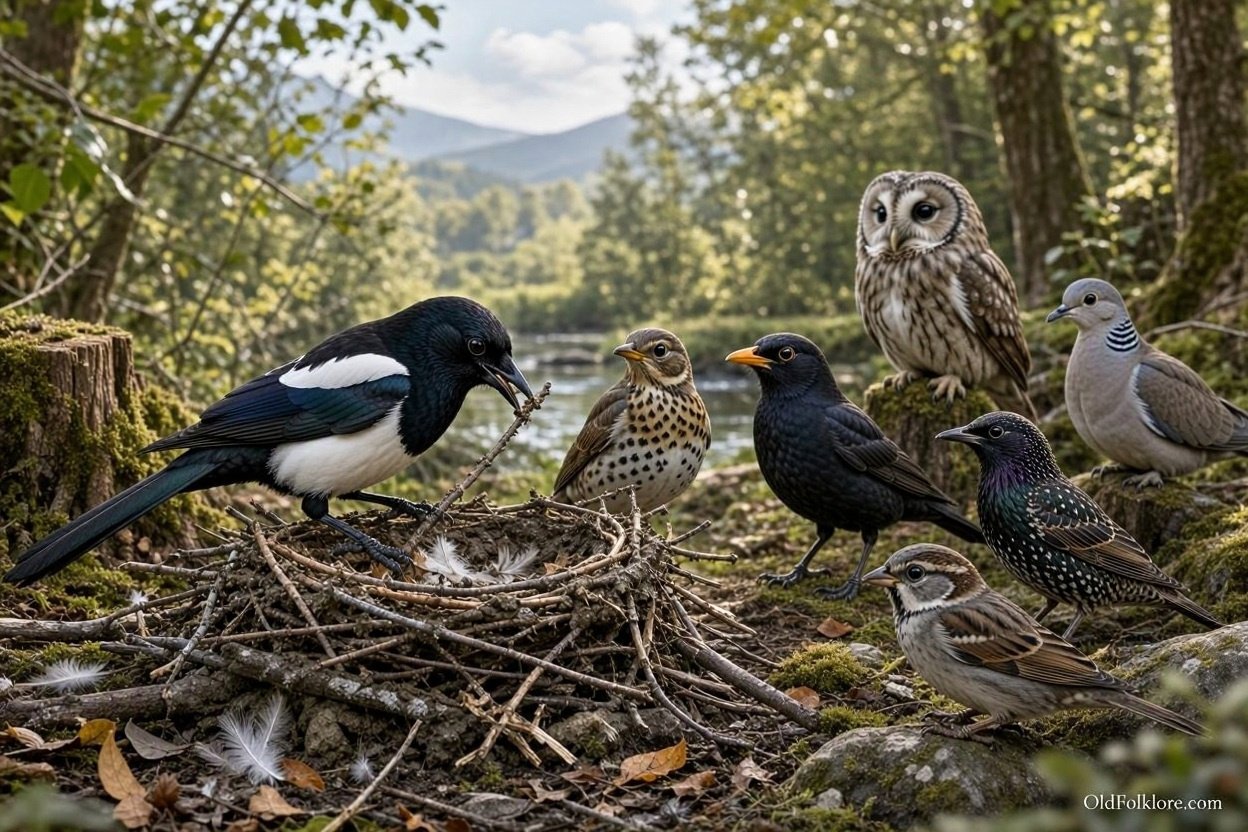
A wood-pigeon had built her nest high among its branches, while a cuckoo often rested there and filled the surrounding forest with its song.
During autumn, when the leaves turned the colour of thin copper plates, migrating birds stopped to rest before continuing their journeys across the sea.
Winter brought a different collection of visitors.
Crows and rooks took turns perching among the bare branches. They discussed the difficult conditions of the season and the struggle to find food.
Although the oak had lost its leaves, it remained a familiar presence in the forest.
Its branches held memories of countless seasons, and its position above the coastline made it a witness to events that had unfolded over generations.
It had watched birds build their nests, travellers pass beneath its crown, and the forest change with every passing year.
Now, during the Christmas season, those memories were about to return in a remarkable dream.
The Old Oak’s Glorious Christmas Dream
It was the holy Christmas season when the ancient tree experienced the most magnificent dream of its existence.
Although it stood in the cold of winter, the oak imagined that the world around it had become a warm summer landscape.
It could almost hear church bells ringing from every direction.
Its branches were once again covered with fresh green leaves, and the sun shone brightly through its enormous crown.
The air carried the fragrance of herbs and blossoms, while colourful butterflies chased one another through the warm atmosphere.
The Ephemera returned, dancing around the tree as though the entire world had been created for their enjoyment.
Everything the oak had experienced over the centuries seemed to pass before it like a magnificent celebration.
The tree saw knights from ancient times riding through the forest on magnificent horses. Their noble companions travelled beside them, wearing plumed hats and carrying falcons on their wrists.
The sounds of hunting horns filled the air, accompanied by the barking of dogs.
The dream then changed.
The oak saw hostile warriors wearing colourful garments and carrying shining weapons. They arrived with spears and halberds, pitching their tents beneath its branches before eventually striking camp and departing.
The fires they had built glowed brightly in the darkness, while the men sang and rested beneath the shelter of the enormous tree.
Other memories followed.
The oak saw loving couples meeting beneath its branches in the moonlight. They stood close to its trunk, sharing their happiness and carving the initials of their names into its grey-green bark.
The tree remembered these moments even though many years had passed since they occurred.
It also recalled the joyful wanderers who had once hung musical instruments from its branches. Citherns and Aeolian harps had produced beautiful melodies beneath its crown, and in the dream those instruments appeared again, filling the forest with enchanting music.
The wood-pigeons cooed gently, while the cuckoo called out as though reminding the oak of the summer days it still had ahead.
Everything seemed alive with happiness.
Then the tree experienced something even more extraordinary.
It felt new life moving through its roots and travelling upwards into its highest branches. Its strength increased, its trunk grew taller and its crown spread wider.
The oak continued growing beyond anything it had ever imagined.
Its happiness increased with every new height it reached, and it felt an overwhelming desire to rise towards the brilliant sun.
Above the Clouds
The ancient oak eventually grew so tall that its crown extended above the clouds.
The clouds floated beneath it like great white swans or dark formations of migrating birds.
Something extraordinary happened to its leaves.
Every leaf seemed to possess eyes, allowing the tree to see the world in a completely new way.
Even the stars became visible in the daylight. They shone brightly, each appearing like a pair of gentle, sparkling eyes.
The stars reminded the oak of familiar faces.
It remembered the gentle eyes of children and the loving eyes of couples who had once met beneath its branches.
The sight filled the tree with overwhelming happiness.
Yet despite the magnificence of its dream, the oak discovered that something was missing.
It looked down towards the forest and realised that the other trees, bushes, flowers and smaller plants were far below.
The old oak did not want to enjoy such splendour alone.
It wished that every living thing in the forest could rise with it and experience the same beauty.
The great tree felt that its happiness was incomplete while the smaller creatures and plants remained separated from it.
Its longing travelled through every branch and leaf, trembling like a feeling within a human heart.
The oak began looking downwards, searching for the familiar plants that had once surrounded it.
It recognised the fragrance of thyme, honeysuckle and violets. It also imagined hearing the cuckoo answering its call.
Then something wonderful happened.
The green tops of the forest began appearing through the clouds.
The other trees were rising towards the oak.
The bushes and herbs grew taller, and some seemed to pull themselves out of the ground in their eagerness to reach the heavens.
The birch tree rose particularly quickly. Its slender white trunk shot upwards like a streak of lightning, while its branches spread around it like green banners.
Even the smaller plants joined the movement.
Brown rushes, delicate flowers and blades of grass rose towards the sky.
The birds accompanied them, singing as they travelled upwards. Bees murmured, May beetles hummed and grasshoppers cleaned their wings while sitting on the rising grass.
The entire forest seemed to have become a magnificent gathering of life and music.
The Oak Searches for Every Living Thing
Although the forest had risen towards it, the old oak wanted to make certain that nothing had been left behind.
It remembered the little blue flower that grew beside the water and wondered where it was.
It also searched for the purple bellflower and the familiar daisy.
The voices of the plants answered from above, assuring the oak that they were present.
Still, the tree remembered other parts of the forest.
It thought about the beautiful thyme that had grown the previous summer, the place covered with lilies of the valley and the wild apple tree that had once blossomed magnificently.
The oak wondered whether these familiar sights had been forgotten.
Again, voices answered from the heights.
They assured the tree that everything was there.
Nothing had been left behind.
The old oak was overwhelmed by happiness.
It looked around and realised that every plant and living thing it had loved was now present. The great trees, tiny flowers, herbs and smaller woodland creatures had all joined it.
The tree could hardly understand how such complete happiness was possible.
Then a voice from above answered its unspoken question.
It explained that such perfection could be imagined and experienced in heaven, the better land.
The oak felt its roots beginning to loosen from the earth.
Rather than fear this sensation, it welcomed it.
For the first time, it felt that nothing was holding it back. It believed it could rise freely into the highest heavens, surrounded by everything it had ever loved.
The tree rejoiced.
It imagined that all its beloved companions, great and small, were rising together towards eternal happiness.
This was the magnificent dream of the old oak tree.
The Storm That Ended the Oak’s Life
While the ancient tree experienced its glorious Christmas dream, a powerful storm swept across the land and sea.
The wind rushed through the forest with tremendous force.
The sea became violent, sending enormous waves towards the shore.
The oak stood beneath the storm, unaware that the dream of its roots becoming free was about to become reality in a very different way.
Its roots began tearing away from the ground.
The trunk cracked, and the enormous tree could no longer remain standing.
At the very moment when it dreamed of rising freely into the heavens, the oak was uprooted by the storm.
It fell.
The tree that had lived for three hundred and sixty-five years had finally reached the end of its existence.
Its entire lifetime was now comparable to the single day enjoyed by the Ephemera.
On Christmas morning, the storm had passed.
The sun rose over the coast, and the sea gradually became calm.
Church bells rang across the countryside, announcing the celebration of Christmas. Smoke rose from the chimneys of houses and small huts, forming blue clouds above the buildings.
The smoke reminded observers of the ancient sacrificial fires once associated with celebrations of thanksgiving.
Out at sea, a large ship that had survived the storm displayed all its flags in celebration.
The sailors looked towards the shoreline and noticed that the old oak had fallen.
They recognised it as the familiar landmark that had guided travellers along the coast for generations.
They expressed sadness at its disappearance, wondering who could ever replace such a magnificent tree.
No one, they believed, could take its place.
Their words became a brief but sincere funeral tribute to the fallen oak.
The Christmas Song and the Final Dream
The enormous tree lay stretched across the snowy shoreline.
Although it had fallen, its memory continued to inspire those who had known its presence.
From the ship, the sailors began singing a Christmas hymn.
Their song celebrated the birth of Christ, the redemption of the human soul and the promise of eternal life.
The words rose across the water, filling the peaceful morning with a sense of spiritual hope.
Everyone aboard the ship experienced the music in their own way.
The sailors felt uplifted by the song and prayer, just as the ancient oak had experienced overwhelming happiness during its final dream.
The tree’s physical existence had ended, but Andersen’s story connects its final dream with the Christian promise of a better and eternal life.
The oak had spent centuries observing the brief lives of creatures that enjoyed the world without worrying about the length of their existence.
It had once pitied the Ephemera because its life lasted only a day.
Yet when the oak finally fell, its own three hundred and sixty-five years became equivalent to that same single day.
The story closes with the Christmas hymn echoing across the sea, leaving the reader with the image of an ancient tree whose final dream was filled with beauty, companionship and the hope of eternity.
Explore our complete Historic Folklore & Fairy-Tale Collections archive.
Moral Lessons from The Last Dream of the Old Oak Tree
One of the central lessons of the story is that the value of life cannot be measured by its duration. The Ephemera lived for only one day, yet it enjoyed every moment of its existence. The oak, despite living for centuries, initially struggled to understand how such a short life could be meaningful. Their conversation reminds readers that happiness is not necessarily determined by how long someone lives.
The story also teaches that every stage of life has its own beauty. Spring, summer, autumn and winter each contribute something different to the natural world. The oak experiences growth, abundance, rest and eventually death, reflecting the continuous changes that shape existence.
Another important lesson is the importance of shared happiness. Even when the oak reached extraordinary heights in its dream, it could not feel completely satisfied while the other trees and plants remained below. Its greatest joy came when everything in the forest rose together. This suggests that happiness becomes more meaningful when it is shared with others.
Finally, Andersen explores the relationship between death and spiritual hope. The Christmas setting, the oak’s final dream and the sailors’ hymn connect the story to the Christian belief in eternal life. The ending encourages readers to consider the possibility that physical endings may carry a deeper spiritual meaning.
Knowledge Check: The Last Dream of the Old Oak Tree
1. How old was the oak tree at the beginning of the story?
The oak tree was exactly 365 years old, although its experience of time differed from that of human beings.
2. Why did the oak feel sorry for the Ephemera?
The Ephemera lived for only one day, and the oak believed that such a short existence was unfortunate.
3. How did the Ephemera understand the meaning of life?
It believed that a single day could contain thousands of happy moments and that the beauty of the world made its brief existence worthwhile.
4. What happened during the oak’s Christmas dream?
The oak dreamed that it grew above the clouds and that every tree, flower, bush and living creature in the forest rose with it towards the heavens.
5. What caused the old oak tree to fall?
A powerful Christmas storm swept across the land and sea, tearing the tree’s roots from the ground and causing it to fall.
6. What did the sailors do when they discovered the fallen tree?
They mourned its disappearance and sang a Christmas hymn celebrating Christ’s birth, redemption and eternal life.
Source
Retold from Hans Christian Andersen, What the Moon Saw and Other Tales, H. W. Dulcken translation (1866), “The Last Dream of the Old Oak Tree” (source heading: “THE LAST DREAM OF THE OLD OAK TREE.”).
Hans Christian Andersen was the original literary author of the story, while H. W. Dulcken translated it into English.
Explore More Hans Christian Andersen Tales
- The Snowman: A Danish Folktale by Andersen
- The Farmer Who Traded His Horse for Rotten Apples
- The Beetle Who Wanted Golden Shoes
- The Goblin and the Huckster: Hans Christian Andersen
- The Story of the Year: A Tale of the Four Seasons
- Jack the Dullard: A Clever Contest for a Princess’s Hand
- The Marsh King’s Daughter: A Powerful Tale of Love and Redemption