A wealthy merchant has two wives, but only one has a child. When jealousy grows within the household, the child’s mother is sent away on an errand. While she is gone, a mysterious exchange takes place, leaving her family facing a frightening discovery. When the child is finally able to speak for himself, he reveals a secret that changes everything.
A Merchant and His Two Wives
A wealthy merchant lived with his two wives. Their household had the comforts that came with his prosperity, but the relationship between the women was not equal. One wife had given birth to a child, while the other had none of her own.
The child was born with a distinctive tuft of hair on his forehead. This mark was a special feature of his appearance and would later become important when questions arose about his identity.
The merchant wanted his wife and child to be cared for. He therefore told the mother that she did not need to perform the household’s usual work. Her responsibility was to look after the child, while the other wife was expected to do the work.
His instruction seemed straightforward. The mother could devote herself to raising her child, and the other woman could attend to the household duties. Yet the arrangement created a source of resentment between the wives.
The woman without a child was expected to do the work while her companion stayed with the baby. Instead of accepting the arrangement, she became determined to make the mother work.
The household appeared peaceful enough when the merchant was present, but the arrangement between the women became a source of conflict whenever he was away.
The Mother Is Sent to Fetch Water
One day, the merchant went to the market. While he was away, the childless wife ordered the child’s mother to fetch water.
The mother refused. She explained that her husband had told her not to work and had instructed her to devote her time to caring for their child.
Her companion did not accept this answer. She repeated the order and insisted that the mother go to the fountain.
Explore more stories from our West African Folk-Tales collection.
The mother was placed in a difficult position. Her husband had given her an instruction, but the other wife was determined to make her obey a different one. Rather than continue the argument, the mother eventually left the house to fetch water.
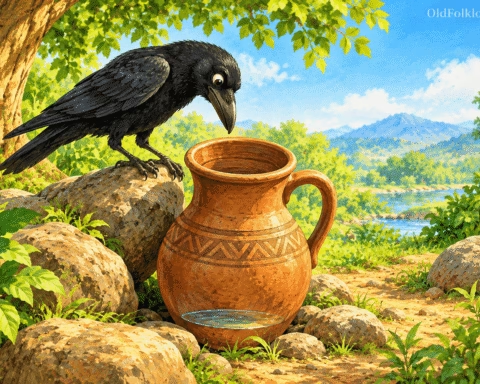
As she travelled towards the fountain, she came across a raven that appeared to be close to death from exhaustion. The bird was so weak that it could scarcely continue on its own.
A passing merchant found the raven and carried it away. His journey eventually brought him to the house where the two wives lived.
The child’s mother was still away at the fountain. The other wife was at home when the travelling merchant arrived with the exhausted bird.
What happened next changed the course of the household’s life.
The Raven and the Unusual Bargain
The travelling merchant asked for something to be done for the raven. The bird was weak, and he wanted to give it away rather than keep it with him.
The childless wife saw an opportunity. She offered to take the raven and promised that she would make the merchant wealthy in return.
The merchant asked what she would give him.
Her answer was shocking. She offered him a child.
The merchant refused to accept the offer without questioning it. He asked whose child she intended to give him and challenged her claim to possess the child.
The woman insisted that the child was her own.
The merchant demanded that she bring the child to him. She went to fetch the baby, and the merchant gave her the raven in exchange.
He then took the child away to his own home.
The bargain had been completed, but the woman had created a terrible deception. The mother who had gone to fetch water knew nothing of what had happened. She had left her child in the household and expected to return to him.
Instead, while she was away, the baby had disappeared.
The travelling merchant carried the child to his home, where the boy grew up. In time, the merchant became very wealthy.
The childless wife remained behind, concealing what she had done.
A Raven Lies in the Cradle
When the child’s mother returned from the fountain, the other wife asked where her son was. She told the mother to listen because the child was crying.
The mother answered that the child was not crying.
The other wife then offered to take the baby, claiming that the mother did not know how to amuse him. The mother refused, explaining that the child was sleeping.
The two women continued with their work, grinding grain. Despite their conversation, the mother did not discover the truth immediately.
When the merchant husband returned from the market, he asked why his wife was not attending to their son.
The mother rose to take the child from the cradle. But when she looked inside, she found a raven where her baby should have been.
The discovery was horrifying. The child she had left at home was gone, and a bird had taken his place.
The other wife mocked her, declaring that she had become the mother of a raven.
The father was also confronted with the strange sight. He instructed that the bird be carried into another house and that hot water be poured over it.
The woman carried out his order. Yet the child who had disappeared was not truly lost. He was growing up elsewhere, far from the mother who had been deceived.
The tale does not explain the exchange in ordinary terms. It presents the raven in the cradle as the visible sign of the terrible change that had taken place in the household.
The Child Grows Up in Another Home
The child remained with the travelling merchant, who raised him as his own son. The boy came to call the merchant his father and the merchant’s wife his mother.
He grew up in their household, separated from his birth family and unaware, at first, of the truth behind his arrival.
The merchant’s prosperity increased, and the boy lived under his care. The story moves forward to a time when the merchant prepared to travel.
During the merchant’s absence, the woman who had raised the child approached him with food. She asked him to promise that he would not betray her.
The boy agreed to her request. He regarded her as his mother and saw no reason to refuse her.
But the woman then revealed something that changed his understanding of his own life. She told him that she was not his real mother and that her husband was not his real father.
The boy had been raised in their home, yet the woman admitted that the relationship he believed he had with them was not the truth.
When the merchant returned from his journey, he brought food to the boy. The child refused to eat.
The merchant asked why he would not take the food and wondered whether the woman had visited him.
The boy denied that she had come.
The merchant then questioned his wife, who also denied visiting the child. Their answers left the boy facing the knowledge that the adults around him had not told him everything about his origins.
The Search for the Truth
The merchant continued to offer the boy food, but the child remained troubled. He eventually appealed to the merchant in the name of God, asking him to tell the truth.
He wanted to know whether the merchant was really his father and whether the merchant’s wife was truly his mother.
The merchant answered honestly. He told the boy that he was not his father and that his wife was not the boy’s mother.
The child’s questions had brought the truth into the open. The family relationship he had accepted since childhood was not the one into which he had been born.
The boy then asked the merchant’s wife to prepare provisions for a journey. Once the food was ready, the child mounted a horse, while the merchant travelled on a mule.
Together, they set out for the village where the boy’s real father was the chief.
They travelled for a long time before reaching the village. There, they entered the chief’s home.
The boy was given food, but he refused to eat. He said that he would not eat until the other woman had been brought before him.
Those present tried to persuade him to eat, explaining that the woman was wicked. But the boy insisted that she must come.
The merchant questioned why the child was behaving this way towards her. The people gathered there recalled the terrible story of a child who had been changed into a raven.
The merchant explained that the child had possessed a distinctive mark.
The Mark That Revealed His Identity
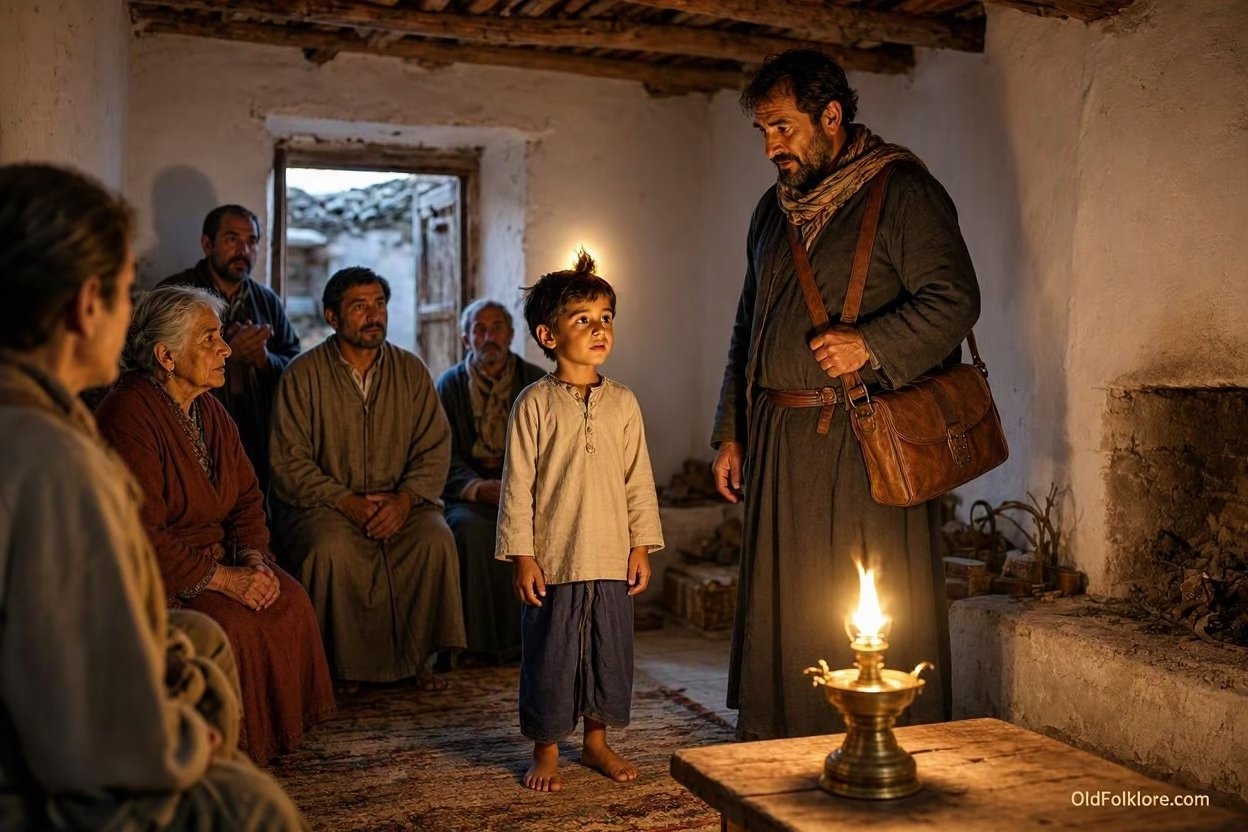
The merchant’s explanation offered a way to establish the child’s identity. The boy had been born with a tuft of hair on his forehead, a detail remembered from the beginning of the story.
The people agreed that the mark could help them recognise him.
The lamp was extinguished. In the darkness, the boy removed his hood and cap. When the lamp was lit again, his appearance could be seen clearly.
The boy announced that he was the missing son.
The distinctive mark helped reveal the identity that had been hidden by the deception. The child who had vanished from his mother’s home had returned to his birth family, and the truth could no longer be concealed.
The tale ends with this recognition. The child’s identity is established, and the mystery surrounding the raven and the missing baby is brought to a conclusion.
Explore our complete Algerian Folktales archive.
Moral Lesson
Jealousy and deception can cause terrible harm, but the truth may eventually come to light. The story also warns against accepting appearances without questioning them and shows the importance of honesty when family relationships and a child’s identity are at stake.
Knowledge Check
1. Who were the two women in the merchant’s household?
They were the merchant’s two wives. One had a child, while the other did not.
2. Why did the child’s mother leave the house?
The other wife insisted that she fetch water from the fountain.
3. What did the childless wife offer the travelling merchant?
She offered him a child in exchange for the raven.
4. What did the child’s mother find when she returned home?
She found a raven in the cradle instead of her baby.
5. How did the boy learn that the merchant was not his real father?
The merchant’s wife revealed that neither she nor her husband was his birth parent, and the merchant later confirmed the truth.
6. What helped establish the boy’s identity?
The distinctive tuft of hair on his forehead helped identify him as the missing child.
Source
Adapted from “Le Corbeau et l’Enfant” (“The Raven and the Child”), a Kabyle folktale recorded by Joseph Rivière in Recueil de contes populaires de la Kabylie du Djurdjura, published in Paris in 1882, pages 39 to 41.
Explore More Algerian Folktales
- The Cow of the Orphans: A Powerful Algerian Folktale
- The Seven Brothers: A Powerful Algerian Folktale
- The Orphan and His Cruel Uncle
- The Mule, the Jackal and the Lion
- Solomon and the House of Eggs
- The Lion and the Son of Woman