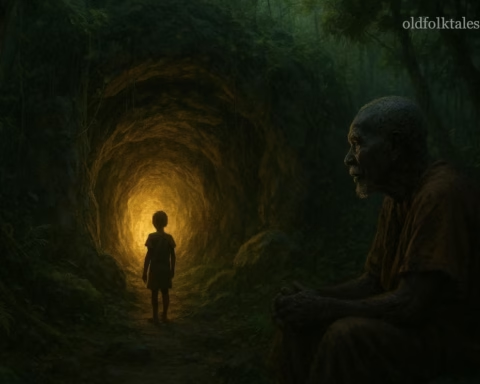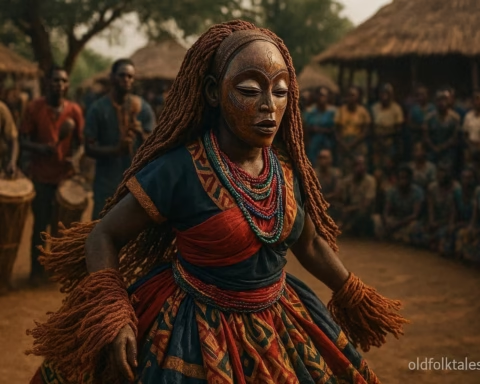
When the fish disappeared from his village’s river, a young fisherman named Kiala set out to seek help from its mysterious guardian. His journey led him to three difficult tests, each revealing a lesson about wisdom, shared responsibility and the true meaning of leadership. To restore his community’s fortunes, Kiala would need more than courage. He would have to demonstrate that he understood what made a community strong.
The River That Fell Silent
In a village in Angola, a broad river sustained families, watered nearby farmland and provided a route for travellers moving between settlements. Each morning, fishermen carried their nets to the water, hoping to bring home enough fish to feed their households.
The river was central to village life. Its waters supported crops during dry periods, while its banks provided places for people to gather, work and rest. The villagers understood that their well-being depended on the river’s continued abundance.
For many years, fishing brought reliable rewards. Families prepared their meals, farmers tended their crops and children grew up watching the fishermen return with their catches. The village enjoyed a comfortable rhythm, and few imagined that its greatest source of nourishment could one day fail.
Then the fish began to disappear.
Fishermen returned with nearly empty nets. Some spent entire mornings on the water without catching enough for a single meal. The river, once lively with movement, seemed strangely quiet. Birds that had gathered along its banks became less frequent, and worry spread through the settlement.
Families began sharing their remaining food. Farmers feared that their harvests would not be enough to make up for the shortage of fish. As the days passed, the villagers realised that they could not continue living as they had before.
The elders gathered beneath a large tree to discuss the problem. Some suspected that the changing weather had affected the river. Others wondered whether the fish had moved to deeper waters. Everyone had a theory, but nobody knew how to restore the village’s supply.
At last, one of the elders spoke of an old legend about a guardian who watched over the river. According to the tale, the guardian could offer guidance to someone who approached with humility and a genuine desire to help others.
The gathering fell silent. The river was vast, and its quieter stretches were unfamiliar to most villagers. No one wanted to risk the journey without knowing what might await them.
Among those listening was a young fisherman named Kiala. He was neither the strongest man in the village nor its wealthiest resident. However, people knew him as a patient, honest man who rarely abandoned a difficult task.
After considering the danger, Kiala stepped forward.
He explained that he could not promise to solve the problem, but he was willing to seek the river guardian’s help. If there was a chance of finding an answer that would save the village, he believed someone ought to try.
The elders warned him that courage alone might not be enough. He would need patience, good judgement and the willingness to accept a truth even if it proved uncomfortable.
Kiala listened carefully and prepared for the journey.
The Journey Upstream
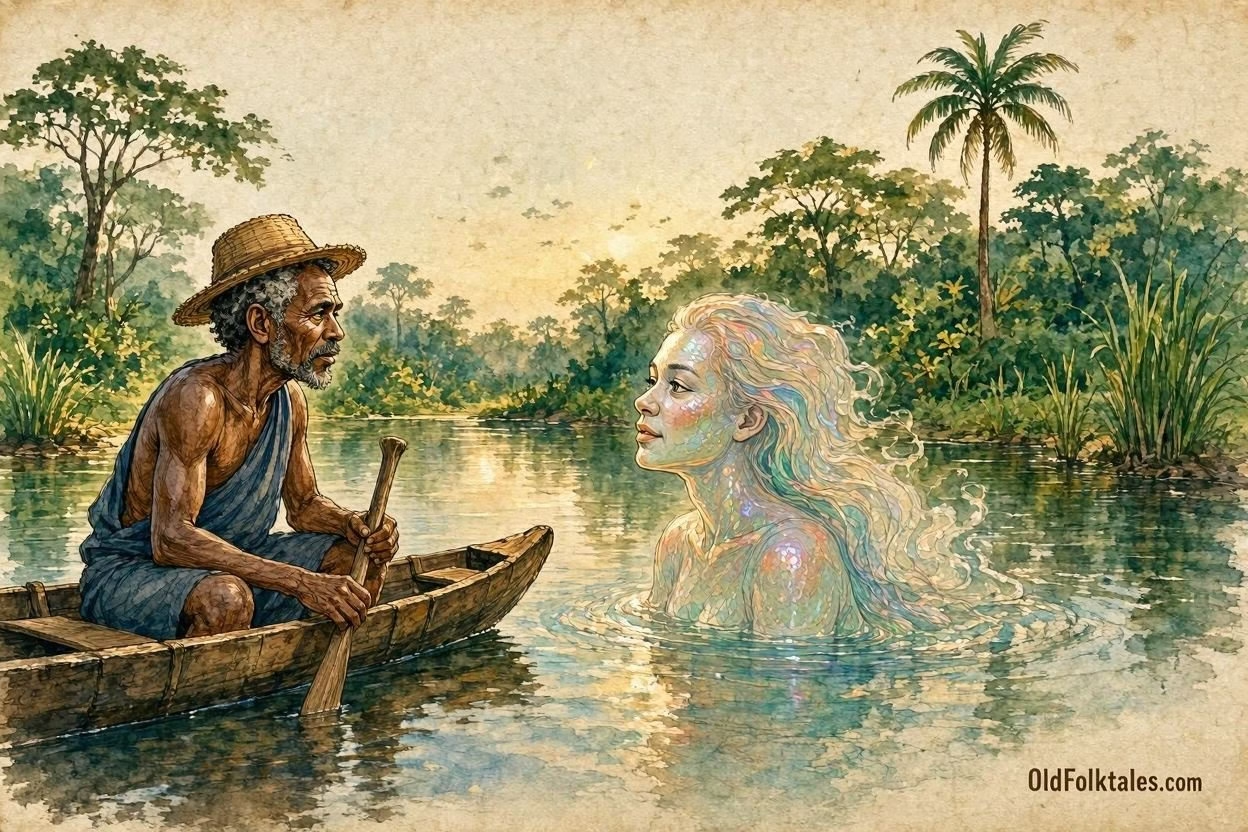
Early the following morning, Kiala climbed into his canoe and began paddling upstream. He carried a little food and water, along with the paddle he used on his fishing trips. The journey took him away from the familiar landing places and towards a stretch of the river few villagers visited.
As he travelled, the banks grew steeper and the trees leaned over the water. Their branches cast long shadows across the surface, while the sound of village life gradually faded behind him.
Explore more stories from our Angolan Folktales Collections archive.
Kiala continued paddling until he reached a broad pool enclosed by smooth, dark rocks. The water was so still that the surrounding trees appeared clearly in its reflection. No fish disturbed the surface, and the usual sounds of the river seemed to have disappeared.
He brought his canoe close to the bank and laid down his paddle.
Remembering the purpose of his journey, Kiala bowed his head and expressed his gratitude for the river that had sustained his people. He admitted that he did not understand why the village was suffering, but he asked for guidance that might help everyone.
Almost immediately, circles began spreading across the water.
A silver glow appeared beneath the surface. Gradually, a figure rose from the river, clothed in flowing garments that shimmered like sunlight on moving water. The figure stood above the pool, watching Kiala with a calm and searching expression.
It was the river spirit.
The spirit addressed Kiala by name and explained that it had watched the village for many seasons. Kiala bowed respectfully and described the hardship that had driven him upstream.
He asked for help, but the spirit did not immediately promise to restore the fish.
Instead, it explained that Kiala would have to demonstrate his understanding of three important truths. Many people, the spirit said, wanted the river’s gifts, but few considered the responsibilities that came with receiving them.
Kiala agreed to the challenge.
The First Test: The Treasure That Grows
The river spirit presented the first question. It asked Kiala to name the treasure that becomes greater each time it is shared, even though sharing it does not reduce what the giver possesses.
Kiala considered the question carefully.
He thought about the knowledge experienced fishermen passed to younger members of their community. A skilled fisherman could explain where fish gathered, how to repair a damaged net and when changing weather made a journey dangerous. When that knowledge reached another person, it did not disappear from the mind of the person who shared it.
Instead, more people became capable of helping themselves and others.
Kiala realised that the treasure was wisdom.
He explained that wisdom grows when people share what they have learned. A person who teaches another does not become less knowledgeable. Both people may benefit, and the knowledge can continue spreading throughout the community.
The river spirit smiled.
Kiala had answered correctly. Wisdom was a treasure that could enrich many people without being divided into smaller portions.
The surface of the pool shimmered with blue light before becoming still again. Kiala felt encouraged, but he understood that two tests remained.
The Second Test: The Burden Shared
The spirit then asked Kiala to identify what becomes lighter when several people carry it together.
This time, Kiala thought about the difficulties his village faced. He remembered how a damaged canoe could be repaired more quickly when several fishermen worked together. He also recalled how families could endure a poor harvest more easily when neighbours shared food and helped one another with their work.
A difficult task could overwhelm one person, yet become manageable when others offered their strength and skills.
Kiala answered that the burden was hardship itself. When people faced difficulties together, they could divide the work, support those who struggled and find solutions that one person might never discover alone.
The river spirit accepted his answer.
A cool breeze moved through the trees, and gentle ripples spread across the pool. Kiala understood that cooperation was not simply an act of kindness. It was also a practical way for a community to survive difficult times.
The village could not depend on one fisherman to solve every problem. Its people would have to work together if they hoped to rebuild their lives.
The Third Test: The Leader Worth Following
Only one test remained.
The river spirit’s expression became serious as it asked Kiala to describe the kind of leader who deserved the trust and loyalty of others.
Kiala fell silent.
He thought about the people who had influenced his life. He remembered elders who listened carefully before offering advice and neighbours who helped others without demanding praise. He also remembered his father, who made sure that the children in the household had eaten before taking his own share of a meal.
These memories helped Kiala understand that leadership was not simply a matter of authority. A person could hold an important position and still fail to care for the people who depended on them.
He told the spirit that a true leader served others before serving himself. Such a person acted with fairness, listened to different opinions and accepted responsibility for the well-being of the community. Respect, Kiala explained, was earned through good conduct rather than forced through fear.
The river spirit studied him for a long moment.
Then it smiled and declared that Kiala had answered all three questions wisely. His answers showed that he understood the value of shared knowledge, collective effort and leadership guided by service.
However, the spirit still had something important to reveal.
Why the River Had Fallen Silent
The spirit explained that the river had not become unproductive because of changing weather alone. The villagers had also contributed to their difficulties.
Some fishermen had begun catching more fish than their families needed. Others had neglected the riverbanks, allowing waste to enter the water. As the community became more concerned with immediate gain, fewer people considered the long-term effects of their actions.
The spirit explained that a river could sustain a community only if the community treated it responsibly. Taking without restraint could damage the very resource on which everyone depended.
Kiala listened without arguing. He had travelled upstream hoping to discover an outside cause for his village’s suffering. Instead, he learned that the villagers themselves had a responsibility to change their behaviour.
The spirit instructed him to return home and share what he had learned. The people would need to use the river carefully, keep its banks clean and ensure that its resources were not wasted.
The spirit then raised a hand above the water.
The pool began to move. Ripples spread towards the rocks, and the river’s current strengthened. Beneath the surface, schools of fish appeared, their movements catching the light. Birds returned to the surrounding trees, and their calls filled the previously quiet valley.
The river spirit gradually disappeared beneath the water, leaving Kiala alone beside the pool.
He collected his belongings, climbed into his canoe and began the journey home.
The Village Learns to Change
Kiala reached the village before sunset. The people gathered near the riverbank, eager to hear what he had discovered.
He told them about the river spirit and the three tests. He explained that wisdom became more valuable when shared, hardship became easier when people worked together, and leadership required service rather than selfishness.
Most importantly, he told the villagers what the spirit had revealed about the river.
Their suffering was not simply a misfortune to endure. Their own choices had contributed to the problem, and their future depended on changing those choices.
The villagers listened and agreed to take responsibility for the river. Fishermen promised to catch only what they reasonably needed. Families joined in cleaning the banks, while the community worked to prevent waste from entering the water.
They also began sharing their knowledge more openly. Experienced fishermen taught younger people how to use their equipment responsibly, and neighbours offered assistance when another household faced hardship.
The village elders encouraged everyone to think beyond immediate needs. The river had to support not only the people living there at the time but also those who would depend on it in the future.
Change did not solve every problem overnight, but the villagers gradually developed better habits. As they treated the river with greater care, its resources became more dependable, and the community regained confidence in its future.
In time, fish became plentiful again, crops grew well and neighbouring settlements noticed the improvement in village life.
Kiala did not claim that he alone had saved the community. He understood that his journey had provided guidance, but the villagers had restored their fortunes through their own decisions and collective effort.
The three lessons remained important to them. Wisdom had to be shared, burdens had to be carried together, and leaders had to put the well-being of others before personal gain.
The story of Kiala and the river spirit offers a reminder that a community’s strength depends not only on the resources around it but also on how its people use those resources and treat one another.
Explore our complete Africa Folktales
Moral Lesson
Wisdom becomes more valuable when it is shared, and difficult challenges become easier when people work together. True leadership places the needs of others before personal gain. The story also reminds us that caring for natural resources is a shared responsibility, because a community’s future depends on the choices its members make today.
Knowledge Check
1. Why did Kiala seek the river spirit?
Kiala wanted guidance after the fish disappeared and his village began suffering from a shortage of food.
2. What was the answer to the first question?
The answer was wisdom, because sharing knowledge allows more people to benefit from it.
3. How did Kiala answer the second question?
He explained that a burden becomes easier to carry when people work together and support one another.
4. What makes a true leader, according to Kiala?
A true leader serves others, acts fairly, accepts responsibility and earns respect through good conduct.
5. Why had the river stopped providing enough fish?
Within the story, the villagers’ careless use of the river, excessive fishing and failure to keep the banks clean contributed to the problem.
6. What are the main lessons of the story?
The story emphasis es shared wisdom, cooperation, responsible leadership and care for natural resources.
Source: A contemporary adaptation inspired by the Angolan water-spirit tradition represented in “The Kianda and the Young Woman,” recorded by Héli Chatelain in Folk-Tales of Angola (1894).
Explore More Algerian Folktales
- The Hidden Storehouse: An Angolan Folktale of Famine and Greed
- The Eagle and the Candimba: A Shocking Betrayal
- The Bangão Crocodile: A Fearless Fight for Justice
- Sudika-Mbambi: The Invincible Hero
- The Cave of the Sleeping Ancestors