Among the Chokwe people of Angola, a carved wooden mask can represent far more than artistic achievement. The Mwana Pwo masquerade honours feminine beauty, female ancestors and the values passed between generations. Through intricate carving, elaborate costumes, music and graceful movements, performers bring this important cultural figure to life. This imaginative retelling draws inspiration from the documented Mwana Pwo tradition and celebrates the artistry and cultural knowledge it preserves.
The Art of the Chokwe People
Across parts of Angola and neighbouring regions of Central Africa, the Chokwe people developed artistic traditions that expressed their understanding of ancestry, community and human relationships. Skilled carvers created wooden masks, figures and other objects that carried meanings beyond their physical appearance.
Among these works, the Pwo mask became one of the most recognisable expressions of Chokwe artistic heritage. Known in some contexts as Mwana Pwo, meaning young woman, the masked figure represents an ideal of femininity within Chokwe masquerade traditions.
The mask’s significance extends beyond its craftsmanship. Chokwe communities trace descent through the maternal line, and Pwo is associated with the female ancestor whose memory connects generations of a family. The masquerade therefore honours women whose lives and contributions remain important to their descendants.
For the people who encounter the tradition within its cultural setting, the mask is not simply a carved face. It forms part of a performance through which ancestral presence, social values and artistic expression come together.
A Face Carved from Wood
Imagine a skilled Chokwe carver sitting beneath the shade of a tree, studying a carefully selected piece of wood. Around him lie the tools of his craft, each one suited to shaping a different part of the material.
He begins with the broad outline of a face.
Gradually, the wood takes on a recognisable form. The forehead emerges, followed by the cheeks, nose and mouth. The carver pays close attention to the proportions, knowing that even small changes can alter the expression of the finished work.
He shapes the eyes with particular care. Their form contributes to the mask’s composed appearance, while the mouth and chin establish the character of the face.
The carving develops through patience and experience rather than haste.
Other details give the mask its distinctive identity. Elaborate hairstyles, decorative patterns and carefully arranged markings may reflect Chokwe ideas of beauty and the artistic choices of individual carvers. Some masks feature designs associated with scarification, while others display variations in coiffure and surface decoration.
No single design accounts for every Mwana Pwo mask. Artists have adapted particular features according to their skills, materials and changing ideas of beauty.
When the carving is complete, the wooden face becomes one element of a larger ensemble. Fibres, cloth and other materials can form the costume that transforms the object into a masked character.
The finished work carries the marks of the artist’s hands, but its meaning reaches beyond the individual who made it.
The Ancestor Behind the Mask
In this imagined scene, a young observer watches as an experienced performer prepares for a gathering.
The performer handles the mask with care. Its features appear calm and composed, while the carved details suggest a carefully considered image of feminine beauty.
The observer initially sees only an impressive work of art. The smooth contours, shaped eyes and decorative markings attract attention, and the elaborate costume adds to its visual appeal.
Explore more stories from our Angolan Folktales Collections archive.
An older member of the community explains that the figure represents more than an idealised young woman.
Within the Chokwe tradition, Pwo is associated with a female ancestor whose memory remains significant to her lineage. The mask gives visible form to an ancestral figure, allowing the performer to represent a presence connected with family history and community life.
The explanation changes the observer’s understanding.
The mask is no longer simply a beautiful object. Its significance lies partly in the relationships and memories it represents.
The observer begins to appreciate why the carver must understand more than the practical techniques of shaping wood. Knowledge of the figure’s cultural meaning also matters.
Through the mask, artistic skill becomes connected with ancestral remembrance.
Preparing for the Dance
Before a Mwana Pwo performance begins, the mask must become part of a complete costume.
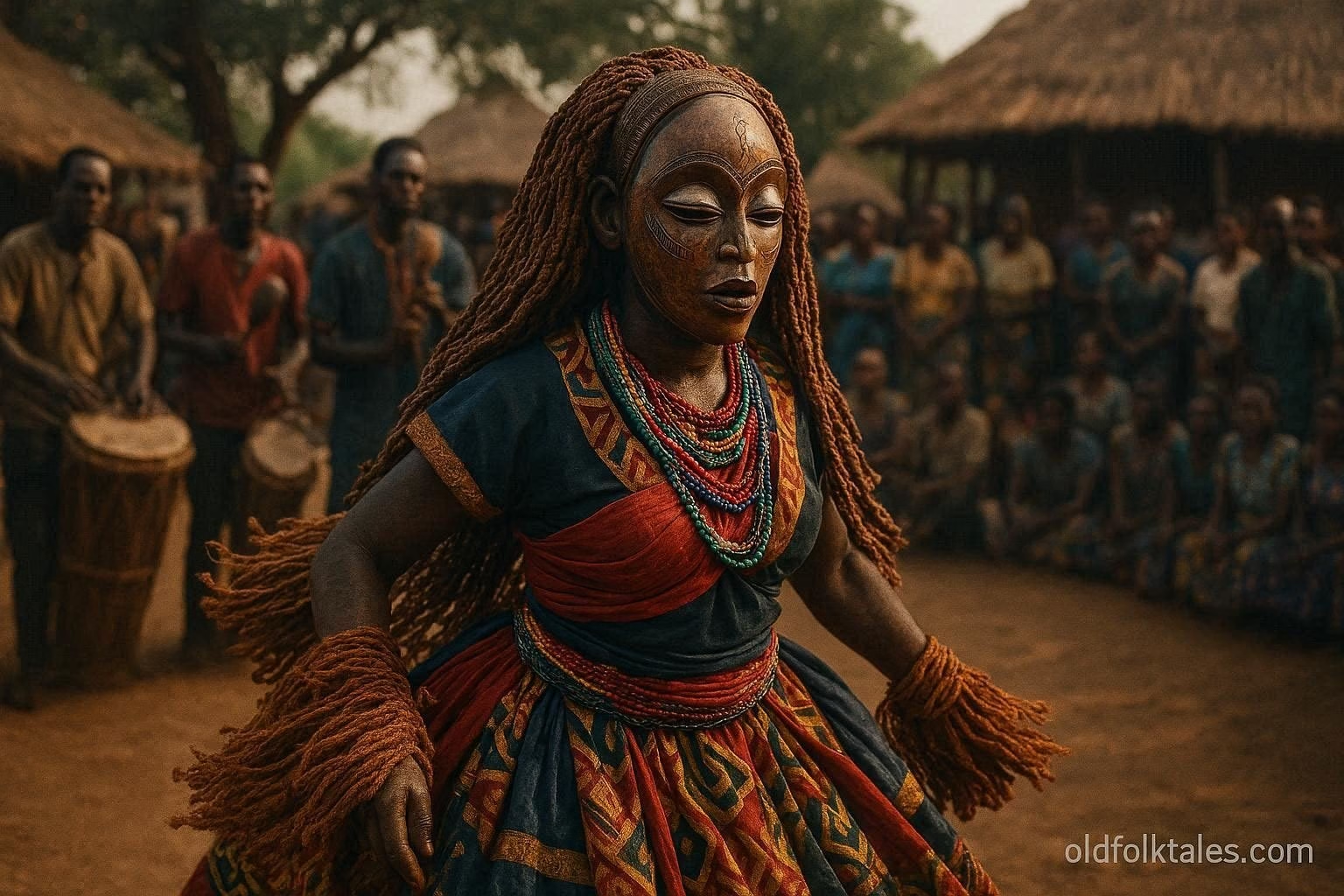
In documented Chokwe masquerade traditions, male performers portray Pwo or Mwana Pwo. Their costumes may cover the body with woven or braided fibres, cloth and other materials, concealing the dancer’s identity.
The performer does not rely on the mask alone to communicate the character.
Posture, gestures, rhythm and movement contribute to the performance. A fan, fly-whisk or other object may also form part of the dancer’s presentation.
In our imagined gathering, musicians prepare their instruments while the performer adjusts the costume. The dancer checks the mask and makes sure that the surrounding materials sit correctly.
Each movement during preparation serves a practical purpose.
The costume must remain secure, and the dancer needs enough freedom to move without losing balance. The mask must sit properly so that the performer can see and respond to the space around him.
Nearby spectators gather to watch.
Some admire the craftsmanship of the mask. Others anticipate the music and movement that will bring the figure to life.
The performer waits until the musicians are ready.
When the Mask Comes Alive
The first rhythms begin, and the gathering gradually settles into the performance.
The masked figure enters the open space.
Although the dancer’s identity remains concealed beneath the costume, the character becomes recognisable through its distinctive appearance and movements.
The performer moves with deliberate control. Gestures of the hands, the position of the body and the rhythm of each step contribute to the portrayal of feminine grace.
The dance is not simply a demonstration of physical skill. Its meaning emerges through the relationship between the performer, the audience and the cultural character represented by the mask.
In documented Mwana Pwo performances, dancers may interact with spectators through gestures, songs and movements. Their actions give the character a presence that a mask displayed behind glass cannot fully communicate.
The audience responds to the performance as it unfolds.
Some spectators focus on the dancer’s steps. Others notice the details of the costume or the expression carved into the wooden face.
The observer from our imagined gathering now understands why the mask cannot be separated entirely from the dance.
The carver created its physical form, but the performer gives that form movement. Music establishes the rhythm, while the audience completes the encounter through its response.
Together, these elements create a performance that combines visual art, movement and shared cultural knowledge.
The Meaning of Feminine Beauty
The Mwana Pwo figure is associated with feminine beauty, but its significance is not limited to outward appearance.
Chokwe masquerade traditions connect the figure with ideas about womanhood, ancestry and the place of women within society. Depending on the particular interpretation, Pwo may represent an honoured female ancestor, while Mwana Pwo emphasises the image of a young woman.
These interpretations are related, but they are not always identical.
The distinction matters because the masks do not all represent the same stage of womanhood in precisely the same way. Their meanings have been examined by researchers and interpreted through different cultural and historical contexts.
The carved face communicates these ideas through artistic conventions. Its hairstyle, facial markings and proportions reflect particular understandings of beauty, while variations allow carvers to express individual creativity.
The performance adds another dimension.
A dancer must convey the character through movement rather than facial expression alone. Graceful steps, carefully controlled gestures and interaction with the audience help communicate the figure’s qualities.
The result is a form of artistic expression in which carving and performance depend upon one another.
For the observer, the lesson becomes clearer with every movement. Beauty within the tradition is not simply a matter of appearance. It is also connected with cultural meaning, ancestral memory and the values represented by the masked character.
Music, Movement and Community
The Mwana Pwo masquerade belongs to a wider tradition of Chokwe masked performances known collectively as akishi.
These masked characters are associated with ancestral spirits and appear in particular social and ceremonial settings. Their roles vary, and their performances can communicate knowledge, entertain spectators and mark important occasions.
Pwo and Mwana Pwo are particularly significant within traditions connected with initiation.
In some Chokwe communities, masquerades appear during mukanda, the initiation process through which boys acquire knowledge and prepare for adult responsibilities. Mwana Pwo may also perform on other occasions, depending on the community and local practice.
Such performances bring together different forms of cultural knowledge.
The carver must understand the artistic conventions associated with the character. The performer must learn its movements and appropriate behaviour. Musicians must coordinate the rhythms, while spectators recognise the figure and respond to its appearance.
These responsibilities demonstrate that a masquerade is not the work of one person alone.
It depends upon the knowledge of artists, performers, musicians and community members who understand its place within their cultural life.
The observer begins to recognise this connection. What appeared at first to be a dance has become an encounter with a tradition sustained by many people.
Each participant contributes something different, yet all help maintain the performance’s meaning.
Learning from the Mask
As the gathering continues, the observer pays closer attention to the details that were initially overlooked.
The carved markings are no longer merely decorative. The costume is no longer simply an attractive arrangement of materials. Even the dancer’s measured movements acquire a deeper significance.
The observer realises that understanding the performance requires patience.
Some meanings can be explained through words, but others become clearer through watching the dance and learning how the community understands the character.
This is one reason cultural knowledge cannot always be separated from the practices through which people express it.
A museum can preserve a mask and make its craftsmanship available to new audiences. Researchers can document its materials, appearance and cultural associations. Photographs can record a performance at a particular moment.
Yet the complete experience of a living masquerade also involves movement, sound, interaction and the knowledge of those who participate in the tradition.
The wooden mask is an important part of that experience, but it is not the whole story.
For younger generations, learning about such traditions can create opportunities to understand the artistic achievements of their communities and the relationships between cultural objects and the people who value them.
The observer leaves the gathering with a different appreciation of the mask.
Its beauty remains striking, but its cultural significance has become equally important.
A Tradition That Connects Generations
The Mwana Pwo masquerade has attracted attention beyond the communities in which it developed. Masks associated with the tradition appear in museum collections, where they provide opportunities to study Chokwe sculpture and the meanings attached to ancestral figures.
Collections at the Smithsonian National Museum of African Art and The Metropolitan Museum of Art document Chokwe Pwo masks and explain their relationship to female ancestors, feminine ideals and masquerade performance.
These records also demonstrate the variety of artistic approaches found within the tradition. Individual masks differ in their materials, hairstyles, facial markings and other details.
Their preservation helps researchers and visitors learn about Chokwe artistic heritage. However, a museum object represents only one part of a wider cultural practice.
The tradition continues to derive meaning from the people who make, perform, interpret and recognise the masked character.
Returning to our imagined observer, the experience of the dance offers a lasting lesson. Cultural heritage survives through more than the preservation of physical objects. It also depends on the transmission of knowledge, the practice of artistic skills and the continued significance of traditions within community life.
The carver, the dancer and the audience all have a place in that process.
Each generation receives knowledge from those who came before, interprets it within its own circumstances and decides how to carry it forward.
The Mwana Pwo mask stands as a powerful example of this relationship between artistic expression and cultural memory.
Its carved face represents a carefully developed artistic tradition. Its performance gives that tradition movement and presence. Its association with female ancestors connects the present with generations whose lives continue to hold meaning for their descendants.
The story of the Mwana Pwo mask dance, as imagined here, is therefore a celebration of the cultural knowledge surrounding the tradition rather than a claim about the historical creation of the first mask.
Through carving, music, movement and shared understanding, the Chokwe people have maintained an artistic heritage that continues to invite study and appreciation.
The mask reminds us that cultural traditions endure when communities continue to practise, interpret and pass on the knowledge that gives them meaning.
Explore our complete Africa Folktales
Moral Lesson
Cultural heritage gains meaning through the knowledge, creativity and shared responsibilities of the people who preserve it for future generations.
Knowledge Check
1. Which people are associated with the Mwana Pwo mask tradition?
The Chokwe people of Angola and neighbouring parts of Central Africa.
2. What does the Pwo figure represent?
Pwo is associated with an honoured female ancestor, while Mwana Pwo emphasises the image of a young woman.
3. What materials are commonly used to make Pwo masks?
Wood is used for the carved face, while plant fibres, cloth, pigments and other materials may form part of the mask and costume.
4. Who traditionally performs the Mwana Pwo dance?
In documented Chokwe masquerade traditions, male performers portray Pwo or Mwana Pwo.
5. Why is movement important to the masquerade?
Gestures, graceful steps, music and interaction with spectators help communicate the character’s meaning.
6. What is the central lesson of this retelling?
Cultural heritage survives through the continued practice and transmission of artistic skills, knowledge and traditions.
Source
Adapted from documented Chokwe Mwana Pwo mask traditions described in the collections of the Smithsonian National Museum of African Art and The Metropolitan Museum of Art.
Explore More Angolan Folktales
- The River Spirit’s Three Questions
- The Cave of the Sleeping Ancestors
- The First Soba’s Staff
- Sona: The Sand Drawings of Wisdom
- The Caravan Leaders of Bié
- The Coronation of an Olosoma
- The Investiture of a Mwata
- The Women of the Kissange
- The Hunters of Cangandala