Long ago, in a forest filled with deer, wild boars, buffaloes, rabbits and many other creatures, there lived a lion named Numskull. He was powerful, feared by every animal and terribly proud of his strength. He considered himself the unquestionable master of the forest, and whenever hunger stirred within him, he hunted without mercy.
No animal was safe. Whether young or old, strong or weak, any creature unfortunate enough to cross his path could become his next meal. His endless killing filled the forest with fear, and the animals began to realise that if nothing changed, their entire community would eventually disappear.
At last, they gathered to discuss their terrible situation. After much deliberation, they agreed to approach the lion and plead for their lives.
With bowed heads and trembling voices, they stood before Numskull.
“Great King,” they began, “we beg you to put an end to this senseless slaughter. Your strength is beyond question, but killing every creature you encounter will bring no lasting benefit. A ruler should protect those under his care rather than destroy them. A king who consumes his subjects without restraint may enjoy a feast today, but he will soon have nothing left to rule.”
They explained that the forest could provide for him in a more orderly way. If Numskull agreed to remain in his dwelling, the animals would send him one creature every day to serve as his meal. This arrangement would guarantee his daily food while allowing the remaining animals to live without constantly fearing an attack.
Explore more stories from our The Panchatantra collection.
Numskull listened to their proposal. Although he was not particularly concerned about the animals’ suffering, he recognised that the arrangement would provide him with a regular supply of food without requiring him to hunt.
He accepted, but attached a frightening condition.
“Very well,” he declared. “I shall remain here, and you shall send me one animal every day. But if my meal fails to arrive, I will come out and devour every creature in this forest.”
The animals had little choice but to agree. Nevertheless, they were relieved that the lion had stopped roaming the forest in search of prey.
From that day onward, the creatures took turns supplying him with food. Each day, one animal was selected and sent to the lion. Some were old, some were frightened, and others were weighed down by grief at the thought of leaving their families behind. Yet none dared to refuse.
For a while, the arrangement continued peacefully.
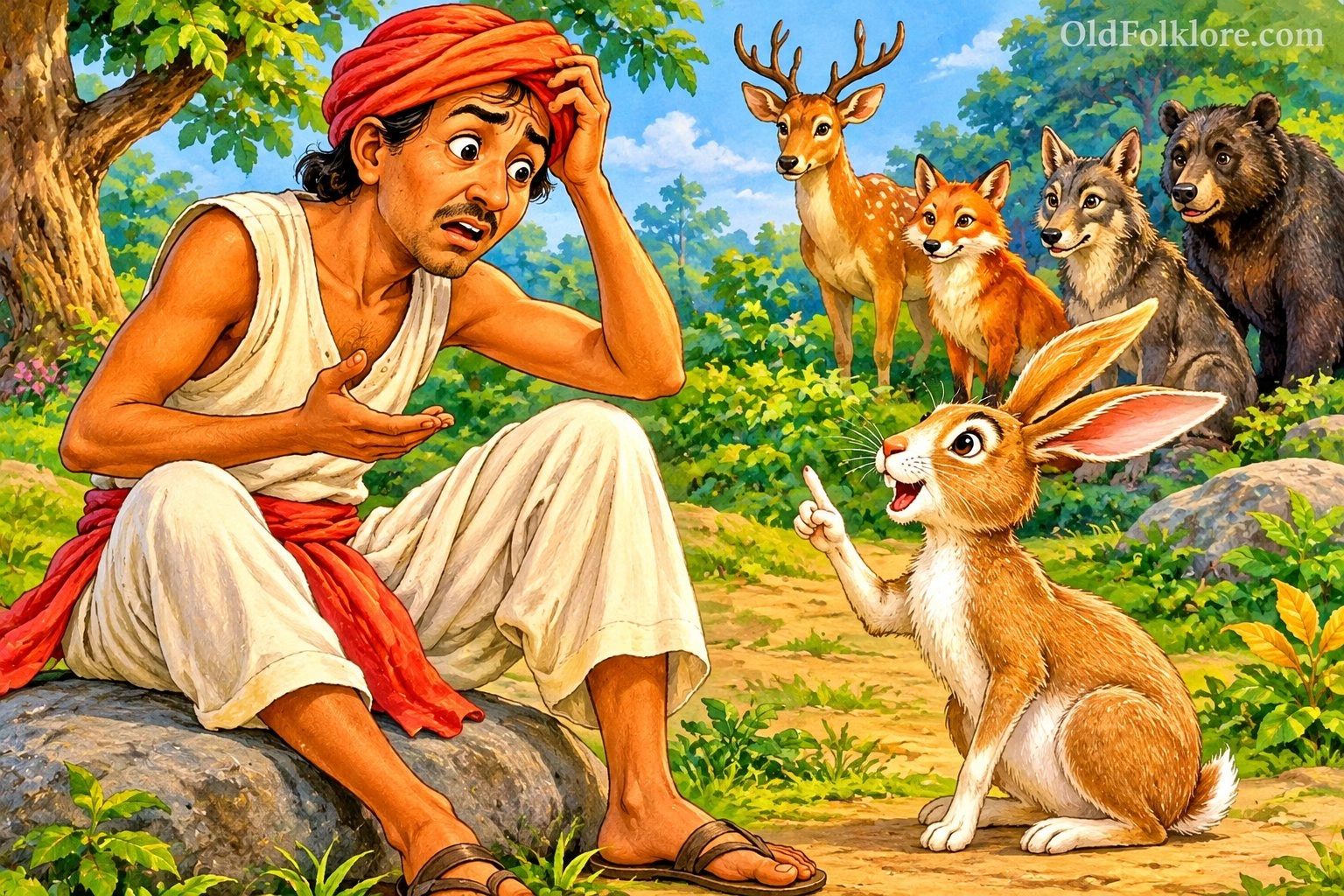
Then the day came when it was the rabbits’ turn.
The rabbits gathered together, knowing that one of them would have to face the lion. After considering their situation, they selected a small rabbit and prepared him for the journey. Because he was so little, they decided to send five other rabbits alongside him, hoping that the group would satisfy the lion’s appetite.
But as the six rabbits travelled through the forest, the selected rabbit began thinking about the terrible fate awaiting them.
He knew that Numskull would continue killing animals until there were none left. The agreement had merely delayed their destruction. If someone did not find a way to stop the lion, every creature in the forest would eventually perish.
The little rabbit considered the problem carefully.
How could a creature as small as himself defeat a lion of such enormous strength? He could not overpower Numskull in a physical fight, and running away would only postpone his death.
Then an idea began to form in his mind.
He realised that although he could not match the lion’s strength, he might be able to defeat him through intelligence.
Determined to try, the rabbit devised a plan. He sent the other five rabbits back and continued alone, deliberately travelling very slowly. He wanted to arrive late enough to make the lion furious, but he also needed time to prepare his deception.
By the time he finally reached Numskull, the sun was already declining.
The lion was terribly hungry. He had waited throughout the day for his meal, and his patience had almost disappeared. As he sat licking his lips, he began imagining what he would do to the animals for making him wait.
He had decided that if his dinner did not arrive soon, he would abandon their agreement and slaughter every animal in the forest the following morning.
When the little rabbit finally appeared, Numskull’s anger erupted.
“You miserable creature!” he roared. “Not only are you late, but you are so small that you could hardly make a proper meal. Your delay is an insult. I shall kill you now, and tomorrow I will destroy every species in this forest!”
The rabbit bowed respectfully.
“Great King,” he replied, “please do not punish the other animals for something that was not their fault. Nor was the delay my doing. I have a very important explanation, and I beg you to hear it before deciding my fate.”
The lion paused, curious despite his anger.
“Speak quickly,” he growled. “You had better have a good explanation.”
The rabbit began his story.
“Master, the animals knew that today was the rabbits’ turn to provide your meal. Because I am so small, they selected six of us to travel together. We were on our way to your dwelling when another lion suddenly appeared from a large hole in the ground.
“He demanded to know where we were going. We explained that we were bringing ourselves as your daily meal, according to the agreement made with you.
“But the stranger became furious. He claimed that the forest belonged to him and that no other lion had the right to receive its animals. He called you a thief and declared that he was the rightful ruler.
“He then challenged you to meet him. He said that whichever lion proved stronger would become king and have the right to feed upon all the animals.
“The stranger frightened us, and I was delayed while dealing with him. Eventually, he ordered me to come and summon you. That is why I have arrived so late, master.”
Numskull’s anger immediately turned away from the rabbit and towards the imaginary rival.
“What!” he thundered. “Another lion claims to rule my forest? Show me where this thief is hiding. I will teach him never to challenge my authority!”
The rabbit appeared hesitant.
“Of course, master. I will take you to him. But I must warn you that he is hiding inside a fortress. He knows how to protect himself, and such a place can be difficult to attack.”
Numskull was not impressed by the warning.
“I fear no fortress and no lion. Take me to him at once!”
The rabbit pretended to admire the king’s courage, although he knew that Numskull’s pride was precisely what he needed to exploit.
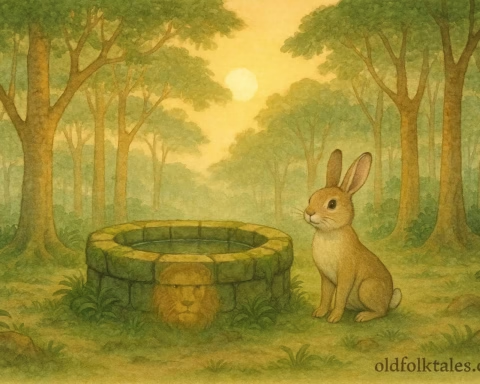
He led the furious lion through the forest until they reached a deep well.
“Here, master,” the rabbit announced. “This is where the other lion hides. He saw you approaching and immediately retreated into his fortress.”
Numskull stepped forward and peered into the well.
Far below, in the still water, he saw the reflection of a large lion staring back at him. He did not recognise his own image. Instead, he believed that his enemy was hiding beneath the surface.
His anger grew even greater.
He roared fiercely at the supposed intruder.
From deep inside the well came another roar, magnified by the echo. To Numskull, it sounded like a powerful challenge from an equally fearsome lion.
Unable to tolerate what he believed was an insult to his authority, he gathered himself and leapt into the well to attack his rival.
But there was no enemy waiting for him.
The lion plunged into the water and drowned.
Thus, the very strength that had made Numskull feared throughout the forest became useless against a clever rabbit who understood how to use his opponent’s pride against him.
The little rabbit returned to the gathering of animals with wonderful news. The tyrant was dead, and they were finally free from the daily terror of sacrificing one of their own.
The forest creatures celebrated his success, praising him for accomplishing what none of them had believed possible. The rabbit, once considered too small to be of any importance, had saved the entire community through intelligence and determination.
From that day onward, the animals lived peacefully in the forest, no longer forced to surrender one of their own to the lion.
And so the story teaches that intelligence can accomplish what physical strength cannot.
Explore our complete Historic Folklore & Fairy-Tale Collections archive.
Moral
Intelligence can overcome physical strength when courage is guided by careful thinking. Pride and uncontrolled anger can destroy even the most powerful individual. The rabbit teaches us that a difficult problem does not always require greater strength; sometimes, it requires a better plan.
Knowledge Check
1. Why did the forest animals agree to send Numskull one animal every day?
They hoped to stop his indiscriminate killing and protect the remaining animals by providing him with regular food.
2. How did the rabbit defeat Numskull?
He invented a story about another lion living inside a well and used Numskull’s reflection and the echo of his roar to convince him that a rival was hiding there.
3. What weakness caused Numskull’s death?
His pride, anger and inability to think carefully before acting.
4. What does the rabbit’s victory teach?
That intelligence, determination and good judgment can overcome physical disadvantages.
5. What literary tradition does the story belong to?
It belongs to the Indian Sanskrit narrative tradition of the Panchatantra, a collection of animal fables and stories about practical wisdom.
Source
This article is an original literary adaptation of Arthur W. Ryder’s 1925 English translation of “Numskull and the Rabbit.”
Explore More Panchatantra Tales