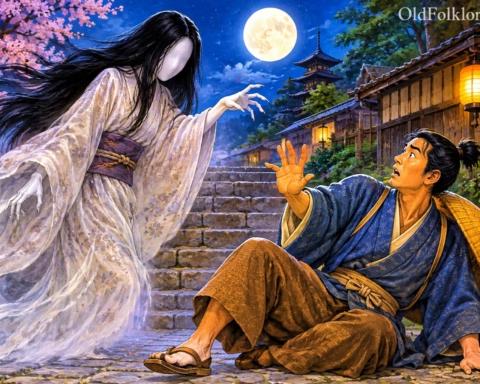
A journey through unfamiliar country can bring unexpected dangers, especially when night falls and a traveller must depend on strangers for shelter. In this Japanese supernatural tale, a Buddhist priest accepts an invitation to spend the night in a remote mountain home. His hosts appear polite and welcoming, but their true nature becomes clear after he discovers five headless bodies inside the house. Drawing upon his knowledge of supernatural writings and the courage he developed during his former life as a warrior, the priest faces creatures that ordinary travellers would struggle to survive.
A Former Samurai Becomes a Travelling Priest
Nearly five hundred years before the events of the tale, a samurai named Isogai Héïdazaëmon Takétsura served Lord Kikuji of Kyūshū. He came from a family of warriors and inherited a natural ability for military exercises. From childhood, he demonstrated exceptional strength and skill.
He surpassed his teachers in swordsmanship, archery and the use of the spear. His courage and ability made him an outstanding soldier, and during the Eikyō war he distinguished himself sufficiently to receive high honours.
However, the fortunes of Lord Kikuji’s household eventually declined. When the family lost its position, Isogai found himself without a master. He could easily have sought employment under another daimyō, but his loyalty to his former lord remained stronger than his desire for advancement.
Rather than enter the service of another ruler, he decided to withdraw from worldly affairs. He cut off his hair, abandoned his former military life and became a travelling Buddhist priest. He adopted the religious name Kwairyō.
Although he now wore the robe of a Buddhist priest, his former warrior spirit remained within him. He continued to possess the courage, alertness and physical strength that had made him respected as a samurai.
An Invitation from a Woodcutter
During his travels, Kwairyō reached the province of Kai. As evening approached, he found himself in a lonely area where there were few places to seek shelter.
Explore more stories from our Lafcadio Hearn’s Kwaidan collection.
A woodcutter noticed the travelling priest and approached him. The man warned Kwairyō that the surrounding area was haunted by dangerous beings. He nevertheless offered to take him to a humble dwelling where he could spend the night.
Kwairyō accepted the invitation.
When they arrived, he discovered that the house contained four other people besides the woodcutter. They received him with considerable politeness and made him comfortable.
Their host explained that he had once served a daimyō. He had been a man of position and means, but he had ruined his household through his attachment to women and wine. His selfish conduct had brought suffering and death upon others, and he had eventually lost everything.
He claimed that he now regretted his former behaviour. He had abandoned his previous life and devoted himself to helping unfortunate people.
Kwairyō listened to the account. The host’s explanation appeared sincere, and the priest promised to pray and read sûtras for his spiritual benefit.
The household treated their guest with respect. They provided him with a place to sleep, and nothing in their behaviour openly suggested that they intended to harm him.
Yet the priest remained unaware of the danger surrounding him.
Five Headless Bodies
After settling down for the night, Kwairyō began reading Buddhist sûtras. He continued his prayers while the household grew quiet.
Later, he became thirsty. Remembering that a bamboo aqueduct stood behind the house, he decided to obtain a drink without disturbing the sleeping people.
He carefully opened the sliding screens separating his room from the main apartment. The light from a lantern allowed him to see the interior.
What appeared before him was extraordinary.
Five bodies lay stretched out on the floor, but none had a head. Their necks were exposed, yet there was no blood around them. Kwairyō examined the scene and noticed that the necks did not appear to have been severed by a blade or any other weapon.
For a moment, he wondered whether he had witnessed a murder. However, the absence of blood and the unusual condition of the bodies made him reconsider.
He remembered the possibility that the house belonged to supernatural beings. The creatures he suspected were rokuro-kubi.
Kwairyō recalled a passage in a book called Sōshinki. According to the account in that book, if someone found the body of a rokuro-kubi without its head and moved the body to another place, the head would be unable to return to its proper position.
The book also described what would happen when the detached head discovered that its body had been moved. It would strike itself against the floor three times, bounce about like a ball and gasp in terror before eventually dying.
The priest reasoned that if the five bodies belonged to rokuro-kubi, their occupants probably intended him harm. He therefore decided to follow the instructions he remembered.
He seized the body of the household master by the feet, dragged it towards the window and pushed it outside. Having moved the body away from its original position, he left the room and went towards the rear of the house.
The Goblins Leave Their Bodies
Kwairyō found the back door barred. He suspected that the detached heads had left through the smoke-hole in the roof, which had been left open.
He carefully unbarred the door and stepped into the garden. Moving quietly, he continued towards a nearby grove.
As he approached the trees, he heard voices. He followed the sounds cautiously, moving from one shadow to another until he found a suitable place to hide.
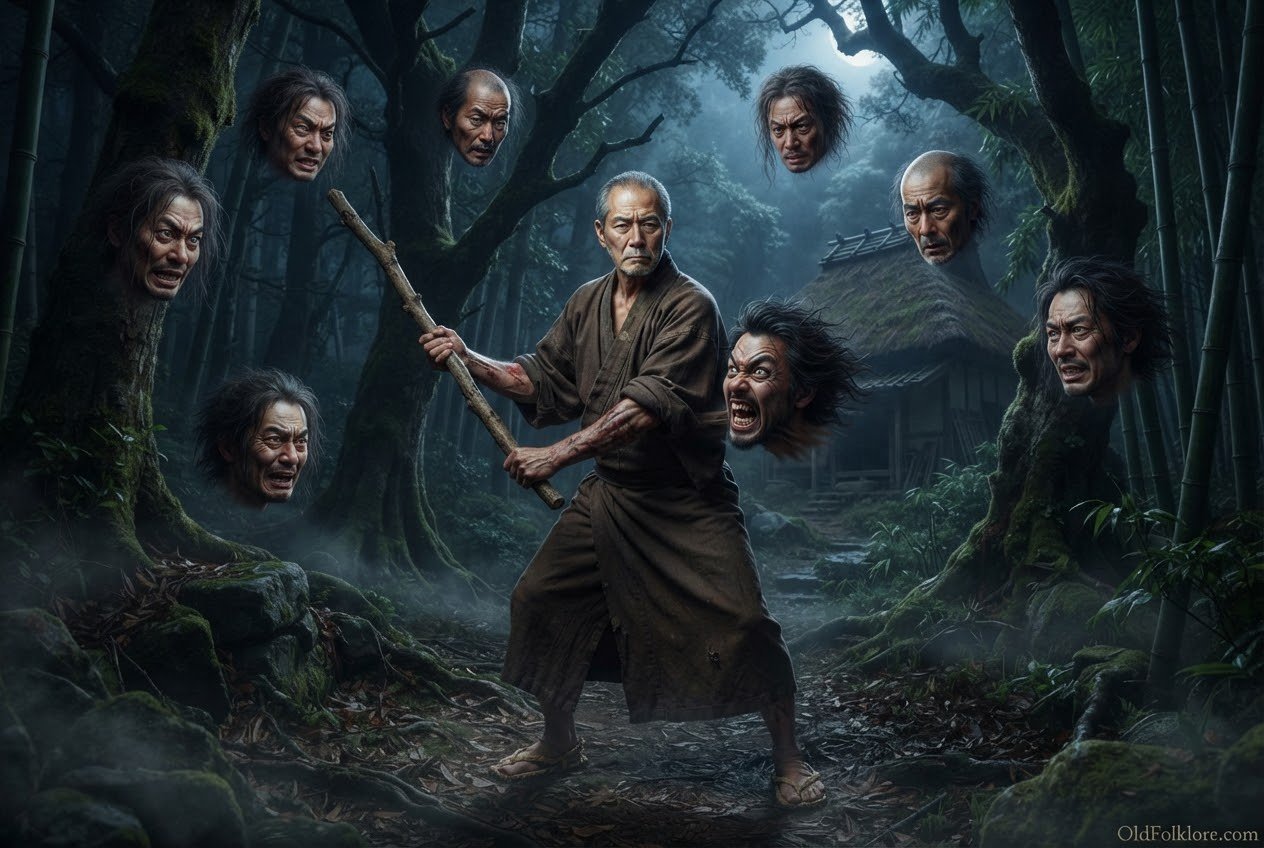
From behind a tree trunk, he saw five heads moving about in the grove.
They were not attached to bodies. They floated and moved independently while their owners conversed with one another. The heads searched the ground and the trees, eating worms and insects.
Kwairyō watched them closely.
Presently, the head belonging to the master of the house stopped feeding and spoke about the travelling priest who had arrived that evening. It described Kwairyō as a particularly fat man whose body would provide them with a satisfying meal.
The creature regretted having spoken to the priest earlier because the conversation had encouraged him to read Buddhist sûtras for its spiritual benefit. It explained that approaching someone while he was praying would be difficult, since the goblins could not touch him during his prayers.
The head believed that it was nearly morning and wondered whether the priest might have fallen asleep.
It then ordered one of the other heads to return to the house and discover what Kwairyō was doing.
The Priest Faces the Five Heads
The head sent to investigate returned to the grove. It reported that the priest was no longer in the house.
The head of the master became furious when it learned that its body had been moved. It understood that it could no longer reunite with the body and that it would eventually die.
The creature was so angry that it began attacking the others with its movements and cries. It then noticed Kwairyō hiding behind a tree.
The five heads immediately turned towards him.
They rushed at the priest, intending to kill him. Kwairyō, however, was not an ordinary traveller. His years as a samurai had given him exceptional physical strength and the ability to act quickly when confronted by danger.
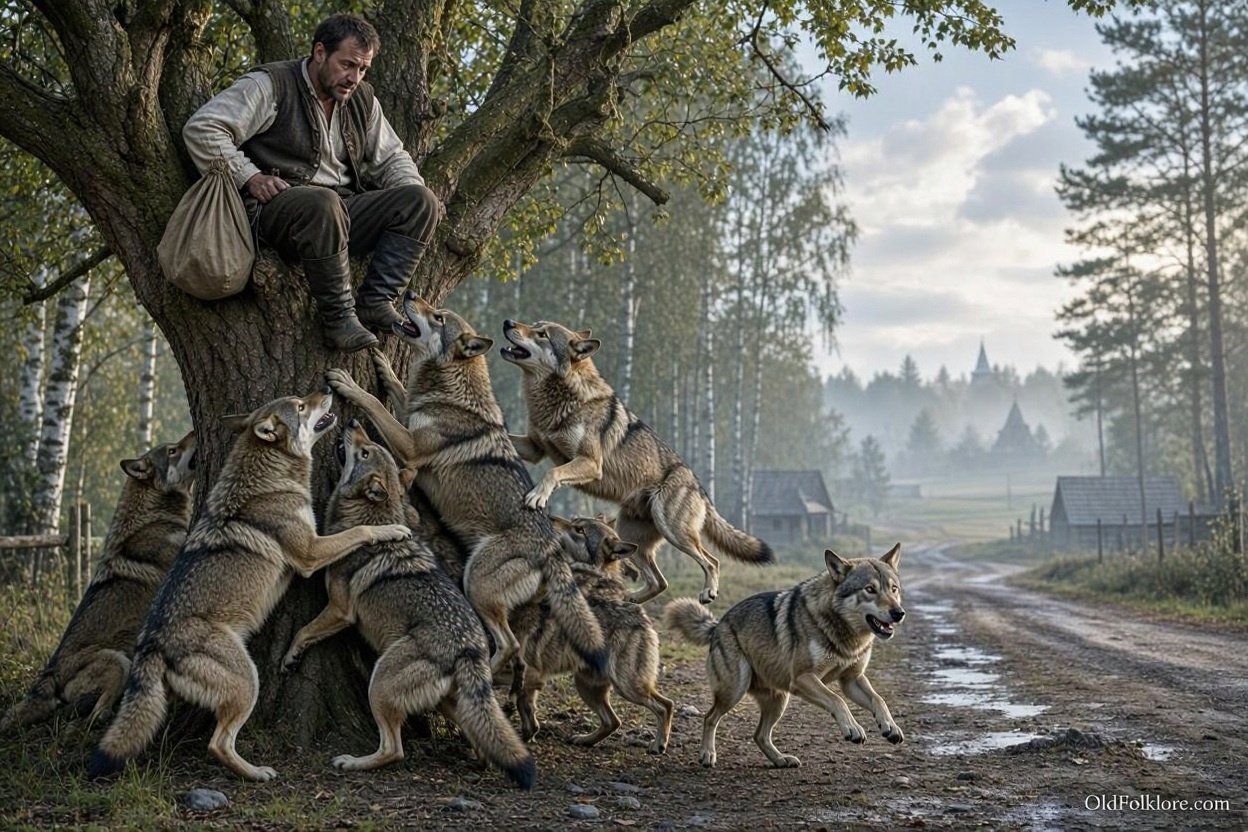
He seized a young tree and used it as a club. As the heads attacked, he struck them repeatedly.
Four of the heads eventually fled from the encounter. The head belonging to the master continued its attack, refusing to retreat even after receiving repeated blows.
It bounded towards Kwairyō and finally caught the left sleeve of his priestly robe with its teeth.
The priest tried to free himself, but the creature held on tightly. He then seized it by its topknot and struck it again and again.
The head continued gripping his sleeve. It eventually gave a long moan and stopped moving. Kwairyō had killed it, but its teeth remained firmly locked in the cloth.
Even with his considerable strength, he could not force open its jaws.
A Terrifying Souvenir
With the dead head still attached to his sleeve, Kwairyō returned towards the house.
There he saw the other four rokuro-kubi. Their heads had reunited with their bodies, and they were crouching together. Their heads appeared bruised and bleeding from the encounter.
When they noticed the priest at the back door, they began shouting in alarm. They recognised him as the man who had fought them in the grove.
The four creatures immediately fled through another doorway and disappeared into the woods.
By then, the eastern sky had begun to brighten. Dawn was approaching, and Kwairyō knew from his knowledge of supernatural beings that the goblins’ power was limited to the hours of darkness.
He looked at the head hanging from his sleeve. Its face was covered with blood, foam and dirt, while its teeth remained clamped onto his robe.
Instead of panicking, he laughed. He regarded the strange object as a miyagé, a souvenir that a traveller might bring home after a journey.
He gathered his belongings and descended the mountain at a leisurely pace, carrying the dead goblin’s head with him.
The Priest Is Accused of Murder
Kwairyō continued travelling until he reached Suwa in the province of Shinano.
The sight of a priest walking through the area with a severed head hanging from his sleeve caused considerable alarm. People who saw him were horrified. They could not understand why a Buddhist priest would carry such a gruesome object.
The authorities soon became involved. Police officers seized Kwairyō, suspecting that he had murdered someone and was carrying the victim’s head as evidence of his crime.
The priest was taken into custody and brought before the magistrates.
He explained that the head did not belong to a human being. According to his account, it was the head of a supernatural creature known as a rokuro-kubi.
The judges were unconvinced. They believed that he was inventing an extraordinary explanation to escape punishment for murder.
Kwairyō remained calm and repeated his account. He described the house in Kai, the five headless bodies, the detached heads in the grove and the fight that had ended with the death of the household master.
The magistrates considered his explanation difficult to believe. They were inclined to treat him as a murderer rather than accept that the head belonged to a goblin.
The Elder Magistrate Recognises the Goblin
An elderly magistrate decided to examine the head more carefully.
He turned it around and inspected the back of its neck. There he discovered several strange red characters. He also noticed that the edges of the neck did not show the appearance of a wound made by a weapon.
The separation was unusually smooth, unlike the result of an ordinary decapitation.
The elder magistrate then referred to a book called Nan-hō-ï-butsu-shi. According to the book, genuine rokuro-kubi could be identified by the presence of certain red characters on the nape of the neck.
The markings on the head matched the description.
The magistrate also explained that such supernatural beings had long been associated with the mountains of Kai. He concluded that Kwairyō had told the truth and that the object before them was indeed the head of a rokuro-kubi.
Having settled the question, the elder magistrate turned his attention to the priest himself. He observed that Kwairyō possessed the appearance and strength of a soldier rather than an ordinary religious traveller.
He asked whether the priest had once belonged to the samurai class.
Kwairyō confirmed that he had formerly been a warrior. He then revealed his earlier name: Isogai Héïdazaëmon Takétsura of Kyūshū.
The name caused a stir among those present. Several people remembered the famous warrior and recognised his reputation. The court filled with admiration for the man who had once served Lord Kikuji and had now demonstrated extraordinary courage against a supernatural enemy.
Kwairyō was no longer regarded as a suspected murderer. Instead, he received respect for his bravery.
The daimyō welcomed him, entertained him at a feast and gave him a present. The priest was allowed to continue his journey with the goblin’s head still in his possession.
A Robber Buys the Head
A day or two after leaving Suwa, Kwairyō encountered a robber on the road.
The robber ordered him to stop and surrender his possessions. He demanded that the priest remove his clothes and hand them over.
As the robber approached, he noticed the strange head still hanging from Kwairyō’s sleeve. The sight startled him.
He asked about the object and learned that it was supposedly the head of a goblin. The robber was impressed by the unusual appearance of the priest and declared that Kwairyō was more frightening than he was.
Rather than simply taking the priest’s clothing, the robber became interested in obtaining the head. He imagined that it could be useful for frightening people along the highways.
He offered Kwairyō his own robe and five ryō in exchange for the goblin’s head.
Kwairyō warned him that the object was not a human head. He explained plainly that it belonged to a supernatural creature and cautioned the robber not to complain later if it brought him trouble.
The robber dismissed the warning. He insisted that he wanted the head and offered the agreed payment.
Kwairyō finally allowed him to take it. He laughed at the robber’s willingness to pay good money for something that he believed was merely a goblin’s head.
The robber departed with the object and the priest’s robe. For some time, he travelled along the highways pretending to be a supernatural priest and using the head to frighten people.
The Robber Returns the Head
Eventually, the robber reached the neighbourhood of Suwa. There he heard the true account of the head and learned more about the strange creature to which it had belonged.
The story frightened him. He began to worry that the spirit of the rokuro-kubi might seek revenge or cause him trouble.
He therefore decided to return the head to the place where it had originated. He hoped to find the original body and bury the head with it.
The robber travelled back to the mountains of Kai and searched for the lonely cottage where Kwairyō had encountered the goblins.
When he arrived, however, the place was deserted. He could not find the household master or any of the other bodies.
He searched for the body that had belonged to the dead head, but it was nowhere to be found.
Since he could not reunite the head with its body, he buried it alone in the grove behind the cottage. He then arranged for a tombstone to be placed over the grave.
The robber also arranged for a Ségaki service to be performed for the spirit of the rokuro-kubi.
The tale concludes by explaining that the tombstone became known as the Tombstone of the Rokuro-Kubi. According to the Japanese storyteller whose account Hearn records, it could still be seen even in his own day.
Explore our complete Historic Folklore & Fairy-Tale Collections archive.
Moral Lessons
The story demonstrates the value of courage and clear judgement when facing unfamiliar dangers. Kwairyō does not allow fear to control him when he discovers the headless bodies. Instead, he considers what he knows, remembers the instructions in a supernatural book and acts decisively. His knowledge and bravery enable him to survive an encounter that could easily have ended in death.
It also shows that outward appearances can be misleading. The people in the mountain house welcome Kwairyō politely and offer him shelter, but their hospitality conceals a dangerous intention. The story reminds readers that friendliness alone does not establish that a stranger can be trusted.
Another lesson concerns the importance of remaining calm when accused or misunderstood. When the authorities mistake Kwairyō for a murderer, he does not abandon his explanation or respond with uncontrolled anger. He patiently describes what happened and allows the evidence on the head to support his account.
The robber’s experience offers a further warning about ignoring sound advice. Kwairyō clearly tells him that the head belongs to a goblin and that he is not deceiving him. The robber nevertheless takes it because he sees an opportunity to frighten people. Only after learning more about the creature does he become afraid and attempt to return it.
Finally, the ending reflects the importance of respecting the dead and acknowledging the spiritual beliefs represented in the tale. Unable to reunite the head with its body, the robber arranges a burial and a religious service for the creature. His actions bring the strange encounter to a formal conclusion.
Knowledge Check
1. What was Isogai Héïdazaëmon Takétsura’s former occupation?
He was a samurai who served Lord Kikuji of Kyūshū before becoming a travelling Buddhist priest.
2. Why did Kwairyō suspect that the five headless bodies belonged to rokuro-kubi?
There was no blood around their necks, and their bodies did not appear to have been cut by weapons. He remembered a supernatural book describing creatures whose heads could leave their bodies.
3. What did Kwairyō do after discovering the headless bodies?
He moved the household master’s body outside, following the instructions he remembered from the book Sōshinki.
4. How did Kwairyō defeat the household master’s head?
He used a young tree as a club, then seized the head by its topknot and struck it repeatedly until it died.
5. Why did the magistrates eventually believe Kwairyō’s account?
An elderly magistrate found unusual red characters on the nape of the head and recognised them as markings associated with rokuro-kubi.
6. What happened to the head after Kwairyō sold it to the robber?
The robber later became frightened after hearing the story. Unable to find the original body, he buried the head in the grove, erected a tombstone and arranged a Ségaki service.
Source
Retold from Lafcadio Hearn, Kwaidan: Stories and Studies of Strange Things (1904), under the original printed heading “ROKURO-KUBI.”
Lafcadio Hearn is credited as the author of this English literary rendering. The story appears in his collection of Japanese supernatural narratives. It should not be described simply as a direct translation from a named original text.
Hearn’s accompanying note explains that the rokuro-kubi is ordinarily conceived as a goblin whose neck stretches to great lengths while remaining attached to its body. The detached-head form in this particular story is therefore unusual.
Digital transcription: Project Gutenberg, eBook 1210.
Explore More Lafcadio Hearn’s Kwaidan
- Hoichi the Earless
- The Dream of Akinosuké
- Of a Mirror and a Bell: The Strange Legend of Mugen
- Jikininki: The Terrifying Japanese Spirit
- Aoyagi and the Willow Tree Spirit