In this Algerian folktale recorded in Oran, a young man named Mqaydesh sets out with his brothers after their father tells them to find their own way in the world. Their journey brings them to the home of a dangerous ogress, whose invitation to share coffee conceals a deadly plan. While his brothers fail to recognise the danger, Mqaydesh watches carefully and uses his intelligence to escape. Yet surviving the ogress is only the beginning of his troubles. His brothers resent his success, and their jealousy leads him into another dangerous test.
A Father Sends His Sons into the World
Long ago, Mqaydesh lived with his father and brothers. They shared a home, but their father eventually decided that his sons should leave and learn to provide for themselves.
One day, he called them together.
“You must go out into the world,” he told them. “Find a way to support yourselves and bring back food for your needs.”
The brothers prepared their horses and set off. They travelled together, searching for a way to make their living. Mqaydesh went with them, but he was not quite like the others. He was bold and quick to think, qualities that would soon prove essential.
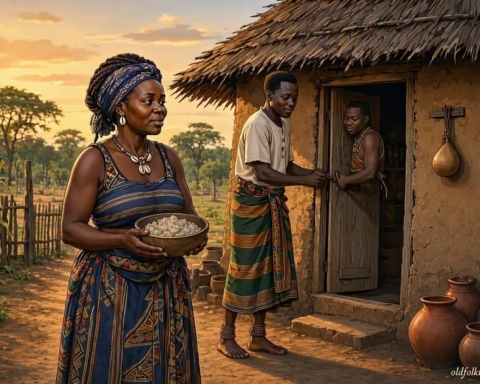
During their journey, the brothers reached a place where an ogress was growing beans. Instead of keeping away from her garden, they began pulling up the plants.
The ogress noticed the strangers disturbing her crop. She approached them and asked what they were doing.
“We are pulling up the beans,” they answered.
Rather than attacking them immediately, she concealed her anger and invited them into her home.
“Come inside,” she said. “I will give you coffee. You can rest before you continue your journey.”
The invitation sounded generous. The brothers accepted, believing they had been offered ordinary hospitality. They did not understand that the ogress had another purpose in mind.
The Ogress Prepares Her Trap
The ogress welcomed the travellers inside. Among the animals they had brought was a donkey. While the brothers were occupied, she slaughtered it and placed its head at a window, arranging it so that it appeared to be eating.
The sight helped conceal what she had done. The visitors did not immediately realise that their animal was dead.
Explore more stories from our West African Folk-Tales collection.
The ogress continued acting as their hostess. She asked what their horses normally ate, explaining that she would provide food for the animals while serving coffee to their riders.
“Give them barley and straw,” the brothers replied.
Mqaydesh, however, did not answer in quite the same way. He told her that his horse ate stones.
The answer was strange, but the ogress accepted it and prepared the food as requested. Mqaydesh’s unusual reply would later become important, for it gave his horse a way to escape the trap that caught the others.
As the day drew towards evening, the ogress prepared a large cooking pot. Her apparent hospitality was a disguise: she intended to kill and cook the travellers.
Before night came, she asked where each of them planned to sleep.
The brothers agreed to sleep on the floor. Mqaydesh chose a different place for himself. He said that he would sleep in a basket rather than on the ground.
The ogress allowed him to do as he wished.
But Mqaydesh remained alert. He did not trust the woman who had welcomed them so warmly after finding them destroying her plants. While his brothers settled down, he kept watch.
A Night of Deception
When darkness fell, the ogress began checking whether the visitors were asleep. She wanted to make sure that no one would interfere with her plan.
She found the brothers resting and was pleased. Yet whenever she asked whether everyone was asleep, Mqaydesh made it clear that he was still awake.
The ogress questioned him.
“Why have you not gone to sleep?”
Mqaydesh gave her an excuse. He said that her goats were making noise and disturbing him. If she wanted him to rest, she should take the animals out to the forest.
The ogress went to deal with the goats. When she returned, she found that the brothers were still lying where they had been. Mqaydesh remained awake.
Again, he told her that the goats were causing trouble and that she should return to the forest to check on them.
The ogress left a second time.
This was the opportunity Mqaydesh had been waiting for.
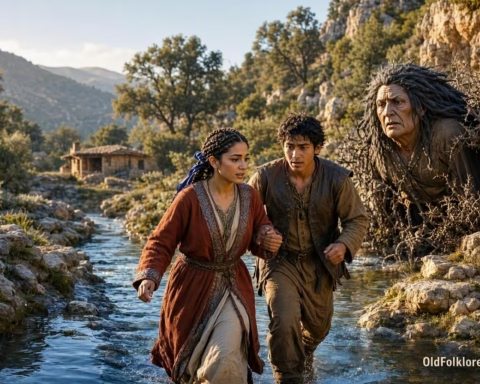
He woke his brothers and moved them away from their places. In their stead, he placed the ogress’s own children. Then he took his brothers and escaped with them.
The ogress returned, believing that the visitors were still where she had left them. She prepared the contents of the pot and cooked her own children, unaware that Mqaydesh had exchanged them with his brothers.
When she discovered the deception, she realised that the young man had escaped with the others.
She rushed after them.
The ogress managed to catch Mqaydesh’s brothers, but he himself escaped. He had saved his own life through quick thinking, although his brothers were now prisoners.
The Brothers Turn Against Their Rescuer
Mqaydesh returned to his father. His father asked how the journey had gone and what had happened to the others.
Mqaydesh explained that they had reached the ogress’s home and that she had captured his brothers. He had escaped, but they had not.
His father was displeased.
“If I had been there,” he said, “I would have rescued your brothers. They would not have been left in her hands.”
The brothers, however, did not acknowledge that Mqaydesh’s actions had saved them from being cooked in the ogress’s pot. They resented him, and their resentment made them unwilling to give him credit for anything he had done.
They began setting him tasks connected with their escape. First, they demanded that he bring the ogress’s covering cloth as proof of his success.
Mqaydesh returned to the ogress’s home. He found the covering cloth hanging out to dry and secretly filled it with needles. When the ogress put it over herself, the needles pricked her. She recognised the trick and suspected that Mqaydesh had been responsible.
He had managed to carry out the task, but the brothers were not satisfied. They wanted him to bring the ogress herself.
This demand was far more dangerous. Mqaydesh knew that if he approached her carelessly, she would kill him.
A Wise Man Offers Advice
Worried about the demand, Mqaydesh sought advice from an older, wise man. He explained the problem and asked how he could capture the ogress without becoming her next meal.
The wise man suggested a plan involving a large coffin.
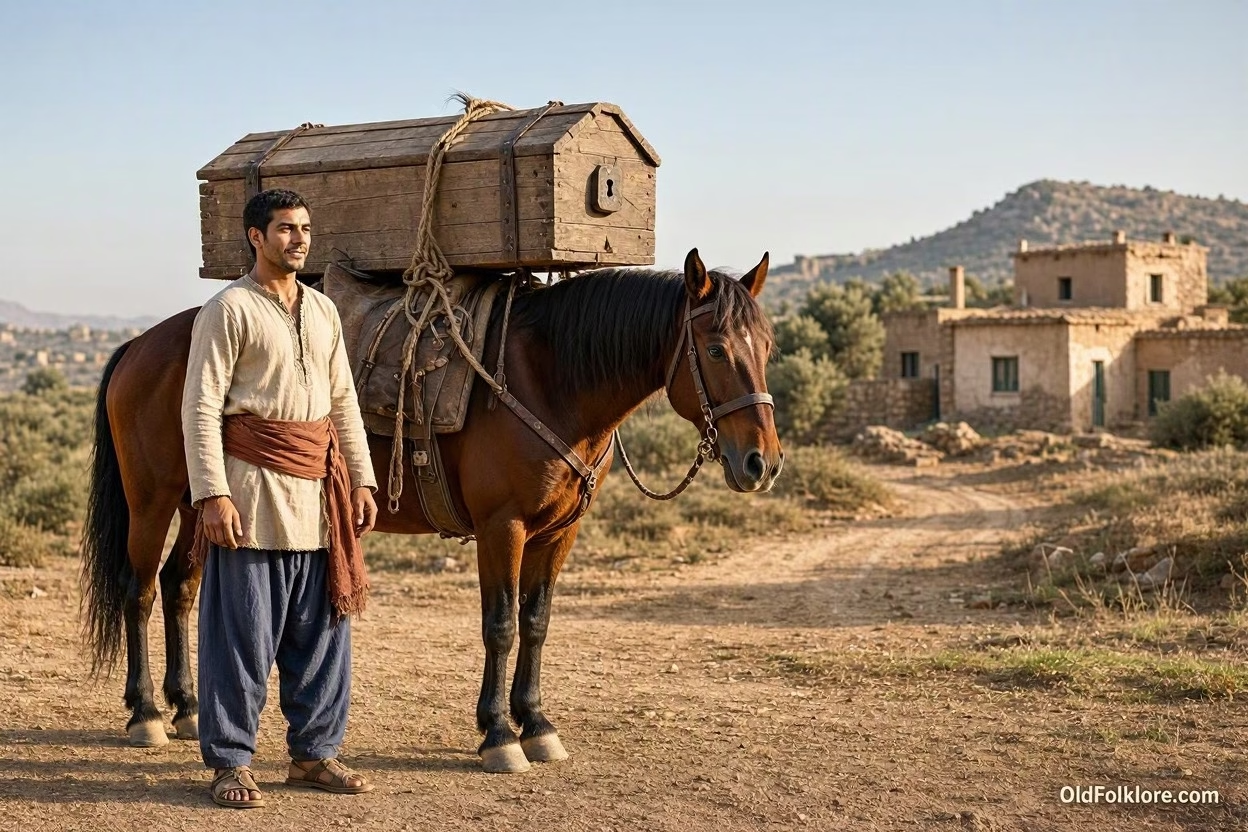
Mqaydesh obtained one and placed it on his horse. He then went to the ogress’s home, presenting himself as someone who sold coffins.
He called out to attract attention and explained that he was selling them for people to use in different seasons. When the ogress came out, he offered to show her the coffin.
She became interested.
Mqaydesh told her that if she wanted to buy it, she would need to climb up and check whether it was the right size. He pretended that he could not lift or lower the coffin in the way she expected.
The ogress climbed up to inspect it.
That was the moment Mqaydesh had prepared for. Once she was inside, he shut the coffin and secured her within it.
He had captured the dangerous creature who had imprisoned his brothers. He then carried her to his father’s home.
The Final Test
When Mqaydesh returned with the ogress, he told his father that he had brought her back.
His brothers refused to believe that he had achieved this by himself. They insisted that other people from the village had brought her and that Mqaydesh was claiming credit for their work.
Their accusations placed Mqaydesh in danger once again.
They proposed a final test: he should spend the night alone with the ogress in a separate house. If she could eat him, then his claims would be exposed as lies. If he survived, he would prove his ability.
Mqaydesh understood the risk. The ogress was still dangerous, and a locked room would give him little opportunity to escape. He did not know how to survive the night.
Once more, he sought help from a wise man.
The man asked whether Mqaydesh had a horse. When he learned that he did, he told him to ride from one village to another and collect a bottle of water. Mqaydesh followed the instructions and returned with the bottle.
The wise man explained what he must do next. When the ogress came close enough to attack him, he should throw the water into her face.
Mqaydesh took the bottle and prepared himself for the final encounter.
Mqaydesh Defeats the Ogress
That night, Mqaydesh was placed in the house with the ogress. His brothers expected her to kill him. They believed that, at last, his luck would run out.
The ogress approached, ready to devour him.
Mqaydesh waited until she came close. Then he threw the water from the bottle into her face, following the wise man’s instructions.
The water had the effect the wise man had promised. The ogress dried up and died.
Morning came, and the others went to see what had happened. They called for Mqaydesh, expecting that he would be dead. At first, he did not answer. He knew that the ogress had been defeated and allowed them to continue calling.
Eventually, they opened the door.
There was Mqaydesh, alive, and the ogress lay dead.
His brothers could no longer deny that he had survived the challenge. Their plan to discredit him had failed, just as the ogress’s earlier attempts to kill him had failed.
Their father recognised what had happened. He had seen Mqaydesh return alive from danger, capture the ogress and survive the final test. His other sons, meanwhile, had responded to their brother’s success with jealousy rather than gratitude.
The father ordered the brothers out of his home and allowed Mqaydesh to remain with him.
So Mqaydesh, who had faced danger through cleverness and courage, finally found safety at home. The ogress could no longer threaten him or his family, and his brothers’ attempts to undermine him had come to nothing.
Explore our complete Algerian Folktales archive.
Moral Lesson
Intelligence, alertness and courage can help a person overcome danger, but jealousy can turn family members against one another. Mqaydesh survives because he observes carefully, thinks quickly and seeks wise advice when he needs it. His brothers, by contrast, refuse to acknowledge his help and allow envy to guide their actions.
Knowledge Check
1. Why did Mqaydesh and his brothers leave home?
Their father told them to go out into the world, find a way to support themselves and bring back food.
2. How did the ogress lure the brothers into her home?
She invited them inside for coffee after finding them pulling up the beans she had planted.
3. How did Mqaydesh escape while his brothers were captured?
He stayed awake, repeatedly persuaded the ogress to go to the forest, exchanged his brothers with her children and escaped with his brothers while she was away.
4. Why did Mqaydesh’s brothers turn against him?
They were jealous and refused to acknowledge that he had saved them from the ogress.
5. How did Mqaydesh capture the ogress?
Following a wise man’s advice, he pretended to sell coffins and tricked the ogress into climbing inside one before shutting her in.
6. How did Mqaydesh survive the final test?
He followed the wise man’s instructions and threw water into the ogress’s face when she approached him. She dried up and died.
Source
Adapted from “Mqaydeš and the Ogress,” a tale recorded from Rabiaa of Boutlelis and published in Francisco Moscoso García and Zohra Labed, Cuentos de Orán y su región (Argelia), Boletín de Literatura Oral, 16 (2026), pp. 324–362.
Explore More Algerian Folktales
- The Lion and the Son of Woman
- The Raven and the Child: A Mysterious Kabyle Folktale
- The Two Hunters: An Algerian Folktale of Justice
- Mohamed ben Soltan: A Thrilling Kabyle Folktale
- Thizourith Imellah: A Powerful Tale of Jealousy