In a Kabyle animal tale from Algeria, a tiny wren builds its nest beside a path. When its young see a camel passing nearby, they are astonished by the enormous creature. Their father, however, refuses to believe that any animal could be greater than himself. His confidence is put to the test when the camel returns.
A Nest Beside the Path
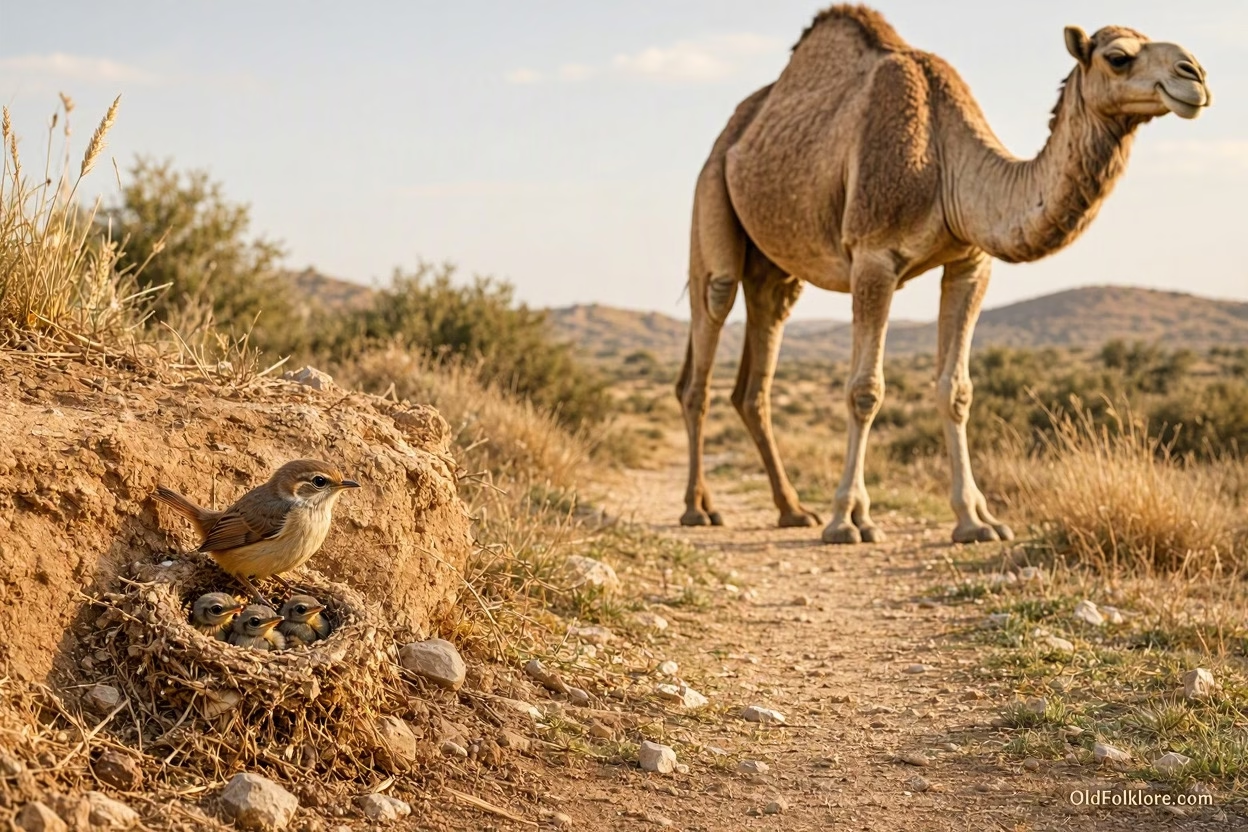
Long ago, a tiny wren built its nest on the bank beside a path. The little bird chose a place where it could raise its young and leave the nest each day to search for food.
Before long, the eggs hatched, and the nest filled with hungry chicks. Their father worked tirelessly, flying away to find nourishment and returning to feed them.
The wren was a small bird, but it took great pride in its place in the world. It had never considered that another creature might be greater than itself.
The Giant on the Road
One day, while the wren was away searching for food, a camel passed along the path.
Explore more stories from our West African Folk-Tales collection.
The young birds had never seen an animal so large. They watched in amazement as the enormous creature moved past their nest.
When their father returned, they hurried to tell him what they had witnessed.
“Father,” they exclaimed, “a gigantic animal has just passed our nest!”
The wren listened to their description with disbelief. It could not imagine that any animal was larger than itself.
“Was it as large as this?” the wren asked, extending one of its legs.
The chicks insisted that the animal had been much bigger.
Their father stretched out a leg and a wing.
“Perhaps it was this large?”
“No, Father,” they replied. “It was far bigger!”
The wren spread its legs and wings as widely as it could, trying to imagine the creature its young described.
Still, the chicks maintained that the passing animal had been much larger.
At last, the wren dismissed their account.
“You must be mistaken,” it declared. “There is no animal greater than I am.”
The Camel Returns
The wren’s certainty remained unshaken. It had listened to its young, but it judged the world according to its own small experience.
Before long, the camel returned along the same path.
The wren settled near its nest as the great animal approached. The camel was indeed enormous beside the little bird, and the difference between them was impossible to ignore.
As the camel moved past, it caught the wren between its teeth. Yet the little bird slipped through and emerged unharmed.
The wren returned safely to its young.
Now the bird had encountered the very creature its chicks had described. The camel was far larger than the wren, and no amount of stretching its legs and wings could make the little bird comparable in size.
Yet the wren had survived the encounter.
The story closes on this contrast: the camel was a giant beside the tiny bird, but the wren escaped unharmed. Its smallness had not made it worthless, even though its pride had prevented it from believing its young.
Explore our complete Algerian Folktales archive.
Moral Lesson
The tale reminds us that our own experience does not define the limits of the world. The wren assumes that no creature can be greater than itself because it cannot imagine anything beyond what it knows. The story encourages humility and reminds us to listen when others describe experiences different from our own. It also shows that being small does not necessarily mean being helpless.
Knowledge Check
1. Where did the wren build its nest?
The wren built its nest on the bank beside a path.
2. What amazed the young birds while their father was away?
They saw a camel passing along the path and were astonished by its enormous size.
3. Why did the wren refuse to believe its young?
The wren was so confident in its own importance that it could not imagine an animal larger than itself.
4. How did the wren try to understand the size of the animal?
It stretched out its leg, then its leg and wing, and finally spread both legs and wings to compare itself with the creature described by its young.
5. What happened when the camel returned?
The camel caught the wren between its teeth, but the little bird escaped unharmed.
6. What lesson does the folktale teach?
It teaches humility, open-mindedness and the importance of recognising that the world is larger than our own experience.
Source
Adapted from “Le Roitelet” in Joseph Rivière’s Recueil de contes populaires de la Kabylie du Djurdjura (1882), page 139.
Explore More Algerian Folktales
- The Lion and the Son of Woman
- The Mule, the Jackal and the Lion
- Solomon and the House of Eggs
- The Lion and the Son of Woman
- The Raven and the Child: A Mysterious Kabyle Folktale
- The Two Hunters: An Algerian Folktale of Justice