When Tembwe joined the other boys preparing to enter Mukanda, he believed that courage and physical strength would earn him respect. The forest camp, however, would demand more than determination. Under the guidance of experienced elders, he would encounter lessons about cooperation, honesty and the responsibilities that accompany adulthood. As the days passed, Tembwe began to understand that becoming a responsible member of the community required him to listen, learn from his mistakes and consider the needs of others.
The Call of Mukanda
Among the Chokwe and Lunda-Cokwe peoples of Angola, Mukanda has traditionally served as an important male initiation institution. Documented accounts describe a period of separation from ordinary village life during which initiates receive instruction, acquire practical knowledge and prepare for greater participation in their communities. The customs and teachings associated with Mukanda vary between communities, reflecting the different circumstances in which the tradition is practised.
For Tembwe, the approaching initiation marked an important stage of his life. He had watched older boys return from their period of instruction with a new sense of maturity. Their experiences made him eager to begin his own journey, although he knew little about what awaited him.
He imagined that the experience would test his endurance and strength. In his mind, the boys who performed the most difficult tasks would earn the greatest respect. He hoped to distinguish himself from his companions and prove that he was ready to take on the responsibilities of an adult.
His grandfather, however, encouraged him to think differently.
“Growing older is not the same as becoming wise,” the old man told him. “Your actions will show what you have learned.”
Tembwe listened, but he did not fully understand the advice. He believed that his grandfather was reminding him to remain courageous when difficulties arose.
As the appointed time approached, families prepared for the boys’ departure. Relatives offered encouragement, while experienced members of the community helped the initiates understand the significance of the transition ahead. The occasion represented more than a change in age. It marked preparation for new responsibilities within the community.
When the day finally arrived, Tembwe joined the other boys and their instructors. After bidding farewell to their families, they followed the path leading away from the village and towards the forest.
Tembwe walked with determination. He was ready to face whatever challenges lay ahead, unaware that some of his most important lessons would concern the way he treated other people.
Entering the Forest Camp
The journey took the group through woodland and patches of open ground. The boys followed their instructors, stopping when necessary to organise their belongings and prepare for the next stage of the journey.
Tembwe observed his surroundings carefully. Although he tried to appear confident, he wondered how different life in the camp would be from the routines he knew at home.
Eventually, they reached the designated camp. Shelters and working areas had been prepared among the trees, providing space for the initiates to live and carry out their daily activities during the period of instruction.
Life there followed an organised routine. The boys were expected to respect the instructions of their elders, complete assigned tasks and contribute to the group’s work. They could not simply pursue their individual interests whenever they pleased.
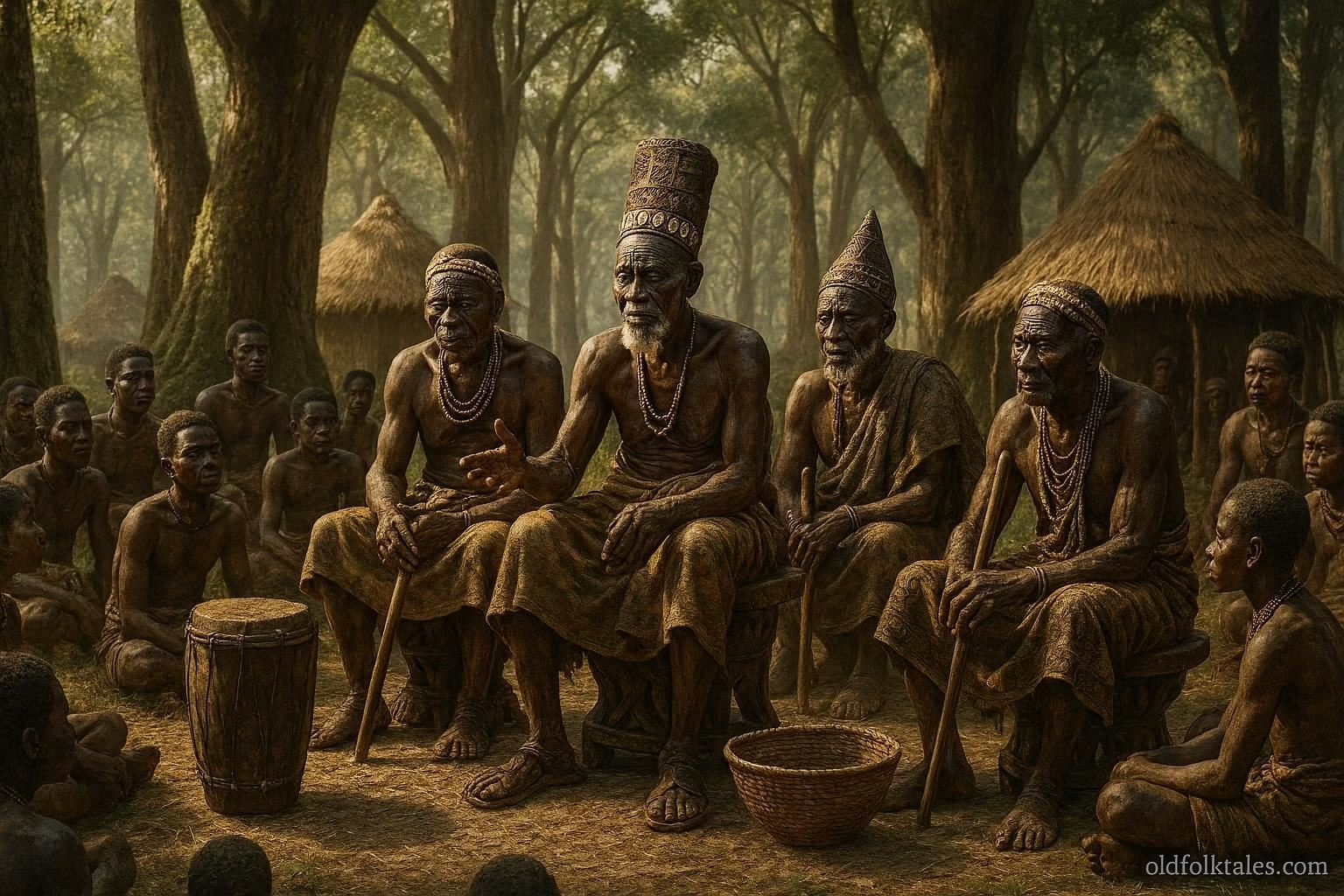
During their first gathering, an elder explained the purpose of their stay.
“You have come here to learn,” he told them. “You will gain knowledge and develop skills, but you must also learn how to use what you know. Understanding a lesson is only the beginning. Your conduct will show whether you have truly understood it.”
Tembwe had expected a physical challenge or a demanding test. Instead, the elder spoke about discipline, respect and the importance of fulfilling one’s obligations.
The boy began to reconsider his expectations. He had imagined adulthood as a time when people gained greater freedom and authority. Now he was beginning to understand that greater responsibility also required self-control.
That evening, as the camp settled into its routine, he remembered his grandfather’s words. Perhaps the greatest challenge would not be proving how strong he was, but learning how to behave when things did not go according to his wishes.
Learning the Value of Cooperation
The days that followed brought practical activities and opportunities to learn from experienced members of the community. Mukanda has traditionally combined instruction with practical work, although the precise activities and teachings differ between communities.
Tembwe soon discovered that completing a task successfully often required more than individual effort.
Explore more stories from our Angolan Folktales Collections archive.
One morning, the boys were divided into groups and asked to organise a working area and prepare a shelter for their activities. Each group needed to gather suitable materials, arrange its supplies and complete the work within the allotted time.
Tembwe immediately began collecting materials. He wanted to finish quickly and believed that taking the initiative would demonstrate his ability.
His companion Chisola suggested that they discuss the task before beginning. By dividing the work, he explained, they could make better use of everyone’s strengths.
Tembwe dismissed the suggestion.
“We will finish faster if we start immediately,” he insisted.
He hurried into the surrounding woodland to collect branches and other suitable materials. Before long, he had gathered more than he could carry comfortably. Meanwhile, his companions struggled to organise the remaining supplies because they had not agreed on how to divide the work.
Their progress slowed. Some materials were unsuitable, and other useful items remained uncollected.
Nearby, Chisola’s group had taken a different approach. The boys had discussed their responsibilities, shared the work and helped one another when difficulties arose. Their shelter was completed before Tembwe’s group had finished organising its materials.
When the instructor inspected the work, he asked Tembwe to explain the difference.
At first, Tembwe blamed the difficulty of the task. He argued that gathering the materials had taken longer than expected.
The instructor listened before asking whether Tembwe had considered his companions’ suggestions.
The boy lowered his head. He admitted that he had been more concerned with demonstrating his own ability than with helping the group succeed.
The instructor reminded him that individual effort was important, but cooperation could make difficult work more manageable. A person who refused to listen might waste time and prevent others from contributing their abilities.
Tembwe accepted the correction.
During the next assignment, he listened to his companions before deciding how to proceed. They divided the responsibilities, checked their materials and assisted one another where necessary.
The task became easier, and the group completed it successfully.
Tembwe began to understand that cooperation did not diminish his abilities. Instead, it allowed him to use those abilities more effectively while respecting the contributions of others.
The Lesson of Honesty
Another experience challenged Tembwe to examine his behaviour more closely.
During a discussion about conduct within the community, an elder asked the boys to consider why honesty mattered in their relationships with other people.
Several initiates responded. One explained that people needed to trust those who made promises. Another observed that dishonesty could cause disagreements between families and companions.
Tembwe remained silent.
He remembered an incident from his village. While playing near his family’s home, he had accidentally damaged a household tool. Afraid of being punished, he blamed another boy.
His lie had caused unnecessary trouble. The accused boy was questioned by his family, and an argument followed before the truth finally emerged.
Although the matter had eventually been resolved, Tembwe had never forgotten the embarrassment and disappointment that followed.
As the discussion continued, he realised that he had an opportunity to acknowledge his mistake. Gathering his courage, he told the group what had happened.
He explained how fear had led him to blame someone else and how his dishonesty had damaged the trust between their families.
The other boys listened. Some recognised that they, too, had made mistakes when trying to avoid punishment or embarrassment.
The elder explained that honesty did not mean a person would never do anything wrong. Everyone could make mistakes. What mattered was the willingness to acknowledge wrongdoing, accept responsibility and make an effort to correct the harm caused.
Tembwe realised that his lie had not protected him. Instead, it had placed the burden of his mistake on an innocent person.
From that day, he tried to speak more honestly about his actions. When he made an error during a task, he worked towards acknowledging it rather than inventing an excuse.
He still found it difficult to admit his mistakes, particularly when he feared criticism. Nevertheless, he began to understand that accepting responsibility was a necessary part of earning the trust of others.
Learning from the Wisdom of Elders
Practical activities were not the only opportunities for learning. In the communities where Mukanda is practised, knowledge and cultural values have also been transmitted through instruction from experienced members, stories, performance and other forms of cultural teaching.
Tembwe paid close attention whenever an elder shared an experience or explained the consequences of a particular choice.
One evening, the boys gathered to hear an account about a village that had experienced a difficult planting season.
Several families had prepared their fields, hoping for a good harvest. However, the weather had affected their crops differently. Some households had lost much of what they planted, while others had managed to preserve a portion of their harvest.
As food became scarce, disagreements arose over how the available supplies should be distributed. Each household worried about the needs of its own members and feared that sharing would leave it with too little.
The disagreement continued until respected members of the community encouraged the families to discuss their circumstances. Through these conversations, the villagers began to understand the different challenges their neighbours faced.
They eventually agreed to share available resources and help the households that had suffered the greatest losses.
The season remained difficult, but the willingness to cooperate helped prevent the shortage from creating deeper divisions within the village.
When the elder finished speaking, he invited the boys to reflect on the lesson.
One initiate observed that families could overcome difficulties more easily when they supported one another. Another pointed out that listening to people before judging them could prevent unnecessary arguments.
Tembwe thought about the shelter-building task. He remembered how his refusal to listen had slowed his group and how a willingness to acknowledge his mistake had helped him improve.
He also considered the incident involving the damaged household tool. His dishonesty had created a problem that extended beyond himself, just as the villagers’ refusal to cooperate had threatened the well-being of their community.
The elder encouraged the initiates to consider how the lessons applied to their own lives.
Tembwe understood that listening to a story was not enough. The real value lay in remembering its message when faced with a difficult choice.
A Test of Responsibility
As the period of instruction continued, Tembwe became more familiar with the camp’s routines. He learned to organise his work, follow agreed rules and contribute to the success of the group.
His confidence grew, but it was no longer based on the belief that he had to do everything himself. He began to recognise the value of advice and the importance of asking for assistance when necessary.
One afternoon, the boys received an assignment that required each initiate to complete a particular task before the group could proceed with a shared activity.
Tembwe concentrated on his own responsibility. He wanted to finish his work properly and avoid repeating the mistakes he had made earlier.
While working, he noticed that one of the younger boys was struggling. The boy had misunderstood the instructions and was falling behind the others.
Tembwe faced a choice. He could ignore the difficulty and concentrate on finishing his own assignment, or he could take time to help his companion.
He remembered the lesson about cooperation and approached the younger boy.
After listening to the problem, Tembwe explained the instructions and helped him organise the remaining work. Together, they identified what needed to be done and completed the task.
They then returned to their individual responsibilities.
An instructor who had observed the exchange reminded the group that responsibility involved more than completing personal assignments. Members of a community also needed to recognise when others required assistance.
Tembwe felt pleased, but his satisfaction came from knowing that he had helped someone rather than from receiving praise.
He thought again about his grandfather’s advice. His actions were beginning to reflect lessons that he had once struggled to understand.
The experience taught him that responsibility could not be measured solely by how much a person accomplished alone. It also involved the choices people made when their actions affected others.
Preparing to Return Home
As the period of instruction approached its conclusion, preparations began for the initiates to return to their communities.
Tembwe reflected on his experiences in the forest. When he first arrived, he had wanted to prove that he was strong, independent and capable of completing every challenge.
His understanding had gradually changed.
He now recognised that strength could involve admitting a mistake, accepting correction or listening patiently to someone whose ideas differed from his own. He had also learned that cooperation often produced better results than individual effort alone.
The experience had taught him that growing older did not mean knowing everything. People continued to learn throughout their lives, and sound judgement often depended on listening to those with greater experience.
When the initiates returned to their community, families and neighbours gathered to welcome them. The occasion marked an important transition, bringing the boys back into familiar surroundings after their period of separation and instruction.
Tembwe searched the gathering until he found his grandfather.
The old man greeted him warmly and asked about his experience.
Tembwe spoke about the work he had completed, the mistakes he had made and the lessons that had changed the way he thought about other people. He explained how cooperation had helped him complete difficult tasks and how honesty had taught him to accept responsibility for his actions.
His grandfather listened carefully.
After Tembwe finished speaking, the old man reminded him that learning did not end with the completion of an initiation.
“The lessons you have received must guide your actions when you return to everyday life,” he said. “It is there that people will see what you have truly learned.”
Tembwe understood the meaning of the advice more clearly than he had before entering the forest.
He had received guidance from experienced people, but he would have to make his own decisions and put that guidance into practice.
Carrying the Lessons into Everyday Life
In the months that followed, Tembwe began to approach his responsibilities differently.
When disagreements arose among his companions, he tried to listen to each person’s account before deciding what he believed. When a task required several people, he encouraged them to share the work rather than allowing one person to carry the entire burden.
He also became more willing to acknowledge the limits of his knowledge. Instead of pretending to understand something unfamiliar, he asked questions and listened to people with greater experience.
These changes did not make him free from mistakes. Sometimes he still acted too quickly or became impatient when things did not happen as he expected.
The difference was that he had begun to recognise these weaknesses and make an effort to improve.
His family noticed that he was becoming more thoughtful. His companions increasingly trusted him with shared responsibilities, and younger boys sometimes approached him when they needed advice.
Tembwe did not claim to know more than everyone else. He remembered how much he had gained by listening to others, and he encouraged those younger than him to remain willing to learn.
The lessons he had received became meaningful through his daily conduct. They influenced the way he worked, responded to disagreements and treated people who depended on him.
He gradually understood that the value of education did not lie solely in receiving recognition. Knowledge mattered because it prepared people to make thoughtful decisions and contribute to the well-being of their communities.
The forest had provided an important period of instruction, but the responsibilities of adulthood continued long after the journey ended.
Mukanda and the Responsibilities of Adulthood
Mukanda has played an important educational and cultural role among the Chokwe and Lunda-Cokwe peoples of Angola. Documented research describes the tradition as a means of transmitting knowledge, cultural values and social expectations to initiates as they prepare to take on adult responsibilities.
The initiation process has historically involved separation from ordinary village life, instruction from experienced members of the community and activities intended to prepare the initiates for their future roles. Depending on the community and period, these may include practical work, cultural teachings and ceremonial activities associated with the transition to adulthood.
The tradition cannot be reduced to a conventional classroom. Its meaning lies within the cultural, social and ceremonial practices of the communities that maintain it.
Tembwe’s journey brings these themes into a story about learning through experience. His difficulties with cooperation, his struggle to acknowledge his mistakes and his willingness to help a companion illustrate the importance of applying knowledge to everyday decisions.
His experience also demonstrates that maturity requires more than physical growth. It involves recognising the consequences of one’s actions, accepting guidance and understanding that individual choices can affect an entire community.
The central lesson extends beyond the forest. Families, elders, teachers and communities all contribute to the ways young people learn about responsibility. What matters is not simply hearing good advice, but using it to make better decisions.
Tembwe entered Mukanda hoping to prove his strength. He returned with a deeper understanding of patience, honesty and the responsibilities that accompany adulthood.
Explore our complete Africa Folktales
Moral Lesson
True maturity involves more than strength or independence. Honesty, cooperation, patience and responsibility help people build trust and contribute positively to their families and communities.
Knowledge Check
1. What is Mukanda?
Mukanda is a traditional male initiation institution practised by the Chokwe and other communities in parts of Angola and neighbouring regions. It prepares initiates for adult responsibilities through cultural instruction and other activities.
2. Why was Tembwe eager to enter the forest camp?
He wanted to prove his strength and courage and demonstrate that he was ready to take on greater responsibilities.
3. What did Tembwe learn from the shelter-building task?
He learned that listening to others, sharing responsibilities and cooperating could make a difficult task easier and more successful.
4. Why did Tembwe admit that he had once lied?
He recognised that his dishonesty had unfairly blamed another boy and damaged trust between their families.
5. How did Tembwe demonstrate responsibility when a younger boy struggled with a task?
He listened to the boy’s difficulty, explained the instructions and helped him complete the work before returning to his own responsibilities.
6. What is the central lesson of the story?
Growing into adulthood requires honesty, patience, cooperation and a willingness to apply what one learns to everyday life.
Source
Adapted from documented research on Mukanda among the Chokwe people of Angola, including Danilson Ernesto Caculo’s 2023 study of the tradition and its cultural significance.
Explore More Angolan Folktales
- The Bangão Crocodile: A Fearless Fight for Justice
- Sudika-Mbambi: The Invincible Hero
- The River Spirit’s Three Questions
- The Cave of the Sleeping Ancestors
- The First Soba’s Staff
- Sona: The Sand Drawings of Wisdom
- The Caravan Leaders of Bié
- The Coronation of an Olosoma
- The Investiture of a Mwata