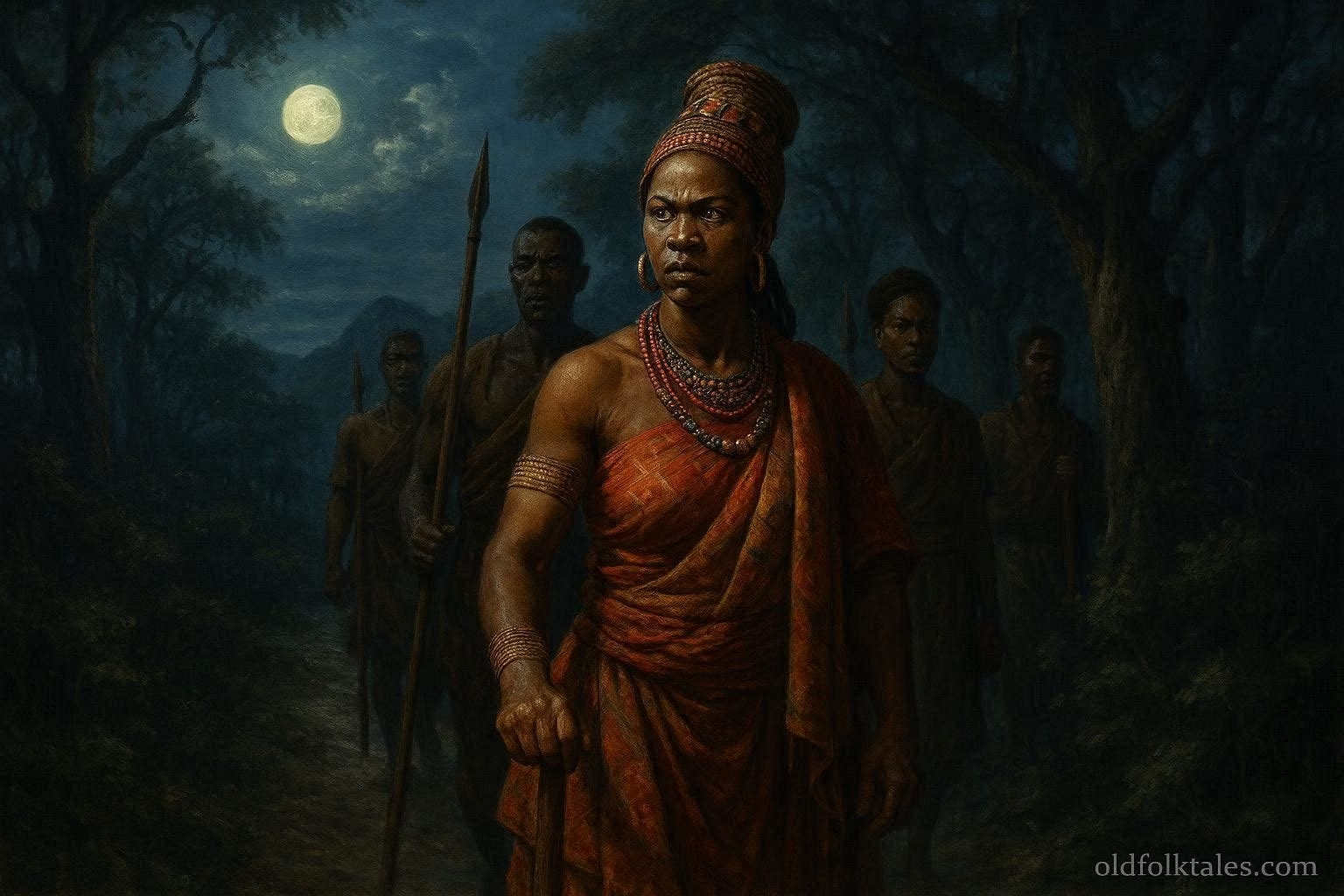
In seventeenth-century Angola, Queen Njinga Mbande fought to preserve the independence of Ndongo against Portuguese expansion. After diplomatic agreements failed to secure her kingdom, she faced mounting military pressure and the threat of losing her authority. In 1626, as Portuguese forces advanced against her, Njinga confronted a decision that would shape the course of her struggle. Rather than accept submission, she chose flight and continued the fight for political freedom.
A Kingdom Under Pressure
The Kingdom of Ndongo was home to the Mbundu people in what is now Angola. Its rulers governed through political alliances, relationships with local authorities and the support of powerful followers. The title Ngola identified the ruler of Ndongo and later contributed to the name Angola.
By the early seventeenth century, however, Portuguese expansion had placed the kingdom under severe pressure. Portuguese authorities sought greater control over the region, including its trade routes and the capture and export of enslaved Africans. Military campaigns devastated communities, displaced families and weakened the authority of Ndongo’s rulers.
Portuguese forces also formed alliances with African military groups, including Imbangala bands. These alliances increased the pressure on Ndongo and made resistance increasingly difficult.
Njinga grew up within the royal family during this period of conflict. She became familiar with the political challenges facing her kingdom and developed the diplomatic and military abilities that later shaped her rule.
Her brother, Ngola Mbande, became ruler after their father’s death. His reign faced serious challenges from Portuguese attacks and internal political divisions. By the early 1620s, Ndongo’s position had become increasingly precarious.
The kingdom needed a way to protect its independence without exposing its people to further destruction.
Njinga’s Mission to Luanda
In 1622, Ngola Mbande sent Njinga to Luanda to negotiate with the Portuguese governor, João Correia de Sousa. The mission offered an opportunity to secure peace and reduce the military pressure on Ndongo.
Njinga approached the negotiations as a political representative of her kingdom. She understood that diplomacy could serve as a means of protecting her people’s interests, even when the opposing side possessed considerable military strength.
Her visit became famous for the account of her meeting with the governor. According to a widely repeated story, the Portuguese provided a chair for the governor but no equivalent seat for Njinga. Rather than accept a position that placed her below him, she reportedly arranged for a servant to kneel so that she could sit at the same level.
The episode has endured as a symbol of her refusal to accept humiliation during negotiations. Although details of the encounter come through historical accounts that require careful interpretation, the story reflects the reputation Njinga developed as a determined diplomat.
She negotiated an agreement with the Portuguese and accepted baptism, taking the Christian name Ana de Sousa. These decisions formed part of the complicated political relationship between Ndongo and Portugal. Njinga sought to use diplomacy to secure her kingdom’s position, but the agreement did not provide lasting protection.
After returning to Ndongo, she faced a political situation that continued to deteriorate. Portuguese expansion persisted, and disagreements over territorial control and the treatment of the kingdom’s people undermined the prospect of lasting peace.
From Diplomacy to Resistance
In 1624, Ngola Mbande died, and Njinga became ruler of Ndongo. Her accession brought her directly into the struggle over the kingdom’s future.
She inherited a state weakened by warfare, displacement and political division. Portuguese authorities supported rival claimants to the throne, creating another challenge for her leadership. Njinga therefore had to defend her authority against both external military pressure and opponents within the region.
Her response combined diplomacy, military organisation and the formation of alliances. She worked to strengthen her forces and sought support from groups capable of resisting Portuguese advances. Among the military partners associated with her struggle were Imbangala forces, although these alliances could be difficult to maintain.
Njinga’s position required continual adjustment. An alliance might provide the soldiers needed to resist an enemy, yet it could also bring new obligations and competing interests. She had to consider not only how to win a battle but also how to preserve her ability to govern.
Explore more stories from our Angolan Folktales Collections archive.
The Portuguese, meanwhile, continued their efforts to weaken Ndongo and expand their control. The earlier agreements had not secured the territorial integrity Njinga sought to protect.
By 1626, the conflict had reached another critical point. Portuguese forces launched a major campaign against her, putting her military position under severe pressure.
The Decision to Flee
Njinga’s flight was not simply a journey away from danger. It was a decision about whether she could continue ruling and resisting without surrendering her independence.
Historical accounts describe her facing the prospect of defeat during the Portuguese campaign of 1626. A later account by the Capuchin missionary Giovanni Antonio Cavazzi relates that Njinga sought spiritual guidance through a traditional religious practitioner associated with her court. According to this account, the advice she received favoured flight rather than submission to Portuguese authority.
This episode must be understood through the nature of the surviving evidence. Cavazzi wrote decades after some of the events he described, and his account reflects the religious outlook of a European missionary. Nevertheless, historians have used such accounts, alongside other records, to examine the political and spiritual decisions that shaped Njinga’s rule.
The choice attributed to Njinga was stark. Submission might have preserved her position temporarily, but it could also have placed her under Portuguese authority and weakened her ability to defend Ndongo’s interests.
Flight carried its own risks. It meant abandoning a position that could no longer be held securely and seeking another way to continue the struggle. It also required her to maintain the loyalty of those who followed her through a period of uncertainty.
Njinga chose not to surrender.
She withdrew from the immediate danger and continued to resist. Her decision preserved the possibility of future action at a time when the Portuguese hoped to bring Ndongo under their control.
The escape did not end the war, nor did it instantly restore her authority over the kingdom. Instead, it marked another stage in a prolonged struggle in which survival, alliances and the ability to reorganise were essential.
The Kindonga Islands and the Continuing Struggle
The Kindonga Islands in the Kwanza River became important to Njinga’s resistance. These islands offered a strategic refuge during the conflicts surrounding Ndongo and provided a position from which she could continue to challenge her opponents.
The river landscape formed part of a wider political and military setting. Control of routes, settlements and areas of refuge could determine whether a ruler retained the freedom to act. For Njinga, maintaining a base outside the immediate reach of her enemies was essential to keeping her resistance alive.
Her forces continued to fight Portuguese troops and the rival ruler whom the Portuguese supported in Ndongo. Between 1626 and 1629, Njinga led military actions against her opponents, seeking to weaken their hold and preserve her own political influence.
These years were difficult. Her alliances were not permanent, and military reverses reduced her options. The Imbangala groups that had supported her did not always remain loyal, while the Portuguese continued to pursue their objectives.
Njinga therefore had to respond to changing circumstances rather than depend on a single plan. She used military action when it served her aims, but she also recognised the importance of finding a position from which she could rebuild her power.
Her resistance demonstrated that retreat did not necessarily mean accepting defeat. A ruler who preserved her forces and political independence could continue the struggle even after losing territory.
The Road to Matamba
By 1629, Njinga’s position in Ndongo had become increasingly difficult. After losing important support and facing continuing Portuguese pressure, she moved east towards the Kingdom of Matamba.
This movement was a significant turning point. Matamba offered an opportunity to establish a stronger political base beyond the territory the Portuguese sought to dominate. Njinga eventually conquered the kingdom and made it the centre of her power.
From Matamba, she continued to challenge Portuguese authority and worked to expand her influence. She developed alliances, strengthened her military organisation and used the kingdom’s position to participate in regional trade.
Her political career did not depend on recovering every lost position immediately. Instead, she built a state capable of sustaining resistance over the long term. Matamba became an important centre of power, allowing her to negotiate and fight from a stronger position.
Njinga also sought allies beyond her immediate region. In the 1640s, she established an alliance with the Dutch, who had taken control of Luanda from the Portuguese in 1641. Their shared opposition to Portuguese power created new opportunities, although the alliance did not achieve all its aims.
The Portuguese eventually recovered Luanda in 1648. Njinga had to adjust her strategy once more, but she continued to rule from Matamba and resist Portuguese expansion for several more years.
In 1656, she reached a peace agreement with Portugal that recognised her position as ruler of Matamba and acknowledged her claims concerning Ndongo. The agreement involved concessions, but it also reflected the political standing she had preserved through decades of conflict.
Njinga died in 1663. By then, she had established herself as one of the most influential rulers in the history of seventeenth-century Central Africa.
A Legacy of Resistance
Njinga’s flight during the Portuguese campaign of 1626 formed part of a much longer struggle. It did not, by itself, secure her kingdom’s independence, and her later achievements came through years of warfare, diplomacy and political negotiation.
Her story also resists a simple division between victory and defeat. She lost territory, faced the collapse of alliances and encountered opponents with substantial military resources. Yet she repeatedly adapted to changing conditions and found ways to continue exercising power.
Her career illustrates the importance of political judgement during a crisis. Sometimes a leader must hold a position; at other times, preserving the ability to act later may matter more than defending ground that can no longer be held.
Njinga’s legacy is remembered in Angola and beyond as a symbol of resistance to colonial conquest. Her life also reveals the complexities of the period. Like other rulers of her time, she pursued power through military campaigns, alliances and regional politics, and her state participated in systems of captivity and enslavement.
Remembering her accurately means acknowledging both her resistance to Portuguese expansion and the difficult realities of the world in which she ruled.
The flight that preserved her struggle was not the end of her story. It was one decisive moment in a political life marked by adaptation, ambition and an enduring determination to remain a ruler rather than become a subject of Portuguese authority.
Explore our complete Africa Folktales
Moral Lesson
Courage does not always mean standing one’s ground. Sometimes wisdom lies in withdrawing from immediate danger, preserving the strength to continue and finding a new path towards a difficult goal.
Knowledge Check
1. Who was Njinga Mbande?
Njinga Mbande was a seventeenth-century ruler of Ndongo and Matamba in present-day Angola who resisted Portuguese expansion.
2. Why did Njinga travel to Luanda in 1622?
Her brother, Ngola Mbande, sent her to negotiate with the Portuguese governor in an attempt to secure peace for Ndongo.
3. Why did Njinga flee during the Portuguese campaign of 1626?
She faced military pressure and chose to escape rather than submit to Portuguese authority, preserving her ability to continue resisting.
4. Which islands became an important refuge for Njinga?
The Kindonga Islands in the Kwanza River became an important base during her struggle.
5. Which kingdom later became the centre of Njinga’s power?
Matamba became her principal base after she moved east and conquered the kingdom.
6. What is one important lesson from Njinga’s flight?
A strategic retreat can preserve the ability to continue a struggle when remaining in place would lead to defeat or submission.
Source
This historical retelling draws on Alexander Ives Bortolot’s “Women Leaders in African History: Ana Nzinga, Queen of Ndongo,” published by the Metropolitan Museum of Art, and the biographical study “Njinga” in the Dictionary of African Christian Biography, which discusses the 1626 campaign and the later missionary account of her decision to flee.
Explore More Angolan Folktales
- The First Soba’s Staff
- Sona: The Sand Drawings of Wisdom
- The Caravan Leaders of Bié
- The Coronation of an Olosoma
- The Investiture of a Mwata
- The Women of the Kissange
- The Hunters of Cangandala
- Mukanda: The School in the Forest
- Oath of the Imbangala